 Back
BackMembrane Structure and Function: Study Notes for BIOL101
Study Guide - Smart Notes
 Tailored notes based on your materials, expanded with key definitions, examples, and context.
Membrane Structure and Function
Overview of Biological Membranes
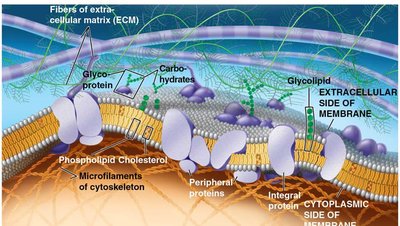
The biological membrane is a fundamental structure in all cells, providing a selective barrier between the internal and external environments. It is primarily composed of a phospholipid bilayer with embedded proteins, carbohydrates, and other molecules that contribute to its function and dynamics.
Phospholipid Bilayer: The basic structural framework of the membrane, consisting of two layers of phospholipids with hydrophilic heads facing outward and hydrophobic tails facing inward.
Cholesterol: Interspersed within the bilayer, cholesterol modulates membrane fluidity and stability.
Proteins: Integral and peripheral proteins are embedded or associated with the membrane, serving roles in transport, signaling, and structural support.
Carbohydrates: Attached to proteins (glycoproteins) or lipids (glycolipids), carbohydrates are involved in cell recognition and communication.
Extracellular Matrix (ECM): Fibers outside the cell membrane provide structural support and mediate cell interactions.
Phospholipids and Membrane Fluidity
Phospholipids are amphipathic molecules, meaning they have both hydrophilic and hydrophobic regions. This property allows them to form bilayers spontaneously in aqueous environments. Membrane fluidity is influenced by the composition of phospholipids and the presence of cholesterol.
Unsaturated fatty acids: Increase fluidity due to kinks in their tails, preventing tight packing.
Saturated fatty acids: Decrease fluidity by allowing closer packing of phospholipids.
Cholesterol: Acts as a fluidity buffer, preventing membranes from becoming too rigid or too fluid.
Equation for membrane fluidity:
Membrane Proteins: Types and Functions
Membrane proteins are essential for the diverse functions of biological membranes. They are classified based on their association with the membrane:
Integral proteins: Span the membrane and are involved in transport, signaling, and structural roles.
Peripheral proteins: Loosely attached to the membrane surface, often involved in signaling or maintaining cell shape.
Functions of membrane proteins:
Transport of molecules across the membrane
Enzymatic activity
Signal transduction
Cell-cell recognition
Intercellular joining
Attachment to the cytoskeleton and ECM
Carbohydrates in Membrane Function
Carbohydrates are found on the extracellular surface of the membrane, attached to proteins (glycoproteins) or lipids (glycolipids). They play crucial roles in cell recognition, signaling, and immune responses.
Glycoproteins: Proteins with carbohydrate chains attached, important for cell-cell recognition.
Glycolipids: Lipids with carbohydrate chains, contribute to membrane stability and cell identity.
Example: Blood group antigens are determined by specific carbohydrate structures on red blood cell membranes.
Extracellular Matrix and Cytoskeleton
The extracellular matrix (ECM) and cytoskeleton are structural components that interact with the cell membrane. The ECM provides external support and mediates cell communication, while the cytoskeleton maintains cell shape and anchors membrane proteins.
ECM fibers: Collagen, elastin, and other proteins form a network outside the cell.
Microfilaments: Actin filaments inside the cell support the membrane and facilitate movement.
Additional info: The interaction between the ECM and membrane proteins is essential for tissue integrity and signaling.
Summary Table: Components of the Cell Membrane
Component | Structure | Function |
|---|---|---|
Phospholipid | Bilayer with hydrophilic heads and hydrophobic tails | Barrier, fluidity |
Cholesterol | Interspersed in bilayer | Modulates fluidity |
Integral Protein | Spans membrane | Transport, signaling |
Peripheral Protein | Attached to membrane surface | Signaling, structure |
Glycoprotein | Protein with carbohydrate chain | Cell recognition |
Glycolipid | Lipid with carbohydrate chain | Cell identity, stability |
ECM Fiber | Protein network outside cell | Support, communication |
Microfilament | Actin filament inside cell | Shape, movement |
