 Back
BackMembrane Structure and Function: Study Notes
Study Guide - Smart Notes
 Tailored notes based on your materials, expanded with key definitions, examples, and context.
Membrane Structure and Function
Plasma Membrane: Overview
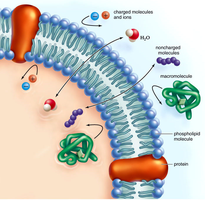
The plasma membrane is the boundary that separates the living cell from its surroundings. It regulates exchanges with the environment and exhibits selective permeability, allowing some substances to cross more easily than others.
Components of the Plasma Membrane
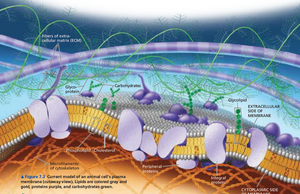
The plasma membrane is composed of several key components:
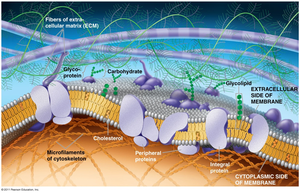
Phospholipid Bilayer: Provides the basic structural framework.
Membrane Proteins: Integral and peripheral proteins serve various functions.
Carbohydrates: Often attached to proteins (glycoproteins) or lipids (glycolipids).
Cholesterol: Modulates membrane fluidity.
Roles of the Plasma Membrane
The plasma membrane performs several essential roles:
Regulates transport of small and macromolecules.
Controls flow of information between cells via receptors.
Cell adhesion for tissue formation.
Cell signaling and communication.
Fluid Mosaic Model
The fluid mosaic model describes the plasma membrane as a dynamic structure where lipids and proteins move laterally within the bilayer. The membrane is a mosaic of proteins embedded in a fluid phospholipid bilayer.
Fluidity depends on phospholipid composition, degree of unsaturation, and presence of cholesterol.
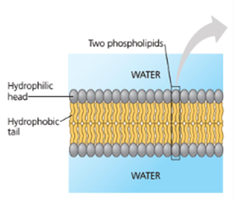
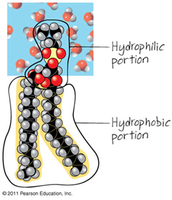
Amphipathic molecules: Phospholipids have hydrophilic heads and hydrophobic tails.
Factors Affecting Membrane Fluidity
Membrane fluidity is influenced by several factors:
Tail Length: Shorter fatty acid tails increase fluidity; longer tails decrease fluidity.
Degree of Saturation: Unsaturated fatty acids increase fluidity; saturated fatty acids decrease fluidity.
Temperature: Higher temperatures increase fluidity; lower temperatures decrease fluidity.
Cholesterol: Acts as a fluidity buffer, preventing the membrane from becoming too rigid or too fluid.
pH: Higher pH lowers permeability.
Protein Content: More proteins decrease fluidity.
Types of Membrane Proteins
Membrane proteins are classified as:
Integral Proteins: Span the membrane or extend into the hydrophobic interior; involved in transport and signaling.
Peripheral Proteins: Loosely bound to the membrane surface; provide structural support and participate in cell signaling.
Functions of Membrane Proteins
Transport: Channel and carrier proteins facilitate movement of substances.
Enzymatic Activity: Catalyze metabolic reactions.
Signal Transduction: Receptors transmit signals from external stimuli.
Cell-Cell Recognition: Glycoproteins serve as identification tags.
Intercellular Joining: Proteins form junctions between cells.
Attachment to Cytoskeleton and ECM: Maintains cell shape and stabilizes proteins.
Selective Permeability of the Membrane
The membrane's structure results in selective permeability:
Nonpolar molecules (e.g., CO2, O2) diffuse through the bilayer.
Polar molecules and ions (e.g., glucose, amino acids) require transport proteins.
Water moves via aquaporins (channel proteins).
Role of Membrane Carbohydrates
Membrane carbohydrates are short, branched chains attached to lipids (glycolipids) or proteins (glycoproteins). They are crucial for cell-to-cell recognition and sorting cells into tissues and organs during development.
Transport Across Membranes
Passive Transport
Passive transport involves movement down a concentration gradient without energy expenditure. Types include:
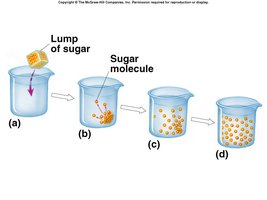
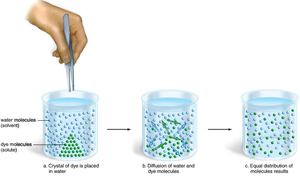
Simple Diffusion: Movement of solutes from high to low concentration.
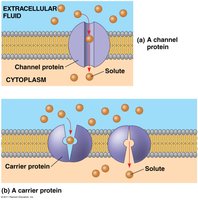
Facilitated Diffusion: Movement of polar molecules and ions via channel or carrier proteins.
Facilitated Diffusion
Facilitated diffusion is a passive process aided by proteins:
Channel Proteins: Provide fixed pathways for specific molecules.
Carrier Proteins: Change shape to transport molecules across the membrane.
Aquaporins: Specialized channels for water transport.
Osmosis
Osmosis is the passive movement of water molecules down their concentration gradient through a selectively permeable membrane. No energy is required.
Tonicity and Water Balance
Tonicity describes the ability of a solution to cause a cell to gain or lose water:
Hypertonic: Higher solute concentration; water leaves the cell.
Hypotonic: Lower solute concentration; water enters the cell.
Isotonic: Equal solute concentrations; no net movement of water.
Osmotic Balance in Cells
Animal cells lack cell walls and are sensitive to osmotic changes. Plant cells have cell walls and maintain turgor pressure, which keeps them firm in hypotonic solutions.
Active Transport and Bulk Transport
Active Transport
Active transport requires energy (ATP) to move substances against their concentration gradient. Examples include:
Sodium-potassium pump
Proton pump
Cotransport proteins
Bulk Transport: Endocytosis and Exocytosis
Bulk transport mechanisms move large quantities of substances:
Endocytosis: Cell engulfs material via phagocytosis (solid), pinocytosis (liquid), or receptor-mediated endocytosis (specific molecules).
Exocytosis: Discharge of material from vesicles at the cell surface (e.g., secretion of mucus).
Summary Table: Types of Membrane Transport
Type | Energy Required | Direction | Example |
|---|---|---|---|
Simple Diffusion | No | Down gradient | O2, CO2 |
Facilitated Diffusion | No | Down gradient | Glucose, ions |
Osmosis | No | Down gradient | Water |
Active Transport | Yes (ATP) | Against gradient | Sodium-potassium pump |
Bulk Transport | Yes (ATP) | Variable | Endocytosis, Exocytosis |
Key Equations
Osmosis and diffusion are governed by concentration gradients:
Fick's Law of Diffusion: where is the flux, is the diffusion coefficient, and is the concentration gradient.
Additional info: Academic context was added to clarify the functions of membrane proteins, the fluid mosaic model, and the mechanisms of transport across membranes. The summary table and equation were inferred for completeness and exam preparation.
