 Back
BackMembrane Structure and Function: Study Notes
Study Guide - Smart Notes
 Tailored notes based on your materials, expanded with key definitions, examples, and context.
Membrane Structure and Function
Membrane Composition and Fluid Mosaic Model
The plasma membrane is a dynamic structure composed of a phospholipid bilayer with embedded proteins, forming a 'fluid mosaic.' This arrangement allows for flexibility and the movement of components within the membrane.
Phospholipid Bilayer: Consists of amphipathic phospholipids with hydrophilic (water-attracting) heads facing outward and hydrophobic (water-repelling) tails facing inward.
Fluidity: The bilayer has a fluid consistency, allowing lateral movement of lipids and proteins.
Proteins: Scattered throughout the membrane, creating a mosaic pattern. Most membrane proteins are also amphipathic.
Cholesterol: Interspersed within the bilayer, cholesterol provides membrane strength and modulates fluidity.
Membrane Proteins: Types and Functions
Membrane proteins are essential for various cellular processes and are classified based on their association with the lipid bilayer.
Integral Proteins: Span the membrane (transmembrane proteins) and are involved in transport and signaling.
Peripheral Proteins: Loosely bound to the membrane surface, often involved in signaling or maintaining cell shape.
Functions of Membrane Proteins:
Recognition: Mark cells for identification (e.g., immune response).
Anchor: Attach the cytoskeleton to the membrane for structural support.
Transduction: Act as receptors for signal molecules.
Transport: Facilitate movement of substances across the membrane.
Linkage: Connect adjacent cells.
Enzyme: Catalyze reactions at the membrane surface.
Membrane Carbohydrates
Carbohydrates attached to lipids (glycolipids) or proteins (glycoproteins) play a crucial role in cell recognition and signaling.
Glycolipids: Short sugar chains attached to lipids.
Glycoproteins: Short sugar chains attached to proteins.
Function: Important for distinguishing 'self' from 'non-self' in immune responses.
Selective Permeability of Membranes
The plasma membrane is selectively permeable, allowing only certain substances to cross freely while restricting others.
Transport Proteins: Span the membrane and are specific for the substances they move.
Channel Proteins: Facilitate rapid movement of water (e.g., aquaporins) and ions.
Carrier Proteins: Bind to specific molecules and change shape to shuttle them across the membrane.
Passive Transport
Passive transport involves the movement of molecules from areas of high concentration to low concentration without energy input.
Diffusion: Movement of particles down their concentration gradient. Influenced by temperature, pressure, electric current, molecule size, and concentration.
Osmosis: Diffusion of water across a selectively permeable membrane from high to low water concentration.
Water Balance and Tonicity in Cells
Water movement across membranes affects cell volume and function, described by the concept of tonicity.
Isotonic Solution: No net water movement; cell volume remains stable.
Hypertonic Solution: Cell loses water and shrinks.
Hypotonic Solution: Cell gains water and may swell or burst.
Facilitated Diffusion
Facilitated diffusion is a type of passive transport aided by proteins, allowing substances to move down their concentration gradient without energy input.
Channel Proteins: Allow ions (e.g., Cl-) or sugars to pass through the membrane.
Carrier Proteins: Undergo conformational changes to transport molecules.
Active Transport
Active transport moves molecules against their concentration gradient and requires energy, usually in the form of ATP.
Sodium-Potassium Pump (Na+/K+ ATPase): Moves Na+ out of and K+ into animal cells, crucial for nerve and muscle function.
Proton Pump: Main pump in plants, fungi, and bacteria, moving H+ ions across membranes.
Equation for Sodium-Potassium Pump:
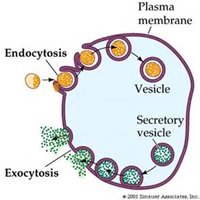
Bulk Transport: Endocytosis and Exocytosis
Large particles and macromolecules are transported across membranes via vesicle formation, requiring energy.
Exocytosis: Vesicles fuse with the plasma membrane to secrete substances out of the cell.
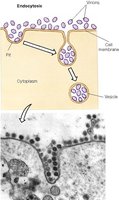
Endocytosis: The cell takes in substances by forming vesicles from the plasma membrane.
Types of Endocytosis
Endocytosis can be classified into three main types based on the nature of the material taken in and the mechanism involved.
Phagocytosis: The cell engulfs large particles or cells using pseudopodia, forming a phagosome that fuses with a lysosome for digestion.
Pinocytosis: The cell 'drinks' extracellular fluid by forming small vesicles containing dissolved substances.
Receptor-Mediated Endocytosis: Specific molecules bind to receptors on the cell surface, triggering vesicle formation for targeted uptake.
Type of Endocytosis | Main Function | Example |
|---|---|---|
Phagocytosis | Uptake of large particles/cells | White blood cell engulfing bacteria |
Pinocytosis | Uptake of extracellular fluid | Absorption of nutrients by intestinal cells |
Receptor-Mediated Endocytosis | Selective uptake of specific molecules | Cholesterol uptake via LDL receptors |
