 Back
BackMembrane Structure and Function: The Fluid Mosaic Model and Membrane Transport
Study Guide - Smart Notes
 Tailored notes based on your materials, expanded with key definitions, examples, and context.
Membrane Structure and Function
Overview of the Plasma Membrane
The plasma membrane is a selectively permeable barrier that regulates the movement of substances into and out of the cell. It is primarily composed of a phospholipid bilayer with embedded proteins, carbohydrates, and cholesterol, which together contribute to its structure and function.
Selective Permeability: The membrane allows some substances to cross more easily than others, maintaining the internal environment of the cell.
Amphipathic Nature: Phospholipids have both hydrophilic (water-attracting) heads and hydrophobic (water-repelling) tails, leading to the formation of a bilayer in aqueous environments.
Fluid Mosaic Model: The membrane is described as a mosaic of proteins floating in or on the fluid lipid bilayer.
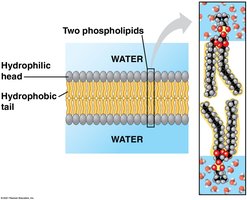
Fluid Mosaic Model of Membrane Structure
The fluid mosaic model depicts the membrane as a dynamic structure with proteins embedded in or attached to a fluid lipid bilayer. This arrangement allows for flexibility and the movement of components within the membrane.
Proteins: Integral and peripheral proteins serve various functions, including transport, signaling, and cell recognition.
Carbohydrates: Attached to proteins (glycoproteins) or lipids (glycolipids), carbohydrates play a role in cell-cell recognition and signaling.
Cholesterol: Modulates membrane fluidity and stability, especially in animal cells.
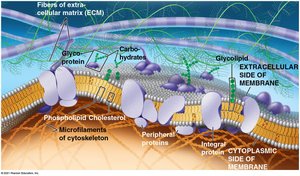
Membrane Fluidity
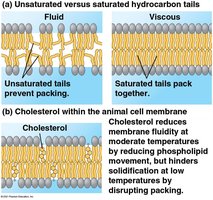
Membrane fluidity is influenced by the composition of fatty acids in phospholipids and the presence of cholesterol. The degree of saturation of fatty acid tails and temperature affect how tightly the lipids pack together.
Unsaturated Fatty Acids: Have kinks that prevent tight packing, increasing fluidity.
Saturated Fatty Acids: Pack closely together, making the membrane more viscous.
Cholesterol: Reduces fluidity at moderate temperatures but prevents solidification at low temperatures by disrupting packing.
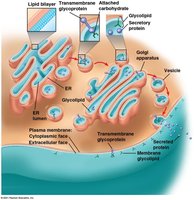
Membrane Sidedness and Synthesis
Membranes have distinct inside and outside faces, with asymmetrical distribution of proteins, lipids, and carbohydrates. This sidedness is established during membrane synthesis in the endoplasmic reticulum and Golgi apparatus.
Glycoproteins and Glycolipids: Synthesized and modified in the ER and Golgi, then transported to the plasma membrane.
Vesicular Transport: Maintains the orientation of membrane components.
Membrane Permeability and Transport Mechanisms
Selective Permeability of the Lipid Bilayer
The plasma membrane's selective permeability is due to its hydrophobic core, which allows small, nonpolar molecules to pass easily while impeding polar molecules and ions.
Can Permeate: Small, nonpolar molecules (e.g., O2, CO2).
Cannot Permeate: Large, polar molecules and ions (e.g., glucose, Na+).
Transport Proteins: Facilitate the movement of specific molecules across the membrane.
Passive Transport: Diffusion and Osmosis
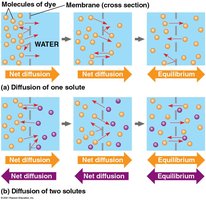
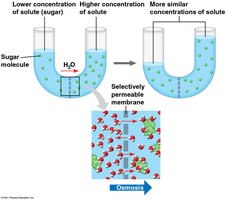
Passive transport involves the movement of substances down their concentration gradients without energy input. This includes simple diffusion, facilitated diffusion, and osmosis.
Diffusion: Movement of molecules from high to low concentration until equilibrium is reached.
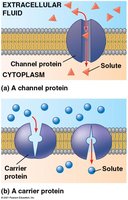
Facilitated Diffusion: Transport proteins (channels and carriers) help hydrophilic substances cross the membrane.
Osmosis: Diffusion of water across a selectively permeable membrane toward higher solute concentration.
Tonicity and Water Balance
Tonicity describes the ability of a surrounding solution to cause a cell to gain or lose water. It is crucial for maintaining cell shape and function.
Isotonic: Solute concentration is equal inside and outside the cell; no net water movement.
Hypertonic: Higher solute concentration outside; cell loses water and shrivels.
Hypotonic: Lower solute concentration outside; cell gains water and may burst (animal cells) or become turgid (plant cells).
Facilitated Diffusion: Channel and Carrier Proteins
Facilitated diffusion uses transport proteins to move substances down their concentration gradients. Channel proteins provide hydrophilic pathways, while carrier proteins undergo conformational changes to transport molecules.
Channel Proteins: Form pores for specific ions or water (e.g., aquaporins).
Carrier Proteins: Bind and transport specific molecules by changing shape.
Active Transport and Bulk Transport
Active Transport
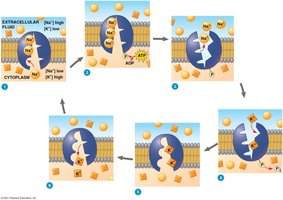
Active transport moves substances against their concentration gradients using energy, typically from ATP. This process is essential for maintaining cellular ion balances.
Sodium-Potassium Pump: Exchanges Na+ out of and K+ into animal cells, maintaining membrane potential.
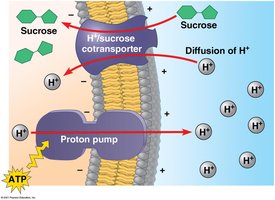
Proton Pump: Moves H+ ions across membranes in plants, fungi, and bacteria, generating electrochemical gradients.
Cotransport: The downhill movement of one solute drives the uphill transport of another (e.g., H+/sucrose cotransporter in plants).
Bulk Transport: Exocytosis and Endocytosis
Large molecules and particles are transported across the membrane via vesicles in processes called exocytosis and endocytosis.
Exocytosis: Vesicles fuse with the plasma membrane to release contents outside the cell (e.g., secretion of insulin).
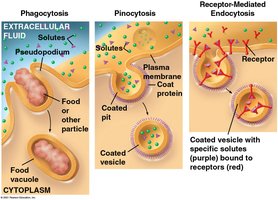
Endocytosis: The cell takes in macromolecules by forming vesicles from the plasma membrane. Types include:
Phagocytosis: "Cell eating"; engulfment of large particles.
Pinocytosis: "Cell drinking"; uptake of extracellular fluid and solutes.
Receptor-Mediated Endocytosis: Specific uptake of molecules via receptor proteins.
Summary Table: Types of Membrane Transport
Transport Type | Energy Required? | Direction | Example |
|---|---|---|---|
Simple Diffusion | No | Down gradient | O2, CO2 |
Facilitated Diffusion | No | Down gradient | Glucose, ions via channels |
Active Transport | Yes (ATP) | Against gradient | Na+/K+ pump |
Osmosis | No | Water down gradient | Water via aquaporins |
Bulk Transport (Exocytosis/Endocytosis) | Yes (ATP) | Both | Secretion, phagocytosis |
Key Terms and Concepts
Amphipathic: Molecule with both hydrophilic and hydrophobic regions (e.g., phospholipids).
Integral Protein: Protein embedded in the lipid bilayer.
Peripheral Protein: Protein attached to the membrane surface.
Glycoprotein/Glycolipid: Protein or lipid with attached carbohydrate, important for cell recognition.
Membrane Potential: Voltage across the membrane due to ion distribution.
Electrochemical Gradient: Combined effect of concentration and electrical gradients on ion movement.
Osmoregulation: Control of water and solute balance.
