 Back
Membrane Structure and Function: Transport Mechanisms in Cells
Study Guide - Smart Notes
 Tailored notes based on your materials, expanded with key definitions, examples, and context.
Membrane Structure and Function
Overview of the Plasma Membrane
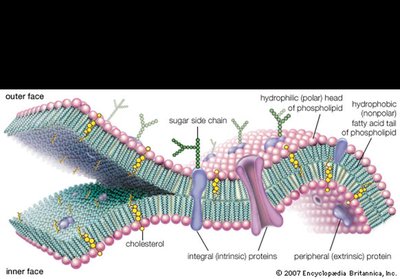
The plasma membrane is a selectively permeable barrier that separates the cell from its environment and regulates the movement of substances in and out of the cell. Its structure is described by the fluid mosaic model, which highlights the dynamic arrangement of lipids, proteins, and carbohydrates.
Phospholipid bilayer: Composed of amphipathic phospholipids with hydrophilic heads facing outward and hydrophobic tails facing inward.
Proteins: Integral (intrinsic) and peripheral (extrinsic) proteins serve various functions such as transport, signaling, and structural support.
Carbohydrates: Attached to proteins (glycoproteins) or lipids (glycolipids) on the extracellular surface, involved in cell recognition.
Cholesterol: Interspersed within the bilayer, modulates membrane fluidity.
Selective Permeability of the Membrane
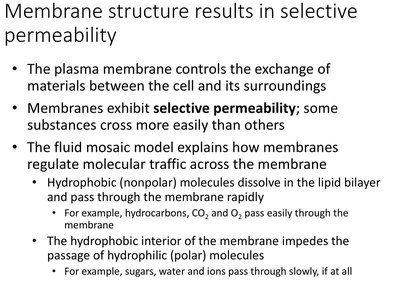
The plasma membrane allows some substances to cross more easily than others, a property known as selective permeability. This is essential for maintaining cellular homeostasis.
Hydrophobic (nonpolar) molecules (e.g., hydrocarbons, O2, CO2) pass through rapidly.
Hydrophilic (polar) molecules (e.g., ions, sugars, water) cross slowly or require transport proteins.
Fluid Mosaic Model
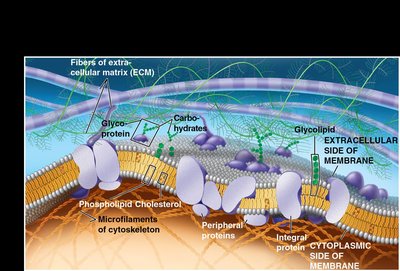
The fluid mosaic model describes the membrane as a flexible layer made of lipid molecules interspersed with proteins. This structure allows for lateral movement of components and dynamic interactions.
Integral proteins span the membrane, while peripheral proteins are attached to the membrane surface.
Carbohydrates are present on the extracellular side, contributing to cell-cell recognition.
Transport Across Membranes
Types of Transport
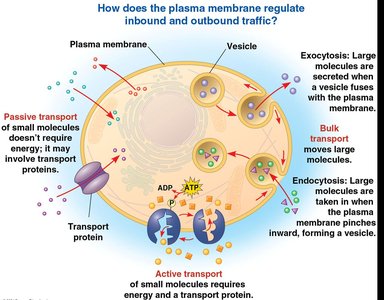
Transport across the plasma membrane can be passive or active, depending on whether energy is required.
Passive transport: Movement of substances down their concentration gradient without energy input (e.g., diffusion, osmosis, facilitated diffusion).
Active transport: Movement of substances against their concentration gradient, requiring energy (usually from ATP hydrolysis).
Bulk transport: Movement of large molecules via vesicles (endocytosis and exocytosis).
Passive Transport
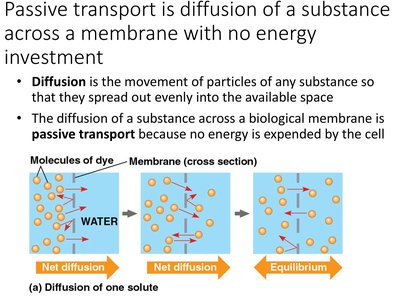
Passive transport involves the movement of molecules from areas of high concentration to low concentration, without energy expenditure.
Diffusion: The net movement of particles down their concentration gradient until equilibrium is reached.
Osmosis: The diffusion of water across a selectively permeable membrane.
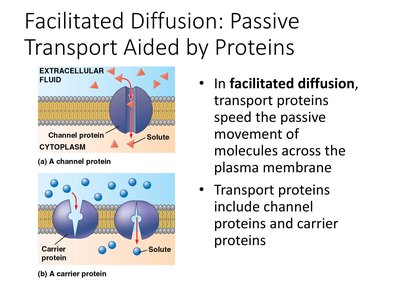
Facilitated diffusion: Transport proteins (channel and carrier proteins) assist the movement of hydrophilic substances across the membrane.
Transport Proteins
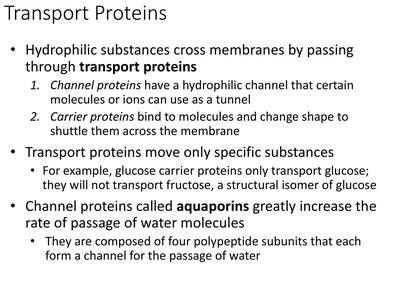
Hydrophilic substances require transport proteins to cross the membrane. These proteins are highly specific for the substances they transport.
Channel proteins: Provide hydrophilic tunnels for molecules or ions to pass through (e.g., aquaporins for water).
Carrier proteins: Bind to molecules and change shape to shuttle them across the membrane.
Aquaporins: Specialized channel proteins that greatly increase the rate of water transport.
Facilitated Diffusion
Facilitated diffusion is a type of passive transport where transport proteins speed up the movement of molecules across the plasma membrane.
Includes both channel and carrier proteins.
No energy is required; substances move down their concentration gradient.
Osmosis and Water Balance
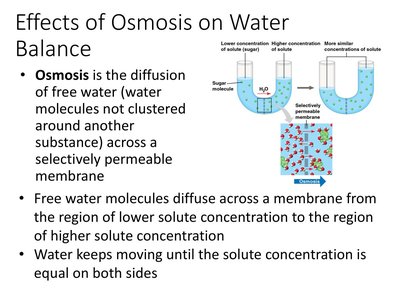
Osmosis is the diffusion of free water across a selectively permeable membrane. It is crucial for maintaining water balance in cells.
Water moves from regions of lower solute concentration to higher solute concentration.
Equilibrium is reached when solute concentration is equal on both sides of the membrane.
Tonicity
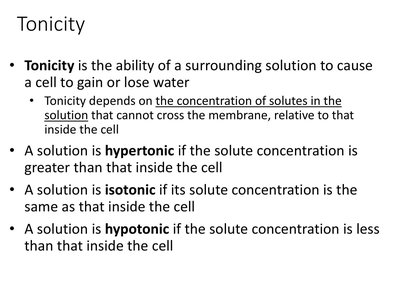
Tonicity describes the ability of a surrounding solution to cause a cell to gain or lose water, depending on solute concentration relative to the cell.
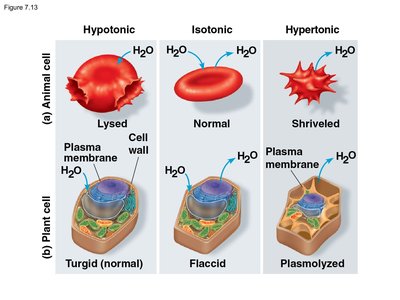
Hypertonic solution: Higher solute concentration outside the cell; cell loses water.
Isotonic solution: Equal solute concentration; no net water movement.
Hypotonic solution: Lower solute concentration outside the cell; cell gains water.
Osmotic Behavior of Plant Cells
Plant cells have a cell wall and a large central vacuole, which influence their response to osmotic changes.
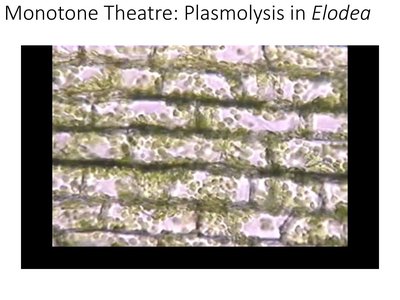
Plasmolysis: In hypertonic solutions, water leaves the cell, causing the protoplast to shrink away from the cell wall.
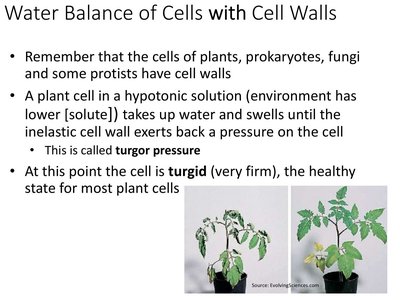
Turgor pressure: In hypotonic solutions, water enters the cell, the protoplast expands, and pressure builds against the cell wall.
Turgidity: The cell becomes firm as the cell wall restricts further expansion.
Wall pressure: The cell wall exerts an inward pressure balancing the turgor pressure.
Water Balance in Cells with Cell Walls
Cells with walls (plants, fungi, some protists, and prokaryotes) respond differently to osmotic stress compared to animal cells. Turgor pressure is essential for maintaining cell rigidity and function.
In hypotonic environments, plant cells become turgid (healthy state).
In hypertonic environments, plasmolysis occurs, and the cell may become flaccid or die.
Active Transport
Active transport moves substances against their concentration gradients, requiring energy, usually from ATP hydrolysis.
All proteins involved in active transport are carrier proteins.
Active transport maintains solute concentrations that differ from the environment (e.g., sodium-potassium pump in animal cells).
Example equation for ATP hydrolysis:
Cotransport
Cotransport is a mechanism where a transport protein couples the downhill diffusion of one solute to the uphill transport of another. In plants, the gradient of H+ ions generated by ATP-powered proton pumps drives the active transport of nutrients such as sucrose.
H+/sucrose cotransport loads sucrose into the veins of leaves for distribution.
The return of H+ ions down their electrochemical gradient is coupled to the transport of sucrose against its gradient.
Summary Table: Types of Membrane Transport
Type of Transport | Energy Required? | Direction Relative to Gradient | Example |
|---|---|---|---|
Simple Diffusion | No | Down | O2, CO2 |
Facilitated Diffusion | No | Down | Glucose via carrier protein |
Osmosis | No | Down (water potential) | Water via aquaporins |
Active Transport | Yes (ATP) | Against | Sodium-potassium pump |
Cotransport | Indirect (uses gradient) | Against (for one solute) | H+/sucrose symport in plants |
