 Back
Membrane Structure and Transport Mechanisms in Eukaryotic Cells
Study Guide - Smart Notes
 Tailored notes based on your materials, expanded with key definitions, examples, and context.
Membrane Structure
Phospholipid Bilayer and Membrane Proteins
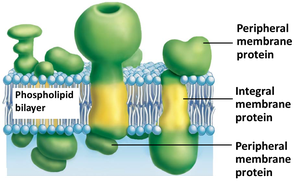
The eukaryotic cell membrane is primarily composed of a phospholipid bilayer interspersed with proteins. This structure provides both a barrier and a platform for various cellular functions.
Phospholipid bilayer: Consists of two layers of phospholipids with hydrophobic tails facing inward and hydrophilic heads facing outward.
Integral membrane proteins: Span the bilayer and are involved in transport, signaling, and structural support.
Peripheral membrane proteins: Attach to the membrane surface and assist in cell communication and structure.
Diffusion Across Membranes
Simple Diffusion
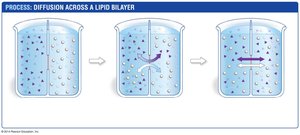
Diffusion is the passive movement of molecules from regions of high concentration to regions of low concentration. It is a fundamental process for the transport of substances across cell membranes.
Simple diffusion: Occurs directly through the phospholipid bilayer without the need for proteins.
Driving force: Concentration gradient.
Example: Oxygen and carbon dioxide gases diffuse freely across membranes.
Permeability of the Phospholipid Bilayer
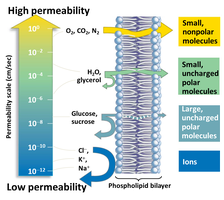
The ability of molecules to cross the membrane depends on their size, polarity, and charge.
High permeability: Small, nonpolar molecules (e.g., O2, CO2, N2).
Moderate permeability: Small, uncharged polar molecules (e.g., H2O, glycerol).
Low permeability: Large, uncharged polar molecules (e.g., glucose, sucrose).
Very low permeability: Ions (e.g., Cl-, K+, Na+).
Mechanisms of Membrane Transport
Types of Transport
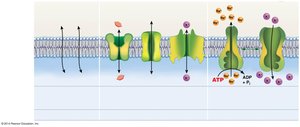
Cells utilize several mechanisms to move molecules across membranes, each with distinct characteristics and requirements.
Diffusion: Passive movement along concentration gradients.
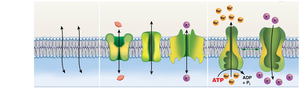
Facilitated diffusion: Passive movement via channel or carrier proteins.
Active transport: Movement against concentration gradients, requiring energy (usually ATP).
Passive Transport
Passive transport does not require energy and relies on the natural movement of molecules along their electrochemical gradients.
Diffusion: Direct movement through the bilayer.
Facilitated diffusion: Movement through channel or carrier proteins.
Electrochemical gradient: Combination of concentration and electrical gradients.
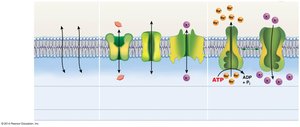
Channel Proteins
Structure and Function
Channel proteins are integral membrane proteins that form hydrophilic pores, allowing specific ions or molecules to pass through.
Specificity: Each channel protein permits only certain ions or molecules.
Bidirectional movement: Molecules can move in either direction, depending on the gradient.
Types: Many different channel proteins exist in cell membranes.
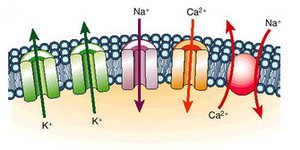
Facilitated Diffusion via Channel Proteins
Facilitated diffusion allows molecules to move across membranes with the help of channel proteins, increasing permeability for specific substances.
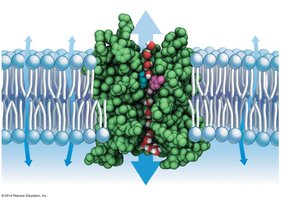
Aquaporins
Aquaporins are specialized channel proteins that facilitate the rapid movement of water across cell membranes.
Structure: Tetrameric transmembrane proteins.
Specificity: Permit only water molecules to pass.
Direction: Movement is not regulated; water flows according to the gradient.
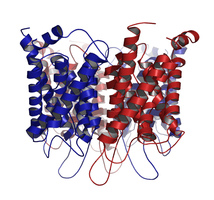
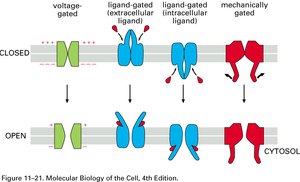
Gated Channels
Gated channels can open or close in response to specific signals, such as ligand binding or changes in membrane voltage.
Voltage-gated: Respond to changes in electrical potential.
Ligand-gated: Respond to binding of specific molecules.
Mechanically gated: Respond to physical deformation.
Potassium Channels
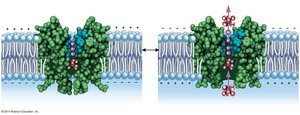
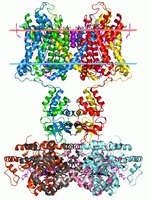
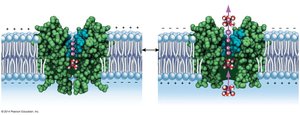
Potassium channels are integral proteins that selectively permit K+ ions to pass through the membrane.
Specificity: Only K+ ions can pass.
Gate: Can be open or closed, regulated by membrane charge.
Direction: Movement is determined by the electrochemical gradient.
Regulation of Channel Opening
The opening and closing of channels can be regulated, but the direction of molecule movement is always determined by the gradient.
Carrier Proteins
Facilitated Diffusion via Carrier Proteins
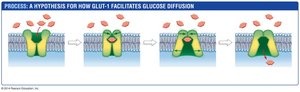
Carrier proteins undergo conformational changes to transport molecules across the membrane. They are slower than channel proteins.
Example: GLUT-1 transporter increases membrane permeability to glucose.
Mechanism: Binding of substrate induces shape change, allowing transport.
Factors Affecting Facilitated Diffusion
The rate of facilitated diffusion depends on several factors:
Difference in concentration of solute across the membrane
Number of channels/carrier proteins available
Affinity of the protein for its substrate
Temperature
Active Transport
Primary Active Transport
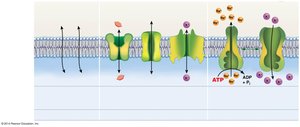
Active transport moves molecules against their electrochemical gradients and requires energy, usually from ATP.
Pumps: Membrane proteins that use ATP to transport molecules.
Example: Sodium-potassium pump (Na+/K+ ATPase).
ATP Hydrolysis
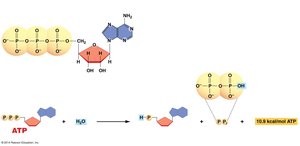
ATP provides energy for active transport by hydrolysis:
Equation:
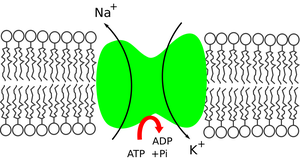
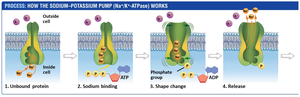
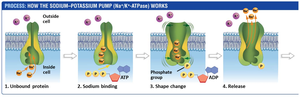
Sodium-Potassium Pump (Na+/K+ ATPase)
The Na+/K+ pump is an integral membrane protein that maintains electrochemical gradients in animal cells.
Function: Transports 3 Na+ ions out and 2 K+ ions in per cycle.
Energy: Requires ATP.
Importance: Maintains cell potential and osmotic balance; uses ~30% of cellular ATP.
Electrochemical Gradient
The Na+/K+ pump establishes a concentration and charge gradient across the plasma membrane.
Outside: High Na+, net positive charge
Inside: High K+, net negative charge
Secondary Active Transport
Co-Transporters: Symporters and Antiporters
Secondary active transport uses the energy stored in electrochemical gradients to move molecules against their concentration gradients.
Symporters: Move two molecules in the same direction.
Antiporters: Move two molecules in opposite directions.
Dependence: Function depends on primary active transport (e.g., Na+/K+ pump).
Examples of Co-Transporters
Ca2+/Na+ antiporter: Exchanges calcium and sodium ions.
Cl-/Na+ symporter: Moves chloride and sodium ions together.
Proton Pumps in Plants, Bacteria, and Fungi
H+ pumps establish electrochemical gradients in non-animal cells, enabling secondary active transport.
Function: Move protons (H+) across membranes.
Importance: Drives nutrient uptake and pH regulation.
Summary Table: Membrane Transport Mechanisms
Mechanism | Energy Requirement | Direction | Example |
|---|---|---|---|
Diffusion | No | Along gradient | O2, CO2 |
Facilitated Diffusion | No | Along gradient | GLUT-1, Aquaporin |
Primary Active Transport | Yes (ATP) | Against gradient | Na+/K+ pump |
Secondary Active Transport | Indirect (gradient) | Against gradient | Symporters, Antiporters |
Key Vocabulary
Electrochemical gradient
Diffusion
Facilitated diffusion
Active transport
Channel
Gated channel
Carrier
Pump
Aquaporin
Co-transporter
Antiporter
Symporter
Learning Objectives
Distinguish between osmosis, diffusion, and facilitated diffusion across a membrane.
Distinguish between passive transport and active transport and give examples of each.
Describe how integral proteins facilitate the movement of molecules across a membrane, including how specificity is determined.
Explain how pumps function using the Na/K pump as an example. Draw a gradient of Na+ and K+ across the plasma membrane of an animal cell.
Explain the function of the proton pump in plants, bacteria, and fungi cells. Compare the function of the proton pump in plant, bacterial, and fungal cells, and the Na+/K+ pump in animal cells.
Distinguish between primary active transport and secondary active transport. Explain how symporters and antiporters function.
Additional info: Academic context was added to clarify mechanisms, definitions, and examples for completeness and exam preparation.
