 Back
Membrane Structure and Transport: Selective Permeability, Diffusion, Osmosis, and Active Transport Part 2
Study Guide - Smart Notes
 Tailored notes based on your materials, expanded with key definitions, examples, and context.
Membrane Structure and Selective Permeability
Selective Permeability of the Plasma Membrane
The plasma membrane is a selectively permeable barrier, allowing certain substances to cross more easily than others. This property is essential for maintaining cellular homeostasis and regulating the internal environment of the cell.
Bidirectional Movement: Small molecules and ions move into and out of the cell across the plasma membrane.
Nutrient and Waste Exchange: Sugars, amino acids, and nutrients enter cells, while metabolic waste products exit.
Gas Exchange: Oxygen (O2) enters, and carbon dioxide (CO2) exits muscle cells.
Regulation of Inorganic Ions: Cells regulate ion concentrations (Na+, K+, Ca2+, Cl-) by controlling their movement across the membrane.
The Permeability of the Lipid Bilayer
The lipid bilayer is composed of hydrophobic (nonpolar) molecules, which influences the permeability of the membrane.
Transport of Hydrophobic Molecules: Hydrophobic molecules (e.g., hydrocarbons, O2, CO2) dissolve in the lipid bilayer and pass through quickly.
Barrier to Hydrophilic Molecules: The hydrophobic interior blocks or slows the movement of hydrophilic (polar) molecules, such as sugars, water, and ions.
Role of Membrane Proteins: Membrane proteins assist in the transport of ions and polar molecules, regulating what enters and exits the cell.
Transport Proteins
Transport proteins facilitate the movement of hydrophilic substances across the membrane.
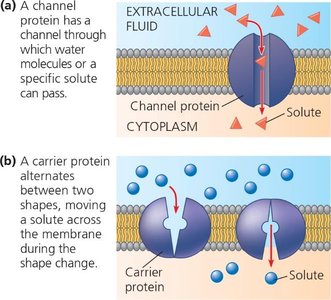
Channel Proteins: Provide hydrophilic channels for specific molecules or ions to pass through.
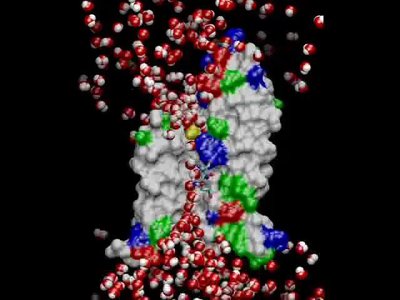
Aquaporins: Specialized channel proteins that increase the rate of water transport across the membrane. Each aquaporin is composed of four polypeptide subunits, each forming a channel for water molecules.
Carrier Proteins: Bind to specific molecules and change shape to move them across the membrane. Highly selective for the substances they transport.
Specificity: Transport proteins are specific to the substances they move (e.g., glucose transport protein only transports glucose, not fructose).
Passive Transport: Diffusion and Facilitated Diffusion
Diffusion
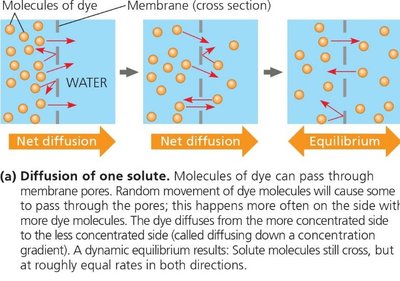
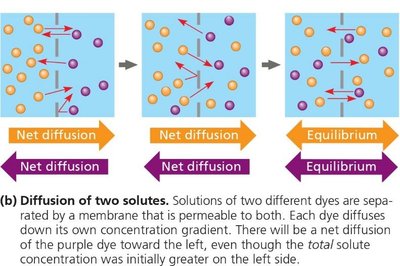
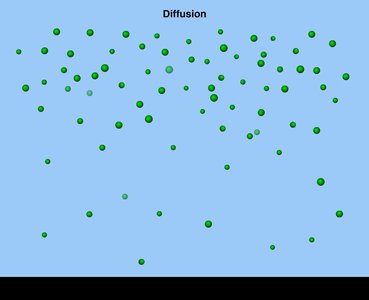
Diffusion is the movement of particles so that they spread out evenly into available space. It is a passive process, requiring no energy input.
Direction: Substances move from high to low concentration, down their concentration gradient.
Energy: No work is required; diffusion is spontaneous.
Diffusion Across Membranes: The diffusion of a substance across a biological membrane is passive transport, driven by the concentration gradient (potential energy).
Membrane Properties: Selective permeability affects the rate and direction of diffusion.
Facilitated Diffusion
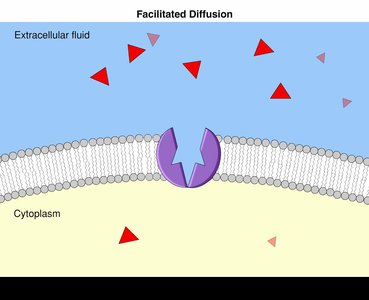
Facilitated diffusion is a type of passive transport that uses transport proteins to help substances move across the membrane without energy input.
Channel Proteins: Create water-filled pathways for molecules or ions to pass through. Each channel is specific to a certain substance.
Aquaporins: Allow rapid water movement, especially important in kidney cells for water reabsorption.
Gated Ion Channels: Open or close in response to electrical, chemical, or physical stimuli.
Carrier Proteins: Bind to a molecule, then change shape to move it across the membrane. No open channel; transport occurs via conformational change.
Energy Use: Facilitated diffusion moves substances down their concentration gradients, requiring no energy input.
Osmosis: Water Balance Across Membranes
Osmosis
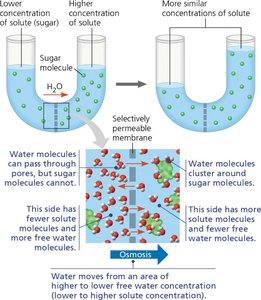
Osmosis is the diffusion of water across a selectively permeable membrane. Water moves from areas of low solute concentration (more free water) to high solute concentration (less free water).
Direction: Water moves down its free water concentration gradient, not the solute gradient.
Equilibrium: Osmosis continues until solute concentration is equal on both sides of the membrane.
Active Transport: Moving Solutes Against Their Gradients
Active Transport
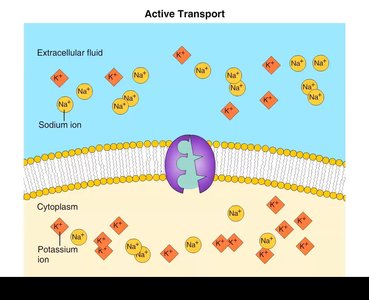
Active transport is the movement of solutes across a membrane against their concentration gradient, from lower to higher concentration. This process requires energy input, usually in the form of ATP.
Carrier Proteins: Proteins involved in active transport are carrier proteins, which change shape to move substances across the membrane.
Energy Requirement: Active transport requires metabolic energy (ATP) because it moves substances against the natural direction of diffusion.
Cell Homeostasis: Helps cells maintain internal concentrations of small molecules and ions.
Example: Sodium-Potassium Pump
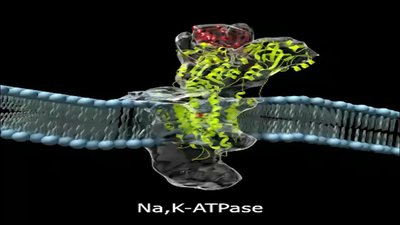
The sodium-potassium pump is a classic example of active transport in animal cells. It maintains a higher concentration of potassium (K+) inside the cell and a lower concentration of sodium (Na+) inside the cell.
Mechanism: Uses energy from ATP to move K+ into the cell and Na+ out of the cell.
Phosphate Group: A phosphate group from ATP is transferred to the pump, energizing it to transport ions.
Comparison of Passive and Active Transport
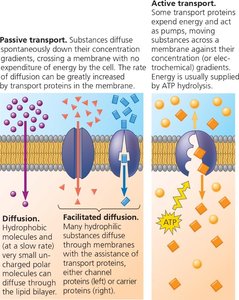
Passive transport (diffusion and facilitated diffusion) moves substances down their concentration gradients without energy input, while active transport moves substances against their gradients using energy from ATP.
Passive Transport: Includes diffusion and facilitated diffusion; no energy required.
Active Transport: Requires energy (ATP); moves substances against concentration gradients.
Summary Table: Types of Membrane Transport
Type of Transport | Energy Requirement | Direction Relative to Gradient | Transport Proteins Involved | Examples |
|---|---|---|---|---|
Simple Diffusion | No | Down gradient | None | O2, CO2 |
Facilitated Diffusion | No | Down gradient | Channel, Carrier | Glucose, ions, water (via aquaporins) |
Osmosis | No | Down free water gradient | Aquaporins | Water |
Active Transport | Yes (ATP) | Against gradient | Carrier | Na+/K+ pump |
Key Equations
Diffusion: No specific equation, but follows the concentration gradient.
Osmosis: Water moves from low solute concentration to high solute concentration.
Sodium-Potassium Pump:
Additional info: The notes above expand on brief points with academic context, definitions, and examples to ensure completeness and clarity for exam preparation.
