Back
Membrane Structure and Transport – Study Notes
Study Guide - Smart Notes
 Tailored notes based on your materials, expanded with key definitions, examples, and context.
Membrane Structure and Transport
Introduction to Membrane Structure and Function
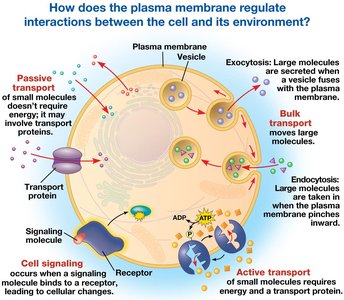
The plasma membrane is a fundamental cellular structure that regulates interactions between the cell and its environment. It is selectively permeable, allowing the cell to maintain internal conditions distinct from the external environment. The membrane's structure and associated proteins enable a variety of essential cellular processes, including transport, signaling, and recognition.
Fluid Mosaic Model of Membrane Structure
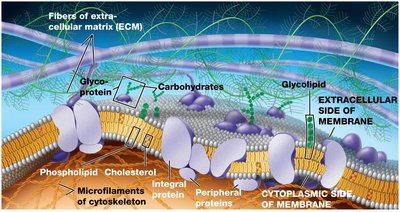
Cellular membranes are described by the fluid mosaic model, which depicts the membrane as a dynamic structure composed of a phospholipid bilayer with embedded proteins. This arrangement allows for both flexibility and the compartmentalization of cellular processes.
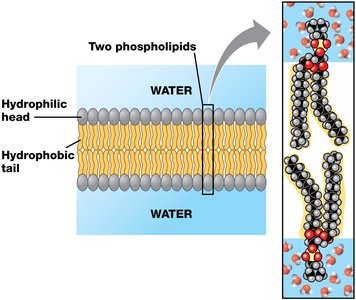
Phospholipids are amphipathic molecules, containing hydrophilic heads and hydrophobic tails, forming a bilayer that serves as a stable boundary between aqueous compartments.
Membrane proteins are interspersed throughout the bilayer, contributing to the mosaic nature of the membrane.
Membrane Fluidity
The fluidity of the membrane is crucial for its function. It is primarily maintained by hydrophobic interactions among phospholipids, which are weaker than covalent bonds, allowing lateral movement of lipids and proteins.
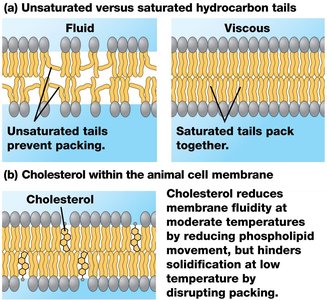
Unsaturated hydrocarbon tails prevent tight packing, increasing fluidity.
Saturated hydrocarbon tails pack together, making the membrane more viscous.
Cholesterol acts as a fluidity buffer, restraining movement at high temperatures and preventing tight packing at low temperatures.
Evolutionary Adaptations in Membrane Lipid Composition
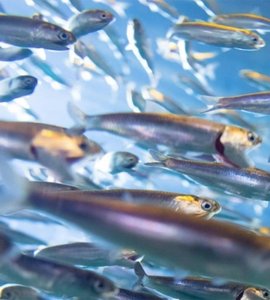
Organisms have evolved variations in membrane lipid composition to adapt to specific environmental conditions, such as temperature fluctuations. For example, fish living in cold environments have membranes with more unsaturated fatty acids to maintain fluidity.
Membrane Proteins: Types and Functions
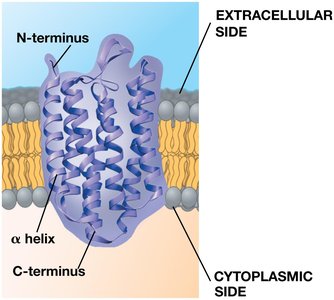
Membrane proteins are classified as integral or peripheral based on their association with the lipid bilayer.
Integral proteins penetrate the hydrophobic core and often span the membrane (transmembrane proteins).
Peripheral proteins are loosely bound to the membrane surface.
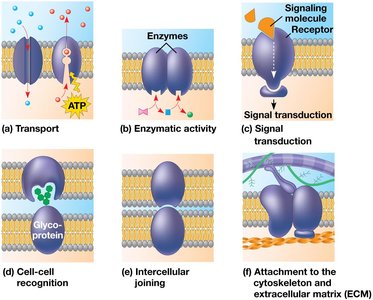
Membrane proteins perform various functions:
Transport
Enzymatic activity
Signal transduction
Cell-cell recognition
Intercellular joining
Attachment to the cytoskeleton and extracellular matrix (ECM)
Membrane Carbohydrates and Cell-Cell Recognition
Carbohydrates attached to lipids (glycolipids) or proteins (glycoproteins) on the extracellular surface of the plasma membrane play a key role in cell-cell recognition. These molecules are critical for immune response and tissue formation.
Selective Permeability of the Membrane
The plasma membrane exhibits selective permeability, allowing some substances to cross more easily than others. Hydrophobic (nonpolar) molecules can dissolve in the lipid bilayer and pass through rapidly, while polar molecules and ions require transport proteins.
Transport Across Membranes
Passive Transport: Diffusion and Osmosis
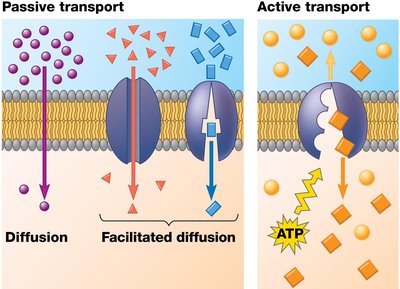
Passive transport is the movement of substances across the membrane without energy input from the cell. It includes simple diffusion and facilitated diffusion.
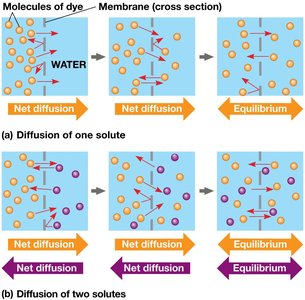
Diffusion is the movement of molecules from an area of higher concentration to lower concentration, down their concentration gradient.
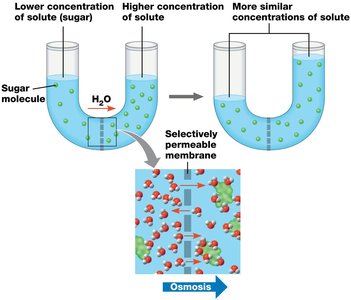
Osmosis is the diffusion of water across a selectively permeable membrane, from lower solute concentration to higher solute concentration.
Water Balance and Tonicity
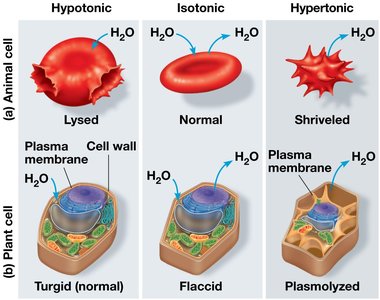
Tonicity describes the ability of a surrounding solution to cause a cell to gain or lose water.
Isotonic solution: No net water movement; cell remains stable.
Hypertonic solution: Cell loses water; may shrivel.
Hypotonic solution: Cell gains water; may swell or burst.
Plant cells rely on their cell walls to maintain water balance, becoming turgid in hypotonic solutions and plasmolyzed in hypertonic solutions.
Facilitated Diffusion
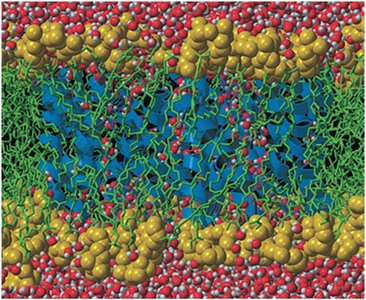
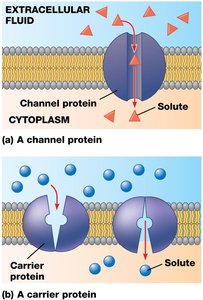
Facilitated diffusion is a form of passive transport aided by proteins. Channel proteins provide corridors for specific molecules or ions, while carrier proteins undergo shape changes to move substances across the membrane. No energy input is required.
Active Transport
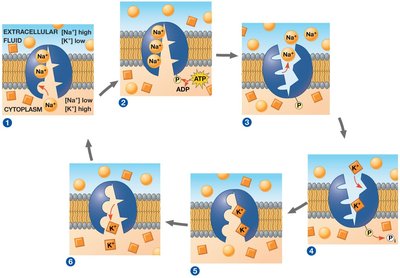
Active transport moves substances against their concentration gradients, requiring energy (usually from ATP). This process allows cells to maintain internal concentrations of small molecules that differ from those in the environment. The sodium-potassium pump is a classic example of active transport in animal cells.
Membrane Potential and Electrogenic Pumps
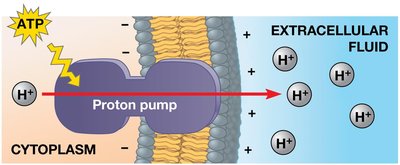
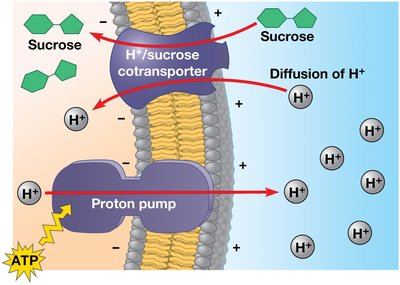
Membrane potential is the voltage across a membrane, created by differences in the distribution of ions. Electrogenic pumps, such as the sodium-potassium pump in animals and the proton pump in plants, fungi, and bacteria, generate this voltage and help store energy for cellular work.
Cotransport
Cotransport involves the coupling of the "downhill" diffusion of one solute to the "uphill" transport of another against its gradient. For example, plant cells use the proton gradient generated by proton pumps to drive the active transport of nutrients like sucrose into the cell.
Bulk Transport: Exocytosis and Endocytosis
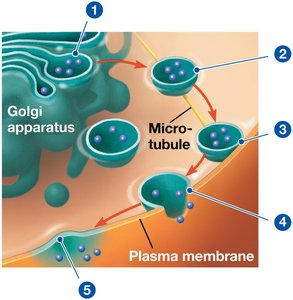
Large molecules, such as proteins and polysaccharides, cross the membrane in bulk via vesicles, a process that requires energy.
Exocytosis: Transport vesicles fuse with the plasma membrane to release their contents outside the cell.
Endocytosis: The cell takes in molecules by forming vesicles from the plasma membrane. Types include phagocytosis ("cellular eating"), pinocytosis ("cellular drinking"), and receptor-mediated endocytosis.