 Back
Membrane Transport and Lipid Structure: Study Guidance for General Biology
Study Guide - Smart Notes
 Tailored notes based on your materials, expanded with key definitions, examples, and context.
Q1. Describe the three types of lipids and their function in life.
Background
Topic: Lipid Types and Biological Functions
This question tests your understanding of the main classes of lipids—fats (fatty acids), steroids, and phospholipids—and their roles in living organisms.
Key Terms:
Fats/Fatty acids: Energy storage, insulation, and protection.
Steroids: Hormones and signaling molecules.
Phospholipids: Structural component of cell membranes.
Step-by-Step Guidance
Identify each lipid type: fats, steroids, and phospholipids.
Describe the basic structure of each lipid type (e.g., fatty acids have long hydrocarbon chains, steroids have a four-ring structure, phospholipids have a hydrophilic head and hydrophobic tails).
Explain the primary function of each lipid in biological systems.
Consider examples of each type (e.g., triglycerides for fats, cholesterol for steroids, and cell membrane phospholipids).
Try solving on your own before revealing the answer!
Final Answer:
Fats (fatty acids) store energy, provide insulation, and protect organs. Steroids act as hormones and signaling molecules, with cholesterol serving as a precursor for many steroids. Phospholipids form the structural basis of cell membranes, creating a barrier and enabling membrane fluidity.
Q2. Draw a structure for saturated and unsaturated lipids and describe the differences.
Background
Topic: Lipid Structure and Saturation
This question focuses on the structural differences between saturated and unsaturated fats and their implications for biological membranes and health.
Key Terms:
Saturated fat: No double bonds, straight chains.
Unsaturated fat: One or more double bonds, kinked chains.
Step-by-Step Guidance
Draw or visualize a saturated fatty acid (all single bonds between carbon atoms).
Draw or visualize an unsaturated fatty acid (at least one double bond causing a kink).
Describe how the presence of double bonds affects the shape and packing of the molecules.
Explain how these structural differences influence membrane fluidity and physical state at room temperature.
Try solving on your own before revealing the answer!
Final Answer:
Saturated fats have straight chains (no double bonds), allowing tight packing and solid state at room temperature. Unsaturated fats have kinks due to double bonds, preventing tight packing and resulting in liquids at room temperature.
Q3. What is the role of saturated and unsaturated fats in health, food, and biological membranes?
Background
Topic: Lipid Function in Health and Membranes
This question examines how the type of fat affects health, food properties, and membrane structure.
Key Terms:
Health: Impact on cholesterol and cardiovascular risk.
Food: Texture and state (solid or liquid).
Biological membranes: Fluidity and permeability.
Step-by-Step Guidance
Consider how saturated fats affect cholesterol and health risks.
Describe the physical properties of saturated vs. unsaturated fats in foods.
Explain how each type influences membrane fluidity and function.
Try solving on your own before revealing the answer!
Final Answer:
Saturated fats can raise cholesterol and are solid at room temperature, while unsaturated fats are healthier and liquid at room temperature. Unsaturated fats increase membrane fluidity, whereas saturated fats decrease it.
Q4. What factors determine the fluidity of the plasma membrane?
Background
Topic: Membrane Fluidity
This question tests your understanding of the structural and environmental factors that influence membrane fluidity.
Key Terms:
Fatty acid saturation
Cholesterol content
Temperature
Step-by-Step Guidance
List the factors affecting membrane fluidity (e.g., saturation, cholesterol, temperature).
Describe how each factor influences fluidity (e.g., more unsaturated fatty acids increase fluidity).
Explain the role of cholesterol in stabilizing membrane fluidity.
Try solving on your own before revealing the answer!
Final Answer:
Membrane fluidity is determined by fatty acid saturation (unsaturated increases fluidity), cholesterol (modulates fluidity), and temperature (higher temperature increases fluidity).
Q5. Describe the different types of steroids and their function. Which molecule acts as the base for many other steroids?
Background
Topic: Steroid Structure and Function
This question focuses on the diversity of steroids and their biological roles, as well as the precursor molecule for steroid synthesis.
Key Terms:
Steroids: Hormones, signaling molecules
Cholesterol: Precursor for steroid synthesis
Step-by-Step Guidance
List examples of steroids (e.g., cholesterol, testosterone, estrogen).
Describe the function of each steroid type.
Identify the molecule that serves as the base for other steroids.
Try solving on your own before revealing the answer!
Final Answer:
Cholesterol is the base molecule for many steroids. Steroids include hormones like testosterone and estrogen, which regulate various physiological processes.
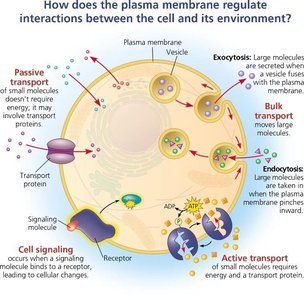
Q6. What is the purpose of the plasma membrane? Describe its structure as seen in the figure.
Background
Topic: Plasma Membrane Structure and Function
This question tests your understanding of the plasma membrane's role and its structural components.
Key Terms:
Selective permeability
Phospholipid bilayer
Proteins, cholesterol, carbohydrates
Step-by-Step Guidance
Describe the main function of the plasma membrane (e.g., boundary, selective transport).
Identify the structural components (phospholipids, proteins, cholesterol, carbohydrates).
Explain how the structure enables selective permeability and communication.
Try solving on your own before revealing the answer!
Final Answer:
The plasma membrane defines cell boundaries, regulates transport, and enables communication. Its structure includes a phospholipid bilayer, embedded proteins, cholesterol, and carbohydrates, allowing selective permeability and signaling.
Q7. Describe the role of each component in the membrane.
Background
Topic: Membrane Components and Functions
This question tests your knowledge of the roles played by phospholipids, proteins, cholesterol, and carbohydrates in the plasma membrane.
Key Terms:
Phospholipids: Structural framework
Proteins: Transport, signaling
Cholesterol: Fluidity regulation
Carbohydrates: Cell recognition
Step-by-Step Guidance
Identify each component of the membrane.
Describe the function of phospholipids in forming the bilayer.
Explain the role of proteins in transport and signaling.
Discuss how cholesterol affects membrane fluidity.
Describe the function of carbohydrates in cell recognition.
Try solving on your own before revealing the answer!
Final Answer:
Phospholipids form the bilayer, proteins enable transport and signaling, cholesterol regulates fluidity, and carbohydrates are involved in cell recognition.
Q8. Describe the factors that affect the fluidity of the membrane.
Background
Topic: Membrane Fluidity
This question focuses on the lipid portion of the membrane and the factors influencing its fluidity.
Key Terms:
Saturation of fatty acids
Cholesterol content
Temperature
Step-by-Step Guidance
List the lipid-related factors (e.g., saturated vs. unsaturated fatty acids).
Describe how cholesterol modulates fluidity.
Explain the effect of temperature on membrane fluidity.
Try solving on your own before revealing the answer!
Final Answer:
Membrane fluidity is increased by unsaturated fatty acids and higher temperatures, and modulated by cholesterol.
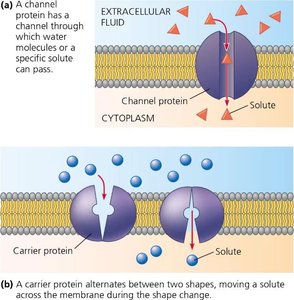
Q9. Describe the structure of the membrane and the properties of each molecule (large, small, polar, non-polar, charged, etc) and if they would easily cross the membrane.
Background
Topic: Membrane Permeability
This question tests your understanding of how molecular properties affect their ability to cross the plasma membrane.
Key Terms:
Permeability
Polarity
Size
Charge
Step-by-Step Guidance
List the molecules: water, glucose, small lipids, oxygen, sodium ions.
Describe the properties of each (e.g., water is small and polar, glucose is large and polar, small lipids are non-polar, oxygen is small and non-polar, sodium ions are small and charged).
Explain which properties favor easy passage through the membrane (small, non-polar molecules cross easily).
Discuss which molecules require transport proteins.
Try solving on your own before revealing the answer!
Final Answer:
Small, non-polar molecules (like oxygen and small lipids) cross easily; polar or charged molecules (like water, glucose, sodium ions) require transport proteins.
Q31. Describe each type of passive transport. Write 3 key points for each.
Background
Topic: Passive Transport Mechanisms
This question tests your knowledge of simple diffusion, facilitated diffusion, and osmosis.
Key Terms:
Simple diffusion
Facilitated diffusion
Osmosis
Step-by-Step Guidance
Define simple diffusion and list three key points (e.g., movement down concentration gradient, no energy required, non-polar molecules).
Define facilitated diffusion and list three key points (e.g., uses transport proteins, movement down gradient, no energy required).
Define osmosis and list three key points (e.g., movement of water, through aquaporins, down gradient).
Try solving on your own before revealing the answer!
Final Answer:
Simple diffusion: movement down gradient, no energy, non-polar molecules. Facilitated diffusion: uses proteins, down gradient, no energy. Osmosis: water movement, through aquaporins, down gradient.
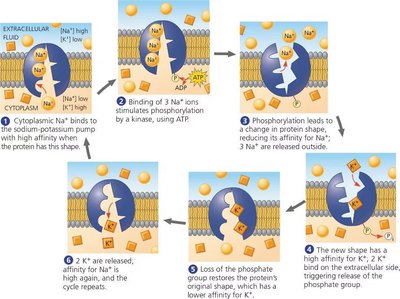
Q32. Describe the operation of the sodium-potassium pump. Give examples of cell types that use this system.
Background
Topic: Active Transport
This question tests your understanding of the sodium-potassium pump mechanism and its importance in cells.
Key Terms:
Active transport
ATP
Na+/K+ pump
Step-by-Step Guidance
Describe the initial binding of Na+ ions to the pump.
Explain how ATP is used to phosphorylate the pump and change its shape.
Describe the release of Na+ and binding of K+ ions.
Explain the return to original shape and release of K+ ions.
List examples of cells that use this pump (e.g., neurons, muscle cells).
Try solving on your own before revealing the answer!
Final Answer:
The sodium-potassium pump uses ATP to move 3 Na+ out and 2 K+ in, maintaining gradients essential for nerve and muscle function.
Q33. Are exocytosis and endocytosis active or passive transport?
Background
Topic: Bulk Transport
This question tests your understanding of whether bulk transport processes require energy.
Key Terms:
Active transport
Bulk transport
Step-by-Step Guidance
Define exocytosis and endocytosis.
Consider whether these processes require energy input.
Explain why energy is needed for moving large molecules.
Try solving on your own before revealing the answer!
Final Answer:
Both exocytosis and endocytosis are active transport processes because they require energy to move large molecules across the membrane.
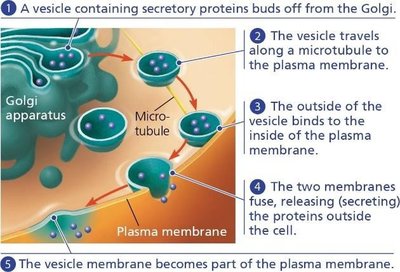
Q34. How do exocytosis and endocytosis use vesicles to transport materials across cell membranes? What types of molecules use each process?
Background
Topic: Bulk Transport Mechanisms
This question tests your understanding of vesicle-mediated transport and the types of molecules involved.
Key Terms:
Vesicle
Exocytosis
Endocytosis
Step-by-Step Guidance
Describe how vesicles form and fuse with the membrane during exocytosis.
Explain how vesicles pinch inward during endocytosis.
List types of molecules transported (e.g., proteins, hormones, nutrients).
Try solving on your own before revealing the answer!
Final Answer:
Exocytosis uses vesicles to secrete large molecules like proteins, while endocytosis brings in substances such as nutrients and signaling molecules.
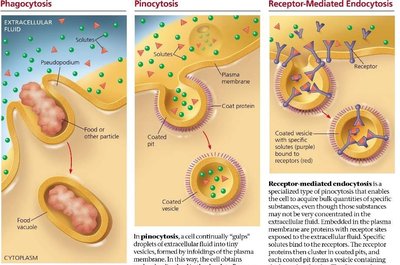
Q35. Describe the difference between phagocytosis and pinocytosis.
Background
Topic: Types of Endocytosis
This question tests your understanding of the two main forms of endocytosis.
Key Terms:
Phagocytosis: "Cell eating"
Pinocytosis: "Cell drinking"
Step-by-Step Guidance
Define phagocytosis and describe its process (engulfing large particles).
Define pinocytosis and describe its process (engulfing fluid and small molecules).
Compare the types of substances taken up by each process.
Try solving on your own before revealing the answer!
Final Answer:
Phagocytosis engulfs large particles (e.g., bacteria), while pinocytosis takes in fluids and dissolved substances.
Q36. Describe how receptor-mediated endocytosis differs.
Background
Topic: Specialized Endocytosis
This question tests your understanding of receptor-mediated endocytosis and its specificity.
Key Terms:
Receptor-mediated endocytosis
Specificity
Step-by-Step Guidance
Define receptor-mediated endocytosis.
Describe how receptors bind specific molecules.
Explain how this process increases efficiency and specificity of uptake.
Try solving on your own before revealing the answer!
Final Answer:
Receptor-mediated endocytosis uses specific receptors to selectively take up target molecules, making the process highly efficient and specific.
