 Back
Membrane Transport and Plasma Membrane Structure – Guided Study Notes
Study Guide - Smart Notes
 Tailored notes based on your materials, expanded with key definitions, examples, and context.
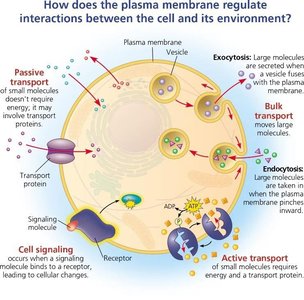
Q1. Describe the structure of the plasma membrane and how it regulates the movement of substances in and out of the cell.
Background
Topic: Plasma Membrane Structure and Function
This question tests your understanding of the components of the plasma membrane and how its structure enables selective transport of substances.
Key Terms and Concepts:
Phospholipid bilayer: Double layer of phospholipids with hydrophilic heads and hydrophobic tails.
Proteins: Integral and peripheral proteins assist in transport and communication.
Selective permeability: The membrane allows some substances to cross more easily than others.
Step-by-Step Guidance
Describe the basic structure of the plasma membrane, focusing on the arrangement of phospholipids.
Explain the role of membrane proteins in transport and signaling.
Discuss how the membrane's structure leads to selective permeability, mentioning which types of molecules can pass freely and which require assistance.
Consider the roles of cholesterol and carbohydrates in membrane stability and recognition.
Try solving on your own before revealing the answer!
Final Answer:
The plasma membrane is composed of a phospholipid bilayer with embedded proteins, cholesterol, and carbohydrates. The hydrophobic core prevents passage of most polar or charged molecules, while proteins facilitate transport and communication. Selective permeability is achieved by the specific arrangement and function of these components, allowing the cell to regulate its internal environment.
Q2. Describe the various transport mechanisms: Active and Passive Transport, Osmosis, and Bulk Transport.
Background
Topic: Membrane Transport Mechanisms
This question assesses your knowledge of how substances move across the plasma membrane, including energy requirements and direction relative to concentration gradients.
Key Terms and Concepts:
Passive transport: Movement down a concentration gradient without energy input (e.g., diffusion, facilitated diffusion, osmosis).
Active transport: Movement against a concentration gradient, requiring energy (usually ATP).
Bulk transport: Movement of large particles via vesicles (endocytosis and exocytosis).
Step-by-Step Guidance
Define passive transport and give examples (simple diffusion, facilitated diffusion, osmosis).
Define active transport and describe how it differs from passive transport, including the role of ATP.
Explain osmosis as a special case of passive transport involving water.
Describe bulk transport processes (endocytosis and exocytosis) and their roles in moving large molecules.
Try solving on your own before revealing the answer!
Final Answer:
Passive transport includes diffusion, facilitated diffusion, and osmosis, all moving substances down their concentration gradients without energy. Active transport moves substances against their gradients using ATP, such as the sodium-potassium pump. Bulk transport uses vesicles for large molecules: endocytosis brings substances in, and exocytosis expels them.
Q3. Describe each type of passive transport. Be sure to write 3 key points for each.
Background
Topic: Types of Passive Transport
This question focuses on distinguishing between simple diffusion, facilitated diffusion, and osmosis.
Key Terms and Concepts:
Simple diffusion: Direct movement of small, nonpolar molecules across the membrane.
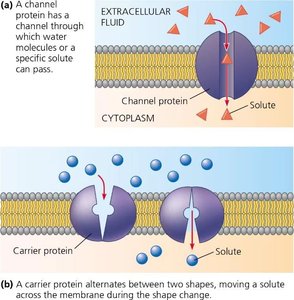
Facilitated diffusion: Movement of larger or polar molecules via transport proteins.
Osmosis: Diffusion of water across a selectively permeable membrane.
Step-by-Step Guidance
For each type, list whether it requires a protein channel or carrier.
Describe the direction of movement relative to the concentration gradient.
Note the types of molecules that use each method.
Try solving on your own before revealing the answer!
Final Answer:
Simple diffusion: no protein required, moves down gradient, for small nonpolar molecules. Facilitated diffusion: uses channel or carrier proteins, moves down gradient, for polar/charged molecules. Osmosis: water movement, uses aquaporins or membrane, down water potential gradient.
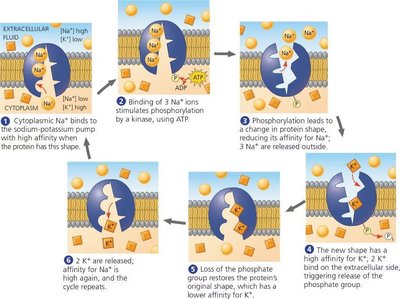
Q4. Describe the operation of the sodium-potassium pump. Give examples of cell types that use this system.
Background
Topic: Active Transport – Sodium-Potassium Pump
This question tests your understanding of how the sodium-potassium pump works and its importance in cells.
Key Terms and Concepts:
Active transport: Requires ATP to move ions against their gradients.
Sodium-potassium pump: Moves 3 Na+ out and 2 K+ in per cycle.
Step-by-Step Guidance
Describe the initial binding of Na+ ions to the pump inside the cell.
Explain how ATP is used to phosphorylate the pump, causing a conformational change.
Describe the release of Na+ outside and binding of K+ ions from the extracellular fluid.
Explain how dephosphorylation returns the pump to its original shape, releasing K+ inside.
Try solving on your own before revealing the answer!
Final Answer:
The sodium-potassium pump uses ATP to move 3 Na+ out of the cell and 2 K+ into the cell, maintaining electrochemical gradients. This is essential in nerve and muscle cells for action potentials and cell volume regulation.
Q5. How do exocytosis and endocytosis use vesicles to transport materials across cell membranes? Describe what types of molecules use each process.
Background
Topic: Bulk Transport – Vesicular Transport
This question examines your understanding of how large molecules are transported via vesicles.
Key Terms and Concepts:
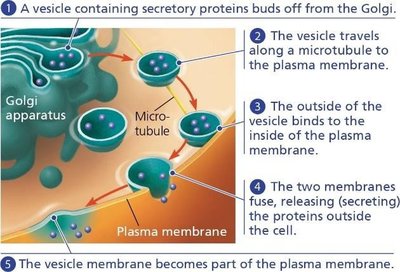
Exocytosis: Vesicles fuse with the plasma membrane to release contents outside the cell.
Endocytosis: The plasma membrane engulfs material to bring it into the cell.
Step-by-Step Guidance
Describe the process of vesicle formation and movement toward the membrane.
Explain how vesicles fuse with the membrane during exocytosis, releasing their contents.
Describe how the membrane invaginates during endocytosis to form a vesicle containing extracellular material.
List examples of molecules transported by each process (e.g., proteins, neurotransmitters, bacteria).
Try solving on your own before revealing the answer!
Final Answer:
Exocytosis exports large molecules like proteins and neurotransmitters by vesicle fusion with the membrane. Endocytosis imports substances such as nutrients, fluids, or pathogens by engulfing them in vesicles. Both processes are essential for cellular communication and nutrient uptake.
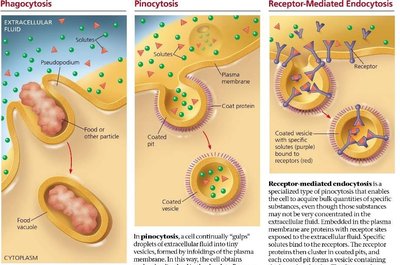
Q6. Describe the difference between phagocytosis and pinocytosis. How is receptor-mediated endocytosis different?
Background
Topic: Types of Endocytosis
This question tests your ability to distinguish between different forms of endocytosis and understand their specificity.
Key Terms and Concepts:
Phagocytosis: "Cell eating" – uptake of large particles or cells.
Pinocytosis: "Cell drinking" – uptake of extracellular fluid and dissolved solutes.
Receptor-mediated endocytosis: Highly specific uptake using membrane receptors.
Step-by-Step Guidance
Define phagocytosis and describe the types of materials it brings into the cell.
Define pinocytosis and explain how it differs in the type of material and process.
Describe receptor-mediated endocytosis and how it increases specificity for certain molecules.
Try solving on your own before revealing the answer!
Final Answer:
Phagocytosis engulfs large particles like bacteria; pinocytosis takes in extracellular fluid. Receptor-mediated endocytosis uses specific receptors to selectively internalize target molecules, making it more selective than the other two forms.
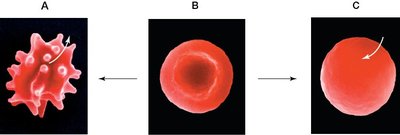
Q7. Describe the concentration of the outside vs inside of the red blood cell in each image below. Be sure to describe what is occurring with the white arrows.
Background
Topic: Osmosis and Tonicity
This question tests your understanding of how water moves in response to solute concentrations across the plasma membrane.
Key Terms and Concepts:
Hypotonic solution: Lower solute concentration outside; water enters cell.
Isotonic solution: Equal solute concentration; no net water movement.
Hypertonic solution: Higher solute concentration outside; water leaves cell.
Step-by-Step Guidance
For each image, identify whether the solution is hypotonic, isotonic, or hypertonic relative to the cell interior.
Describe the direction of water movement indicated by the arrows.
Explain the resulting effect on the red blood cell's shape and volume.
Try solving on your own before revealing the answer!
Final Answer:
In a hypotonic solution, water enters the cell (arrows in), causing it to swell or lyse. In an isotonic solution, water moves equally in and out (arrows balanced), and the cell remains normal. In a hypertonic solution, water leaves the cell (arrows out), causing it to shrink or crenate.
