 Back
Mendel and the Gene: Chromosomal Basis, Extensions, and Human Inheritance
Study Guide - Smart Notes
 Tailored notes based on your materials, expanded with key definitions, examples, and context.
Mendel and the Gene: Chromosomal Basis of Inheritance
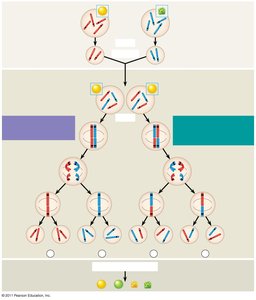
Chromosomal Basis of Mendel’s Laws
The behavior of chromosomes during meiosis provides the foundation for Mendel’s laws of segregation and independent assortment. Chromosomes undergo segregation and independent assortment, explaining how alleles are distributed to gametes.
Law of Segregation: The two alleles for each gene separate during gamete formation.
Law of Independent Assortment: Alleles of genes on nonhomologous chromosomes assort independently during gamete formation.
Example: Dihybrid crosses result in a 9:3:3:1 phenotypic ratio in the F2 generation.
Experimental Evidence for Chromosomal Theory
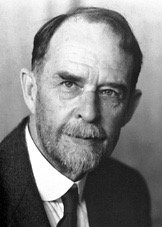
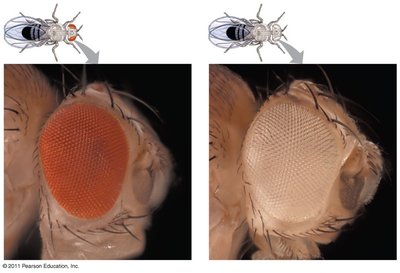
Thomas Hunt Morgan’s experiments with fruit flies (Drosophila melanogaster) provided the first solid evidence associating a specific gene with a specific chromosome. Morgan observed that certain traits, such as eye color, were linked to the X chromosome.
Wild type: The normal phenotype, indicated by a plus sign (e.g., w+ for red eyes).
Mutant phenotype: Traits alternative to the wild type, such as white eyes (w).
Sex Determination and X-Linked Inheritance
Chromosomal Basis of Sex
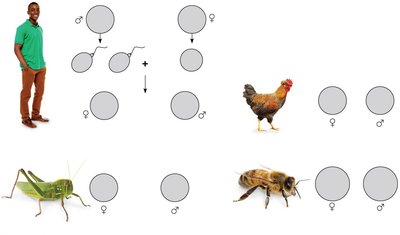
Sex determination varies among species. In mammals and fruit flies, females are XX and males are XY. Other systems include X-0 (insects), Z-W (birds), and haplo-diploid (bees).
Sex-linked gene: A gene located on either sex chromosome (X or Y).
X-linked genes: Genes on the X chromosome, often unrelated to sex.
Y-linked genes: Genes on the Y chromosome, mostly related to male sex determination.
X-Linked Inheritance
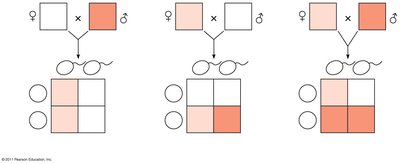
X-linked recessive disorders are more common in males because males (XY) need only one copy of the allele to express the trait, while females (XX) need two copies. Examples include color blindness, Duchenne muscular dystrophy, and hemophilia.
Hemizygous: Males have only one X chromosome, so a single recessive allele will cause the disorder.
Carrier: Females with one normal and one mutant allele are carriers but typically unaffected.
Linkage and Recombination
Linked Genes and Genetic Recombination
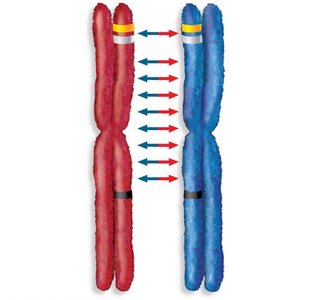
Genes located close together on the same chromosome tend to be inherited together (linked genes). The chance of recombination between two genes is proportional to the distance between them.
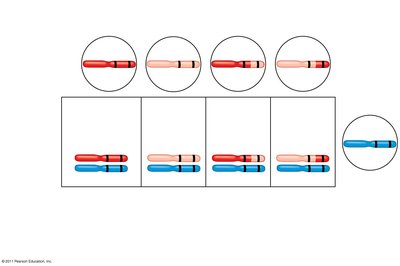
Parental types: Offspring with phenotypes matching one of the parents.
Recombinant types: Offspring with new combinations of traits.
Recombination frequency: The percentage of recombinant offspring, used to map gene distances.
Calculating Recombination Frequency
Recombination frequency is calculated as the number of recombinant offspring divided by the total number of offspring, multiplied by 100. One percent recombination equals one map unit (centimorgan).
Formula:
Example: 391 recombinants out of 2,300 total offspring gives a recombination frequency of 17%.
Linkage Maps and Cytogenetic Maps
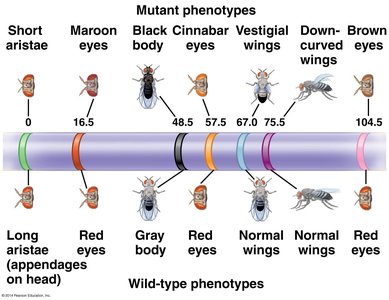
Linkage maps are constructed using recombination frequencies to determine the relative positions of genes on a chromosome. Cytogenetic maps use chromosome banding to locate genes with respect to chromosomal features.
Map unit (centimorgan): Represents a 1% recombination frequency.
Genes far apart: Can have recombination frequencies near 50%, behaving as if on different chromosomes.
Extensions of Mendelian Genetics
Degrees of Dominance
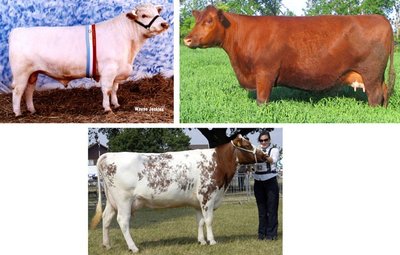
Not all alleles are completely dominant or recessive. Some genes exhibit incomplete dominance or codominance.
Incomplete dominance: Heterozygotes have an intermediate phenotype (e.g., pink flowers from red and white parents).
Codominance: Both alleles are fully expressed in different sectors (e.g., blood types, speckled chickens).

Multiple Alleles and Pleiotropy
Many genes have more than two alleles, and some genes affect multiple phenotypic traits (pleiotropy).
Example: ABO blood groups have three alleles (i, iA, iB) and four phenotypes.
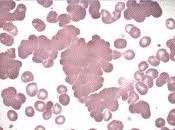
Pleiotropy: One gene affects multiple traits, such as sickle-cell anemia and phenylketonuria (PKU).
Epistasis and Polygenic Inheritance
Epistasis occurs when the expression of one gene masks the effect of another gene. Polygenic inheritance involves multiple genes contributing to a single trait, resulting in quantitative variation.
Epistasis: Example in Labrador retrievers, where one gene determines pigment deposition and another determines color.
Polygenic inheritance: Traits like skin color and height are controlled by several genes.
Environmental Effects
The phenotype of many traits can be influenced by environmental factors, leading to phenotypic plasticity. Examples include flower color in hydrangeas (affected by soil pH), seasonal fur coloration, and temperature-dependent sex determination.
Multifactorial traits: Influenced by both genetic and environmental factors.
Mendelian Inheritance in Humans
Pedigree Analysis
Pedigrees are family trees used to trace inheritance patterns of traits across generations. They help predict probabilities of specific phenotypes using multiplication and addition rules.
Autosomal recessive traits: Require two copies of the allele; often skip generations.
Autosomal dominant traits: Require only one copy; do not skip generations.
X-linked traits: More common in males; can be recessive or dominant.
Examples of Human Genetic Disorders
Sickle-cell disease: Autosomal recessive; affects hemoglobin in red blood cells.
Cystic fibrosis: Autosomal recessive; affects chloride transport in cells.
Huntington’s disease: Autosomal dominant; neurodegenerative disorder with late onset.
Hemophilia: X-linked recessive; affects blood clotting.
Summary
The work of Mendel and Morgan established the gene concept and the chromosomal basis of inheritance. These principles explain how traits are passed from parents to offspring and form the foundation of modern genetics. Extensions of Mendelian genetics, such as incomplete dominance, codominance, multiple alleles, pleiotropy, epistasis, polygenic inheritance, and environmental effects, reveal the complexity of inheritance patterns. Pedigree analysis and genetic testing are essential tools for understanding human genetics and predicting inheritance of traits and disorders.
