 Back
BackMendel and the Gene: Foundations and Extensions of Mendelian Genetics
Study Guide - Smart Notes
 Tailored notes based on your materials, expanded with key definitions, examples, and context.
Chapter 14: Mendel and the Gene
The Garden Pea as a Model Organism
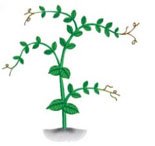
Gregor Mendel established the foundation for the chromosome theory of inheritance through his experiments with garden peas (Pisum sativum). Mendel selected peas because they were inexpensive, easy to grow, had a short generation time, produced many seeds, and allowed controlled mating. These features made peas an ideal model organism for genetic studies.
Key Terms in Mendelian Genetics
Gene: A hereditary factor that determines a particular trait.
Allele: Different versions of a gene.
Genotype: The genetic makeup of an organism.
Phenotype: The observable traits of an organism.
Homozygous: Having two identical alleles for a gene.
Heterozygous: Having two different alleles for a gene.
Dominant allele: An allele that determines the phenotype in a heterozygote.
Recessive allele: An allele whose phenotype is masked in a heterozygote.
Self-Fertilization and Cross-Fertilization in Peas
Pea plants can reproduce by self-fertilization (pollen from the same plant fertilizes the ovule) or cross-fertilization (pollen from one plant fertilizes the ovule of another). Mendel controlled these processes to study inheritance patterns.
The Principle of Segregation
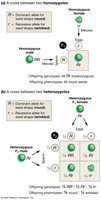
Mendel's principle of segregation states that two members of each gene pair segregate into different gametes during the formation of eggs and sperm. This explains why offspring inherit one allele from each parent. Mendel used letters to represent alleles (e.g., R for dominant, r for recessive).
Mendel’s Monohybrid Crosses
Monohybrid crosses involve parents that differ in one trait. Mendel observed that the F2 generation showed a 3:1 ratio of dominant to recessive phenotypes, supporting the principle of segregation.
The Principle of Independent Assortment
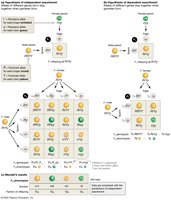
Mendel’s dihybrid crosses (involving two traits) demonstrated that alleles of different genes are transmitted independently of one another. The predicted phenotypic ratio for the F2 generation in a dihybrid cross is 9:3:3:1, supporting the principle of independent assortment.
Testcrosses
A testcross involves crossing an individual with a dominant phenotype (but unknown genotype) with a homozygous recessive individual. The phenotypes of the offspring reveal the genotype of the unknown parent. Mendel used testcrosses to confirm the principle of independent assortment.
Meiosis Explains Mendel’s Principles
The behavior of chromosomes during meiosis explains Mendel’s principles. Genes located on different nonhomologous chromosomes assort independently, while alleles of the same gene segregate during gamete formation.
Extending Mendel’s Rules
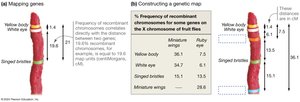
Further research revealed that not all traits follow Mendel’s simple patterns. Some genes are linked (inherited together because they are on the same chromosome), and crossing over during meiosis can separate linked genes. The frequency of crossing over is used to create genetic maps, which show the relative positions of genes on a chromosome.
Multiple Alleles and Blood Types
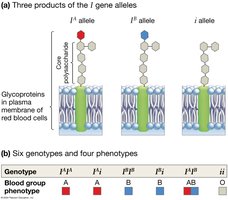
Some genes have more than two alleles in a population, a phenomenon known as multiple allelism. For example, the human ABO blood group is determined by three alleles (IA, IB, and i), resulting in four blood types (A, B, AB, O).
Codominance and Incomplete Dominance
Codominance: Both alleles in a heterozygote are fully expressed (e.g., AB blood type).
Incomplete dominance: Heterozygotes have an intermediate phenotype (e.g., red and white flowers produce pink offspring).
Environmental Effects on Phenotype
Most phenotypes are influenced by both genes and the environment. Mendel controlled environmental variables in his experiments, but in nature, factors such as sunlight, water, and soil can affect trait expression.
Quantitative Traits
Some traits, called quantitative traits, vary continuously and are influenced by many genes (polygenic inheritance). These traits often show a normal distribution in populations (e.g., human height).
Applying Mendel’s Rules to Human Inheritance
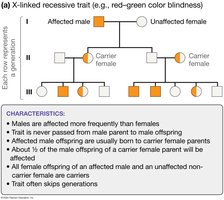
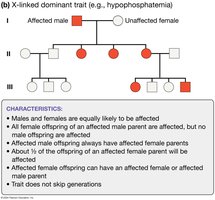
Pedigrees (family trees) are used to study the inheritance of traits in humans. The mode of transmission can be autosomal or sex-linked, and traits can be dominant or recessive. Pedigrees help distinguish between these patterns.
X-Linked Recessive Traits
Males are affected more frequently than females.
Trait is never passed from father to son.
Affected males are usually born to carrier mothers.
Trait often skips generations.
X-Linked Dominant Traits
Males and females are equally likely to be affected.
Affected males always have affected mothers.
Trait does not skip generations.
Summary Table: Mendelian Genetics Terms
Term | Definition |
|---|---|
Gene | Hereditary factor that determines a trait |
Allele | Alternative form of a gene |
Genotype | Genetic makeup of an organism |
Phenotype | Observable characteristics |
Homozygous | Two identical alleles |
Heterozygous | Two different alleles |
Dominant | Allele expressed in heterozygote |
Recessive | Allele masked in heterozygote |
Key Equations
Probability of genotype in monohybrid cross:
Phenotypic ratio in monohybrid cross (F2):
Phenotypic ratio in dihybrid cross (F2):
Additional info: This summary integrates foundational Mendelian genetics with modern extensions, including linkage, multiple alleles, and human inheritance patterns, to provide a comprehensive overview suitable for college-level biology students.
