 Back
Mendel and the Gene: Foundations and Extensions of Mendelian Genetics
Study Guide - Smart Notes
 Tailored notes based on your materials, expanded with key definitions, examples, and context.
Chapter 14: Mendel and the Gene
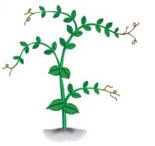
The Garden Pea as a Model Organism
The garden pea (Pisum sativum) was chosen by Gregor Mendel for his pioneering genetic experiments due to its advantageous characteristics for controlled breeding and observation of inheritance patterns.
Model Organism: An organism suitable for laboratory study due to ease of maintenance, short generation time, and ability to produce many offspring.
Key Features of Peas:
Inexpensive and easy to grow
Short generation time
Large number of seeds per mating
Ability to control mating (self- or cross-fertilization)
Significance: These features allowed Mendel to systematically study inheritance and lay the groundwork for the chromosome theory of inheritance.
Key Terms in Mendelian Genetics
Mendelian genetics uses specific terminology to describe inheritance patterns. Understanding these terms is essential for interpreting genetic crosses.
Term | Definition |
|---|---|
Gene | A hereditary factor that determines a particular trait |
Allele | Different versions of a gene |
Genotype | The genetic makeup of an organism |
Phenotype | The observable traits of an organism |
Homozygous | Having two identical alleles for a gene |
Heterozygous | Having two different alleles for a gene |
Dominant | An allele that determines phenotype in heterozygotes |
Recessive | An allele whose phenotype is masked in heterozygotes |
The Principle of Segregation
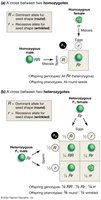
Mendel's principle of segregation states that two members of each gene pair must separate into different gamete cells during the formation of eggs and sperm. This explains why offspring inherit one allele from each parent.
Allele Representation: Dominant alleles are often represented by uppercase letters (e.g., R), and recessive alleles by lowercase (e.g., r).
Genetic Crosses: Monohybrid crosses (single trait) reveal segregation patterns.
The Principle of Independent Assortment
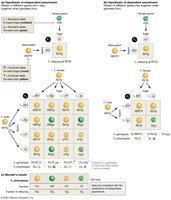
Mendel's dihybrid crosses (involving two traits) demonstrated that alleles of different genes are transmitted independently of one another, provided the genes are on different chromosomes.
Dihybrid Cross: Cross between individuals heterozygous for two traits.
Predicted Ratio: Four possible phenotypes in a 9:3:3:1 ratio in the F2 generation.
Significance: Demonstrates independent assortment of genes.
Testcrosses
A testcross is used to determine the genotype of an individual with a dominant phenotype by crossing it with a homozygous recessive individual. The offspring phenotypes reveal the unknown genotype.
Application: Confirms predictions made by the principle of independent assortment.
Chromosomal Basis of Mendel’s Principles
Mendel’s principles are explained by the behavior of chromosomes during meiosis. Genes located on different nonhomologous chromosomes assort independently, while those on the same chromosome may be inherited together unless crossing over occurs.
Principle of Segregation: Homologous chromosomes separate during meiosis I.
Principle of Independent Assortment: Nonhomologous chromosomes align independently at metaphase I.
Extending Mendel’s Rules
Not all traits follow simple Mendelian inheritance. Extensions include linkage, multiple alleles, codominance, incomplete dominance, and quantitative traits.
Linkage and Crossing Over
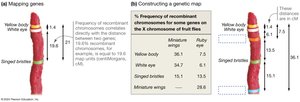
Linkage refers to the tendency of genes located on the same chromosome to be inherited together. However, crossing over during meiosis can separate linked genes, producing recombinant offspring. The frequency of recombination can be used to construct genetic maps, showing the relative positions of genes on a chromosome.
Genetic Map: Diagram showing gene positions based on recombination frequencies.
Multiple Allelism
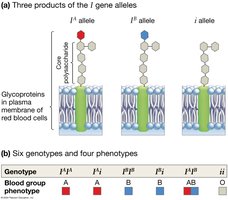
Some genes have more than two alleles in a population, a phenomenon known as multiple allelism. For example, the human ABO blood group is determined by three common alleles (IA, IB, i), each coding for a different enzyme that modifies red blood cell surface polysaccharides.
Codominance
In codominance, both alleles in a heterozygote are fully expressed, resulting in a phenotype that shows both traits equally. The ABO blood group is a classic example, where IA and IB are codominant.
Incomplete Dominance
In incomplete dominance, the heterozygote displays an intermediate phenotype between the two homozygotes. For example, crossing red-flowered and white-flowered plants produces pink-flowered offspring.
Environmental Effects on Phenotype
Most phenotypes are influenced by both genetic and environmental factors. Mendel minimized environmental variation in his experiments, but in nature, factors such as sunlight, water, and soil can affect trait expression.
Phenotype = Genotype + Environment
Quantitative Traits
Traits that show continuous variation (e.g., height, skin color) are called quantitative traits. These are typically influenced by many genes (polygenic inheritance) and environmental factors, resulting in a bell-shaped distribution of phenotypes.
Applying Mendel’s Rules to Human Inheritance
Human geneticists use pedigrees (family trees) to study inheritance patterns and determine whether traits are autosomal or sex-linked, and whether alleles are dominant or recessive.
Autosomal Traits: Located on non-sex chromosomes
Sex-Linked Traits: Located on sex chromosomes (usually X-linked)
Dominant vs. Recessive: Determined by pedigree analysis
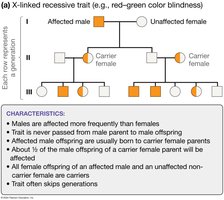
X-Linked Recessive Inheritance
Traits such as red-green color blindness are X-linked recessive. Males are more frequently affected, and the trait often skips generations.
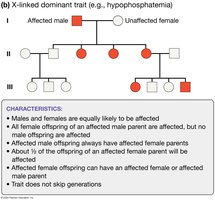
X-Linked Dominant Inheritance
In X-linked dominant inheritance, both males and females can be affected, but affected males always have affected daughters. The trait does not skip generations.
Additional info: These notes synthesize and expand upon the provided material, integrating standard academic context for clarity and completeness. Tables and images are included only when directly relevant to the explanation of the adjacent text.
