 Back
BackMendel and the Gene: Foundations of Classical Genetics
Study Guide - Smart Notes
 Tailored notes based on your materials, expanded with key definitions, examples, and context.
Chapter 14: Mendel and the Gene
Introduction to Mendelian Genetics
Gregor Mendel's experiments with garden peas established the foundational principles of inheritance, forming the basis for modern genetics. Mendel's careful selection of the pea plant as a model organism allowed him to control mating and observe patterns of trait inheritance across generations.
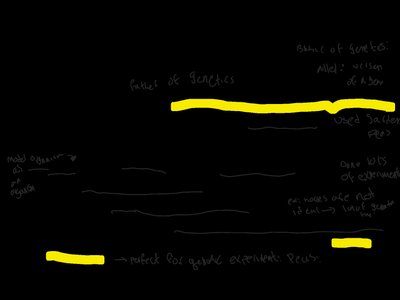
Model Organism: Peas were chosen for their ease of cultivation, short generation time, and ability to produce many offspring.
Controlled Crosses: Mendel could manipulate which plants mated, enabling precise genetic studies.
Key Terms in Mendelian Genetics
Understanding Mendel's work requires familiarity with several essential genetic terms:
Term | Definition | Example/Comment |
|---|---|---|
Gene | A hereditary factor influencing a trait | Modern: DNA region coding for protein/RNA |
Allele | A specific form of a gene | Diploids may have same or different alleles |
Genotype | Allele listing for an individual | Diploid: two alleles/gene; haploid: one allele/gene |
Phenotype | Observable traits of an individual | From molecular to organismal level |
Homozygous | Two identical alleles for a gene | e.g., RR or rr |
Heterozygous | Two different alleles for a gene | e.g., Rr |
Dominant allele | Expressed in both homozygous and heterozygous states | Does not imply high frequency or fitness |
Recessive allele | Expressed only in homozygous state | "Recedes" in heterozygotes |
Pure line | Individuals identical in phenotype, always produce same phenotype offspring | Homozygous for the gene |
Hybrid | Offspring from parents with different genotypes | Heterozygous |
Polymorphic trait | Trait with two or more common forms | e.g., flower color in peas |
Reciprocal cross | Cross with reversed parental phenotypes | Tests for sex influence on inheritance |
Testcross | Cross with homozygous recessive to determine unknown genotype | Used to reveal genotype of dominant phenotype |
X-linked/Y-linked | Gene located on X or Y chromosome | Shows sex-specific inheritance patterns |
Mendel’s Monohybrid Crosses and the Principle of Segregation
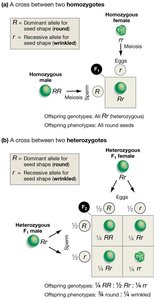
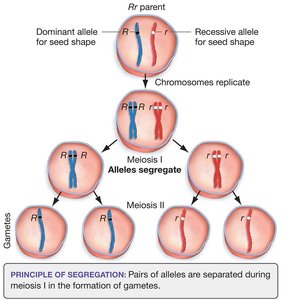
Mendel observed that crossing pure lines for a single trait (monohybrid cross) produced a 3:1 ratio of dominant to recessive phenotypes in the F2 generation. This led to the principle of segregation:
Each individual has two alleles for each gene, which segregate during gamete formation.
Each gamete receives only one allele from each gene pair.
Trait | Dominant Phenotype | Recessive Phenotype | F2 Ratio |
|---|---|---|---|
Seed shape | Round | Wrinkled | 2.96:1 |
Seed color | Yellow | Green | 3.01:1 |
Pod shape | Inflated | Constricted | 2.95:1 |
Pod color | Green | Yellow | 2.82:1 |
Flower color | Purple | White | 3.15:1 |
Flower/pod position | Axial | Terminal | 3.14:1 |
Stem length | Tall | Short | 2.96:1 |
Mendel’s Dihybrid Crosses and the Principle of Independent Assortment
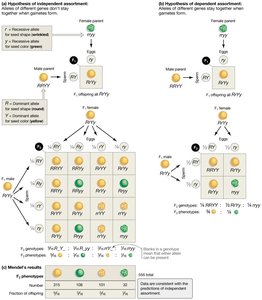
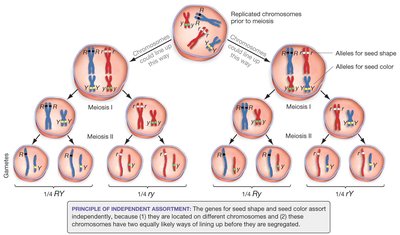
When Mendel studied two traits simultaneously (dihybrid cross), he found a 9:3:3:1 phenotypic ratio in the F2 generation, supporting the principle of independent assortment:
Alleles of different genes assort independently during gamete formation if they are on different chromosomes.
Testcrosses
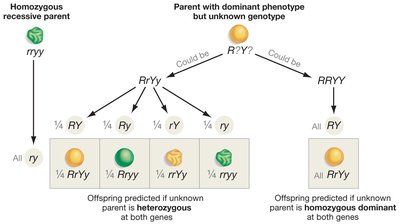
A testcross is used to determine the genotype of an individual with a dominant phenotype by crossing it with a homozygous recessive individual. The offspring phenotypes reveal the unknown genotype.
Chromosomal Basis of Mendel’s Principles
Mendel’s principles are explained by the behavior of chromosomes during meiosis:
Segregation: Homologous chromosomes (and thus alleles) separate during meiosis I.
Independent Assortment: Chromosomes align independently, so genes on different chromosomes assort independently.
Extending Mendel’s Rules: Linkage and Crossing Over
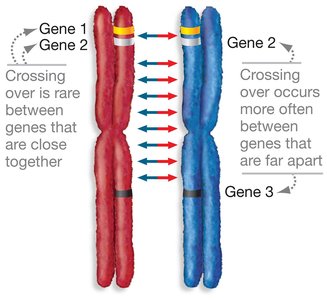
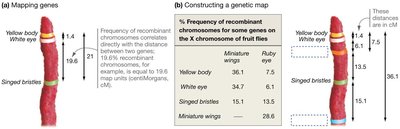
Some genes do not assort independently because they are located close together on the same chromosome—a phenomenon known as linkage. However, crossing over during meiosis can separate linked genes, producing recombinant offspring. The frequency of recombination can be used to map gene positions on chromosomes.
Multiple Alleles, Codominance, and Incomplete Dominance
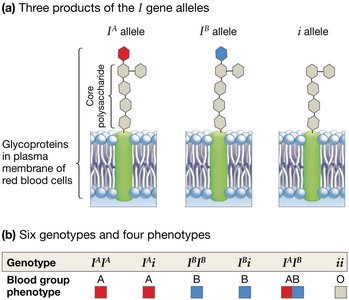
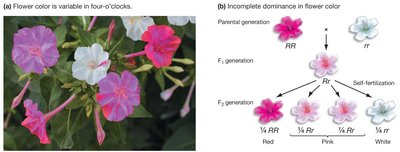
Many genes have more than two alleles (multiple allelism). Some alleles are codominant (both expressed in heterozygotes), while others show incomplete dominance (heterozygotes have an intermediate phenotype).
Example (Multiple Alleles & Codominance): Human ABO blood types are determined by three alleles (IA, IB, i). IA and IB are codominant; both are dominant over i.
Example (Incomplete Dominance): Crossing red-flowered and white-flowered plants yields pink-flowered offspring.
Environmental Effects and Quantitative Traits
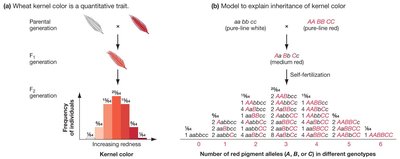
Most phenotypes are influenced by both genes and the environment. Some traits, called quantitative traits, vary continuously and are controlled by multiple genes (polygenic inheritance), often resulting in a normal distribution of phenotypes.
Human Inheritance and Pedigree Analysis
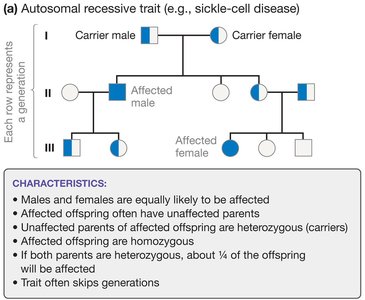
Pedigrees are used to study inheritance patterns in humans. Traits can be autosomal or sex-linked, and dominant or recessive. Pedigree analysis helps determine the mode of transmission for genetic traits.
Trait Type | Key Characteristics |
|---|---|
Autosomal Recessive | Affects males and females equally; often skips generations; affected offspring usually homozygous |
Autosomal Dominant | Affects males and females equally; does not skip generations; affected offspring usually heterozygous |
X-linked Recessive | Males more frequently affected; trait often skips generations; no male-to-male transmission |
X-linked Dominant | Affects both sexes; does not skip generations; all daughters of affected males are affected |
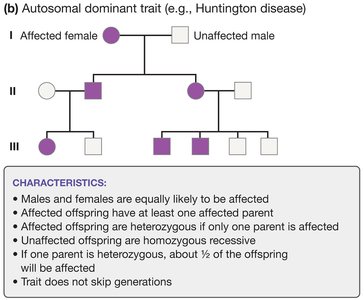
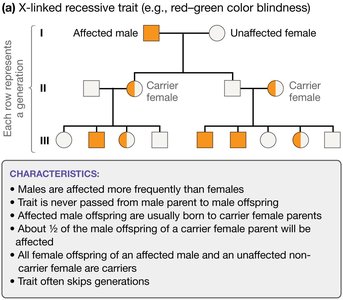
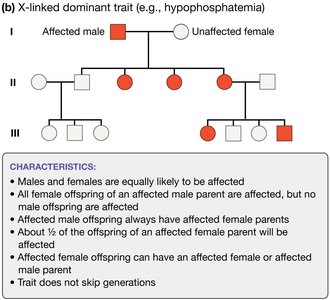
Additional info: These principles form the basis for understanding classical genetics and are foundational for advanced studies in molecular genetics, genomics, and evolutionary biology.
