 Back
Mendel and the Gene: Foundations of Classical Genetics
Study Guide - Smart Notes
 Tailored notes based on your materials, expanded with key definitions, examples, and context.
Mendel and the Gene Idea
Introduction to Inheritance
Inheritance is the process by which offspring acquire traits from their parents. Early observations noted that offspring often resemble their parents in appearance and behavior, but the mechanism was not understood until the work of Gregor Mendel in the mid-1800s. Mendel's experiments laid the foundation for modern genetics by demonstrating how traits are passed as discrete units from one generation to the next.
Inherited traits are characteristics passed from parents to offspring.
Examples include height, color, and shape in plants and animals.
Early hypotheses, such as the blending hypothesis, failed to explain the persistence of variation.
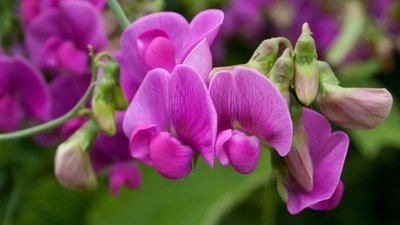
The Blending vs. Particulate Hypothesis
Early scientists believed in the blending hypothesis, where parental traits mixed in offspring, producing intermediate forms. However, this could not explain why some traits disappeared in one generation and reappeared in the next. Mendel proposed the particulate hypothesis, where traits are inherited as discrete units (now called genes) that retain their identity across generations.
Blending hypothesis: Traits mix like paint; variation should disappear over time.
Particulate hypothesis: Traits are passed as separate, unchanged units.
Traits can be hidden and re-expressed in later generations.
Useful Genetic Vocabulary
Understanding Mendel's experiments requires knowledge of key genetic terms:
Alleles: Different versions of a gene.
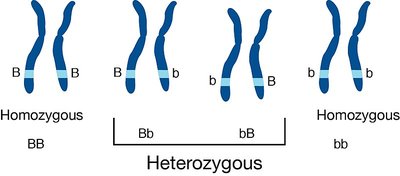
Homozygous: Two identical alleles for a gene.
Heterozygous: Two different alleles for a gene.
Genotype: The genetic makeup of an organism.
Phenotype: The observable traits of an organism.
Mendel’s Experimental Approach
Mendel’s Experiments with Pea Plants
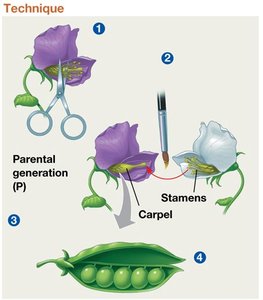
Mendel chose pea plants for their clear, contrasting traits and ability to self-fertilize. He controlled pollination by removing pollen-producing parts and manually transferring pollen from one plant to another. This allowed him to study inheritance patterns across generations.
Traits studied included flower color, seed shape, and pod color.
True-breeding plants consistently produced offspring with the same trait.
Cross-pollination enabled Mendel to observe how traits were inherited.
Results of Mendel’s Experiments
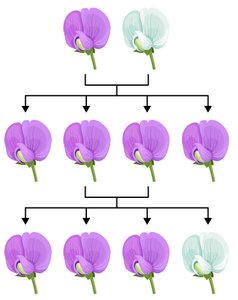
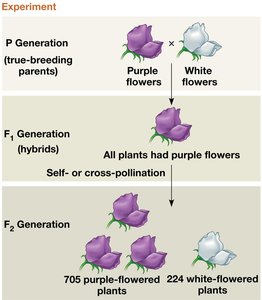
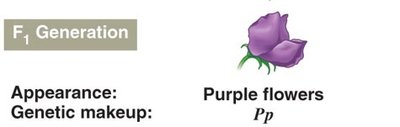
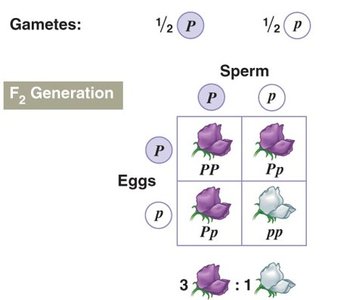
Mendel observed that crossing a purple-flowered plant with a white-flowered plant produced all purple-flowered offspring in the first generation (F₁). When these F₁ plants self-fertilized, the second generation (F₂) showed a 3:1 ratio of purple to white flowers, indicating that the white trait was not lost but masked.
Dominant traits appear in the F₁ generation.
Recessive traits reappear in the F₂ generation.
The same pattern was observed across seven different characteristics.
Summary Table: Mendel's Seven Characteristics
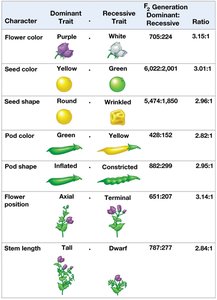
Mendel studied seven traits, each showing a dominant and recessive form. The F₂ generation consistently showed a ratio close to 3:1 for dominant to recessive traits.
Character | Dominant Trait | Recessive Trait | F₂ Generation Ratio |
|---|---|---|---|
Flower color | Purple | White | 3.15:1 |
Seed color | Yellow | Green | 3.01:1 |
Seed shape | Round | Wrinkled | 2.96:1 |
Pod color | Green | Yellow | 2.82:1 |
Pod shape | Inflated | Constricted | 2.95:1 |
Flower position | Axial | Terminal | 3.14:1 |
Stem length | Tall | Dwarf | 2.84:1 |
Genetic Mechanisms and Tools
How Alleles Affect Traits
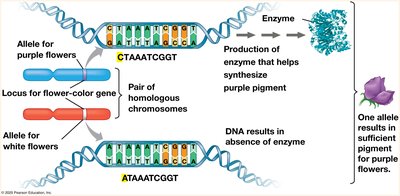
Alleles are different versions of a gene that determine traits. For flower color, the purple allele (P) produces pigment, while the white allele (p) does not. One P allele is sufficient for purple flowers, so both PP and Pp genotypes result in purple flowers, while pp results in white flowers.
Alleles segregate during meiosis, so each gamete receives one allele.
At fertilization, alleles combine to form the offspring's genotype.
The Punnett Square
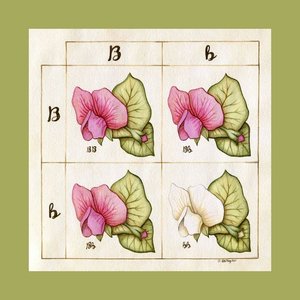
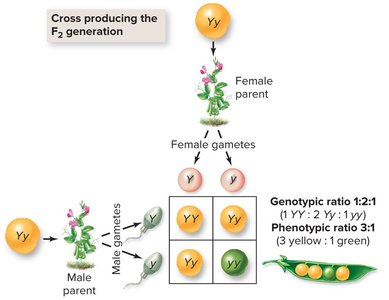
The Punnett square is a tool used to predict the outcome of genetic crosses. It shows all possible combinations of parental alleles and their probabilities.
Uppercase letters represent dominant alleles; lowercase represent recessive.
Each box shows a possible genotype for the offspring.
Proportions indicate the probability of each genotype and phenotype.
Mendelian Inheritance in Humans
Dominant and Recessive Inheritance
Some human traits are determined by a single gene and show dominant or recessive inheritance. Dominant traits require only one copy of the allele, while recessive traits require two.
Dominant example: Huntington disease
Recessive example: Cystic fibrosis
Huntington’s Disease
Huntington’s disease is caused by a dominant mutation in the HTT gene. One altered copy is sufficient to cause the disease, which leads to progressive neurological symptoms.
Each person has two copies of the HTT gene.
One disease-causing copy results in Huntington’s disease.
Each child of an affected parent has a 50% chance of inheriting the mutation.
Cystic Fibrosis
Cystic fibrosis is caused by mutations in the CFTR gene. Two disease-causing copies are required for the disorder to appear; carriers have one functional and one mutated copy and usually do not show symptoms.
Thick mucus buildup affects lungs and digestive system.
Carriers do not have the disease but can pass the allele to offspring.
Alternatives to Simple Mendelian Patterns
Incomplete Dominance
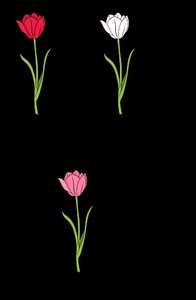
In incomplete dominance, neither allele is completely dominant. The heterozygote shows an intermediate phenotype, but parental traits can reappear in later generations.
Example: Snapdragons—red (CᴿCᴿ) × white (CᵂCᵂ) produces pink (CᴿCᵂ) in F₁.
F₂ generation shows a 1:2:1 ratio of red:pink:white.
Codominance
In codominance, both alleles are fully expressed in the heterozygote. Traits do not blend; both appear side by side.
Example: Roan cattle—red and white hairs are both visible.
Human ABO blood group—Type AB expresses both A and B antigens.
Multiple Alleles
Some genes have more than two alleles in the population, increasing genetic diversity and possible phenotypes. Each individual still inherits only two alleles.
Example: ABO blood group—A, B, and O alleles.
Pleiotropy
Pleiotropy occurs when one gene influences multiple traits. This is often due to the gene’s protein having roles in different parts of the body.
Example: Marfan syndrome—mutation in FBN1 gene affects connective tissue throughout the body.
Nature and Nurture: Gene–Environment Interactions
Multifactorial Traits
Most traits are influenced by both genes and the environment. These are called multifactorial traits. Environmental factors can enhance, reduce, or change genetic expression.
Examples: Hydrangea flower color (soil pH), human height (nutrition), skin pigmentation (sun exposure).
Gene–environment interactions explain variation in disease risk and expression among individuals.
Summary
Mendel’s work established the principles of inheritance, including the concepts of dominant and recessive traits, segregation of alleles, and predictable ratios in offspring. Modern genetics recognizes additional patterns such as incomplete dominance, codominance, multiple alleles, pleiotropy, and the influence of environmental factors.
