 Back
Mendel and the Gene: Foundations of Classical Genetics
Study Guide - Smart Notes
 Tailored notes based on your materials, expanded with key definitions, examples, and context.
Mendel and the Gene Idea
Introduction to Inheritance
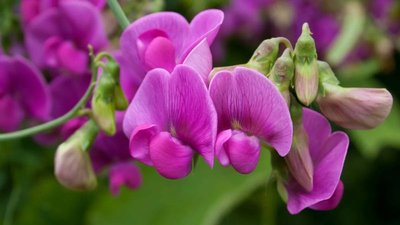
Inheritance is the process by which traits are passed from parents to offspring. Early observations noted that offspring often resemble their parents in appearance and behavior, but the mechanism was not understood until the work of Gregor Mendel in the mid-1800s, which established the foundation for modern genetics.
Inherited traits are characteristics passed from one generation to the next.
Examples include height, color, and shape in plants and animals.
Mendel’s experiments with pea plants revealed the basic principles of inheritance.
Early Theories of Inheritance
Before Mendel, the Blending Hypothesis suggested that parental traits mixed in offspring, much like blending paints. This theory could not explain the reappearance of traits after they seemed to vanish in one generation.
Blending would eliminate variation over generations.
Some traits reappear after skipping a generation, indicating traits are not lost but hidden.
Traits must be passed as separate, unchanged units.
The Particulate Hypothesis
Mendel proposed that traits are inherited as discrete units, later called genes. Each parent contributes one unit for every trait, and these units retain their identity across generations. This became known as the Particulate Hypothesis of Inheritance.
Genes are inherited as distinct units.
Each parent provides one gene for each trait.
Genes do not blend but combine in offspring.
Genetic Vocabulary
Key Terms
Understanding genetics requires familiarity with several key terms:
Alleles: Different versions of a gene.
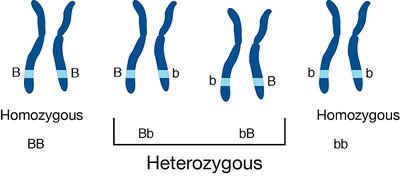
Homozygous: Two identical alleles for a gene.
Heterozygous: Two different alleles for a gene.
Genotype: The genetic makeup of an organism.
Phenotype: The visible or measurable expression of the genotype.
Mendel’s Experimental Approach
Pea Plant Experiments
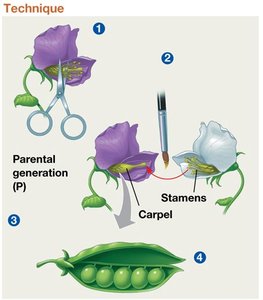
Mendel chose pea plants for their clear, contrasting traits and ability to self-fertilize or be cross-fertilized. He removed pollen-producing parts to prevent self-fertilization and manually transferred pollen from one plant to another.
Studied traits with two distinct forms (e.g., purple vs. white flowers).
Controlled pollination to track inheritance.
Observed offspring over several generations.
Results of Mendel’s Flower-Color Experiment
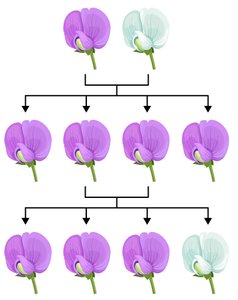
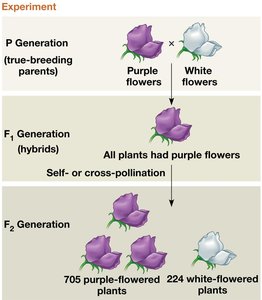
Mendel began with true-breeding plants and crossed purple-flowered with white-flowered plants. All F₁ offspring had purple flowers. When F₁ plants self-fertilized, the F₂ generation showed a 3:1 ratio of purple to white flowers, demonstrating that the white trait was not lost but masked.
Parental (P) generation: purple × white.
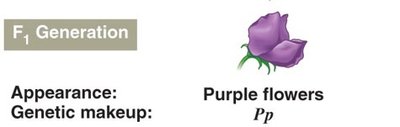
F₁ generation: all purple.
F₂ generation: 3 purple : 1 white.
Patterns Across Multiple Traits
Mendel repeated his experiments with other traits, such as seed shape and pod color, and found similar inheritance patterns. The dominant trait appeared in the F₁ generation, while both traits appeared in the F₂ generation in a 3:1 ratio.
Dominant trait: visible in F₁ generation.
Recessive trait: masked in F₁, reappears in F₂.
Consistent ratios across seven characteristics.
Character | Dominant Trait | Recessive Trait | F₂ Ratio |
|---|---|---|---|
Flower color | Purple | White | 3.15:1 |
Seed color | Yellow | Green | 3.01:1 |
Seed shape | Round | Wrinkled | 2.96:1 |
Pod color | Green | Yellow | 2.82:1 |
Pod shape | Inflated | Constricted | 2.95:1 |
Flower position | Axial | Terminal | 3.14:1 |
Stem length | Tall | Dwarf | 2.84:1 |
How Alleles Affect Traits
Alleles and Flower Color
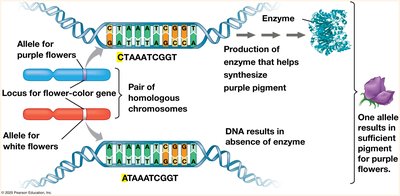
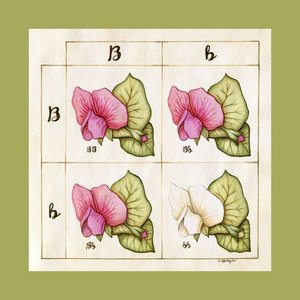
The purple-flower allele (P) produces pigment, while the white-flower allele (p) does not. One P allele is sufficient for purple flowers, so both PP and Pp genotypes result in purple flowers, while pp results in white flowers.
PP and Pp: purple flowers.
pp: white flowers.
p allele is masked in Pp plants.
Allele Segregation and Gamete Formation
During meiosis, alleles segregate so each gamete receives one allele. Fertilization combines alleles from each parent, forming the offspring’s genotype. A Punnett square illustrates possible combinations and their probabilities.
Pp plant produces gametes with P or p alleles.
Fertilization results in PP, Pp, or pp offspring.
Punnett square shows expected ratios.
Punnett Square Example: Seed Color
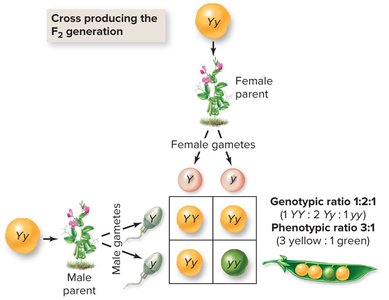
When both parents are heterozygous (Yy) for seed color, the Punnett square predicts a 1:2:1 genotypic ratio and a 3:1 phenotypic ratio.
Genotypic ratio: 1 YY : 2 Yy : 1 yy.
Phenotypic ratio: 3 yellow : 1 green.
Mendelian Inheritance in Humans
Dominant and Recessive Traits
Some human traits are determined by a single gene and show dominant or recessive inheritance. Dominant traits require only one allele for expression, while recessive traits require two.
Dominant: Huntington disease (mutation in HTT gene).
Recessive: Cystic fibrosis (mutation in CFTR gene).
Huntington’s Disease
Huntington’s disease is caused by a dominant mutation in the HTT gene, leading to toxic protein buildup in brain cells. One disease-causing copy is sufficient for the disorder.
Symptoms: uncontrolled movements, mood changes, cognitive decline.
Inheritance: 50% chance if one parent is affected.
Cystic Fibrosis
Cystic fibrosis is caused by recessive mutations in the CFTR gene, resulting in thick mucus buildup and respiratory/digestive issues. Two disease-causing alleles are required for the disorder.
Carriers have one functional and one mutated allele, usually without symptoms.
Inheritance: both parents must carry the mutated allele for offspring to be affected.
Alternatives to Simple Mendelian Patterns
Incomplete Dominance
In incomplete dominance, neither allele is completely dominant. The heterozygote shows an intermediate phenotype, but parental traits can reappear in later generations.
Example: Snapdragons – Red (CᴿCᴿ) × White (CᵂCᵂ) → Pink (CᴿCᵂ).
F₂ generation: 1 Red : 2 Pink : 1 White.
Codominance
In codominance, both alleles are fully expressed in the heterozygote, resulting in a phenotype that shows both traits side by side.
Example: Roan cattle – both red and white hairs are visible.
Human ABO blood group: IᴬIᴮ individuals express both A and B antigens (Type AB blood).
Multiple Alleles
Some genes have more than two alleles in the population, increasing genetic diversity and possible phenotypes. Each individual still inherits only two alleles.
Example: ABO blood group – alleles Iᴬ, Iᴮ, and i.
Type A: IᴬIᴬ or Iᴬi; Type B: IᴮIᴮ or Iᴮi; Type AB: IᴬIᴮ; Type O: ii.
Pleiotropy
Pleiotropy occurs when one gene influences multiple traits, often because the gene’s protein has roles in different parts of the body.
Example: Marfan syndrome – FBN1 gene affects connective tissue, leading to multiple symptoms.
Gene–Environment Interactions
Nature and Nurture
The environment can affect how genes are expressed, resulting in multifactorial traits. Genes set the biological potential, but environment and lifestyle determine how that potential is expressed.
Examples: Hydrangea flower color (soil pH), human height (nutrition), skin pigmentation (sun exposure).
Health conditions like heart disease and diabetes are influenced by both genetics and environment.
Summary Table: Mendelian and Non-Mendelian Inheritance
Pattern | Description | Example |
|---|---|---|
Mendelian (dominant/recessive) | One allele masks the other | Flower color in peas, Huntington disease |
Incomplete dominance | Heterozygote shows intermediate phenotype | Snapdragon flower color |
Codominance | Both alleles fully expressed | ABO blood group, roan cattle |
Multiple alleles | More than two alleles in population | ABO blood group |
Pleiotropy | One gene affects multiple traits | Marfan syndrome |
Gene–environment interaction | Environment modifies gene expression | Hydrangea color, human height |
Additional info: These notes expand on the original lecture content by providing definitions, examples, and tables for clarity. All images included are directly relevant to the explanation of Mendelian genetics and inheritance patterns.
