 Back
BackMendel and the Gene Idea: Foundations of Classical Genetics
Study Guide - Smart Notes
 Tailored notes based on your materials, expanded with key definitions, examples, and context.
Mendel and the Gene Idea
Introduction to Mendelian Genetics
Gregor Mendel's experiments with garden peas established the basic principles of heredity, forming the foundation of classical genetics. By analyzing patterns of inheritance, Mendel identified key laws that explain how traits are transmitted from one generation to the next.
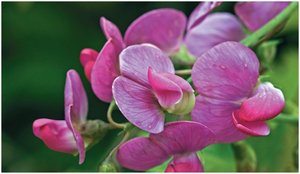
Concept 14.1: Mendel’s Experimental Approach and Laws of Inheritance
Mendel’s Experimental Design
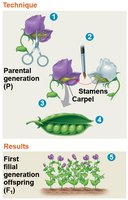
Mendel used garden peas as a model organism due to their many varieties and easily observable traits. He tracked characters with two distinct forms and began with true-breeding varieties, which consistently produce offspring identical to themselves when self-pollinated.
Character: A heritable feature that varies among individuals (e.g., flower color).
Trait: Each variant for a character (e.g., purple or white flowers).
Hybridization: Mating two contrasting, true-breeding varieties.
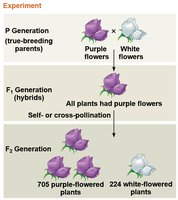
P Generation: Parental generation (true-breeding parents).
F1 Generation: First filial generation, hybrid offspring of the P generation.
F2 Generation: Offspring resulting from self- or cross-pollination of F1 individuals.
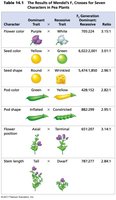
Results of Mendel’s Crosses
Mendel observed consistent ratios in the F2 generation for several characters, leading to the formulation of his laws.
Character | Dominant Trait | Recessive Trait | F2 Ratio |
|---|---|---|---|
Flower color | Purple | White | 3:1 |
Seed shape | Round | Wrinkled | 2.96:1 |
Seed color | Yellow | Green | 2.82:1 |
Pod shape | Inflated | Constricted | 2.95:1 |
Pod color | Green | Yellow | 3.01:1 |
Flower position | Axial | Terminal | 3.14:1 |
Stem length | Tall | Dwarf | 2.84:1 |
Mendel’s Model of Inheritance
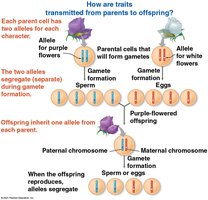
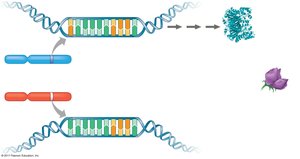
Alleles: Alternative versions of a gene that account for variations in inherited characters. Each gene is located at a specific locus on a chromosome.
Diploid Inheritance: Each organism inherits two alleles for each gene, one from each parent.
Dominant and Recessive Alleles: If two alleles differ, the dominant allele determines the organism’s appearance, while the recessive allele has no noticeable effect.
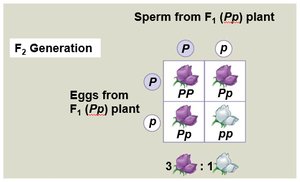
Law of Segregation: The two alleles for a heritable character segregate during gamete formation and end up in different gametes.
Punnett Squares and Genetic Ratios
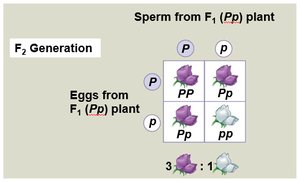
Punnett squares are used to predict the possible combinations of alleles in offspring. A capital letter represents a dominant allele, and a lowercase letter represents a recessive allele.
Genetic Vocabulary
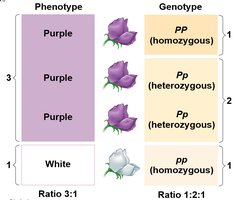
Phenotype: The observable physical or biochemical characteristics of an organism.
Genotype: The genetic makeup, or combination of alleles, for a given gene.
The Testcross
A testcross is used to determine the genotype of an individual with a dominant phenotype by crossing it with a homozygous recessive individual. If any offspring display the recessive phenotype, the unknown parent must be heterozygous.
The Law of Independent Assortment
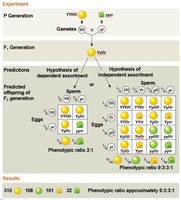
Mendel’s law of independent assortment states that each pair of alleles segregates independently of other pairs during gamete formation. This law applies to genes on different chromosomes or those far apart on the same chromosome.
Concept 14.3: Complex Patterns of Inheritance
Degrees of Dominance
Complete Dominance: The phenotype of the heterozygote is identical to that of the dominant homozygote.
Incomplete Dominance: The phenotype of F1 hybrids is intermediate between the two parental varieties.
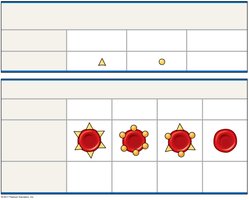
Codominance: Both alleles affect the phenotype in separate, distinguishable ways.
Multiple Alleles and Codominance
Some genes have more than two alleles in the population. The ABO blood group system in humans is an example, with three alleles (IA, IB, i) producing four phenotypes (A, B, AB, O).
Pleiotropy
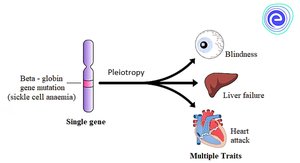
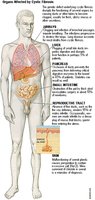
Pleiotropy occurs when one gene influences multiple phenotypic traits. For example, the gene responsible for sickle-cell disease affects multiple organ systems.
Epistasis
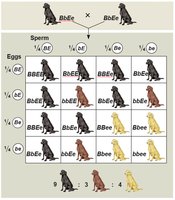
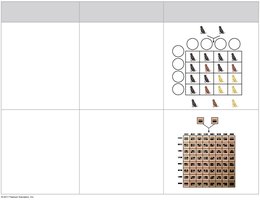
Epistasis is the phenomenon where the expression of one gene affects the expression of another gene. For example, in Labrador retrievers, one gene determines pigment color, while another gene determines whether pigment is deposited in the fur.
Polygenic Inheritance
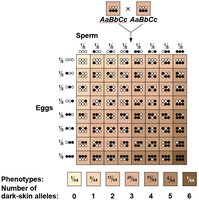
Polygenic inheritance occurs when two or more genes have an additive effect on a single phenotype, resulting in continuous variation. Human skin color and height are classic examples.
Concept 14.4: Human Mendelian Genetics
Recessively Inherited Disorders
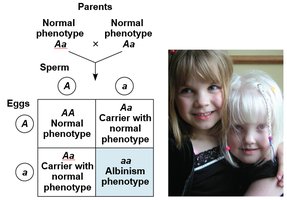
Recessive disorders only appear in individuals who are homozygous for the recessive allele. Heterozygotes are carriers but do not show symptoms. Albinism is an example of a recessive disorder.
Dominantly Inherited Disorders
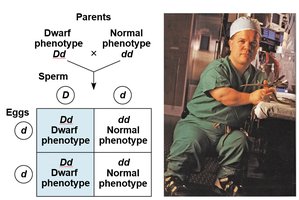
Some disorders are caused by dominant alleles. These are less common, especially if they are lethal. Achondroplasia (a form of dwarfism) and Huntington’s disease are examples. Huntington’s disease has a late onset, so it can be passed on before symptoms appear.
Summary Tables: Relationships Among Genes
Relationship | Description | Example |
|---|---|---|
Complete dominance | Heterozygote phenotype same as homozygous dominant | PP, Pp (purple flowers) |
Incomplete dominance | Heterozygote phenotype intermediate | CRCW (pink flowers) |
Codominance | Both phenotypes expressed in heterozygotes | IAIB (AB blood group) |
Multiple alleles | More than two alleles in the population | ABO blood group |
Pleiotropy | One gene affects multiple traits | Sickle-cell disease |
Additional info: Mendel’s principles remain the foundation of modern genetics, though many traits are influenced by more complex patterns of inheritance, including gene interactions and environmental effects.
