 Back
BackMendel and the Gene Idea: Foundations of Classical Genetics
Study Guide - Smart Notes
 Tailored notes based on your materials, expanded with key definitions, examples, and context.
Chapter 11: Mendel and the Gene Idea
Introduction to Mendelian Genetics
Mendelian genetics forms the basis of classical genetics, describing how traits are inherited from one generation to the next. Gregor Mendel's experiments with pea plants led to the discovery of fundamental laws governing inheritance, which remain central to our understanding of heredity.
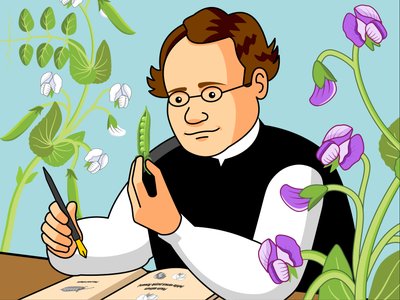
Gregor Mendel: The Founder of Genetics
Background: Mendel was born in 1822 and began his groundbreaking studies on pea plants in 1856.
Methodology: He kept meticulous records and used quantitative data to analyze inheritance patterns.
Contribution: Mendel proposed natural laws that govern inheritance, laying the foundation for modern genetics.
Competing Hypotheses of Inheritance
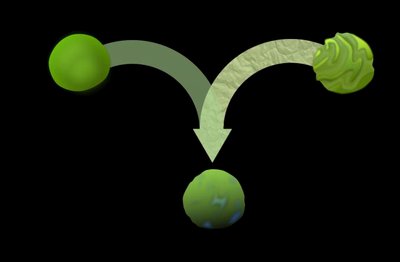
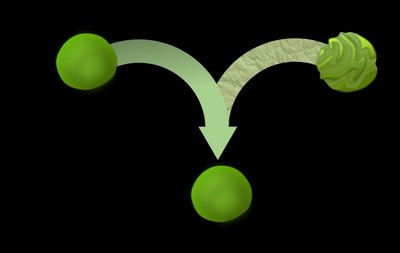
Blending Hypothesis: Genetic material from two parents blends together in offspring.
Particulate Hypothesis: Genetic material is passed on as discrete heritable units (genes).
Mendel's experiments supported the particulate hypothesis, demonstrating that traits are inherited as distinct units.
Why Pea Plants?
Easy to grow and maintain.
True-breeding strains available (consistent phenotype over generations).
Controlled matings possible (self- or cross-fertilization).
Short generation time (one season to maturity).
Observable heritable features with two distinct forms (traits).
Mendel's Experimental Technique
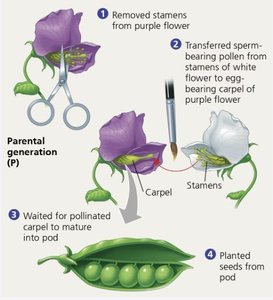
Mendel performed controlled crosses between true-breeding plants, tracking the inheritance of specific traits across generations.
Results of Mendel's Experiments
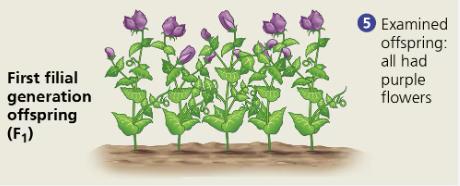
Crossing true-breeding purple and white flowered plants produced all purple F1 offspring.
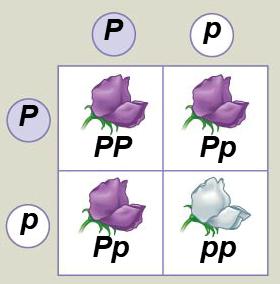
Self-pollination of F1 hybrids yielded a 3:1 ratio of purple to white flowers in the F2 generation.
This pattern was consistent across multiple traits, revealing dominant and recessive relationships.
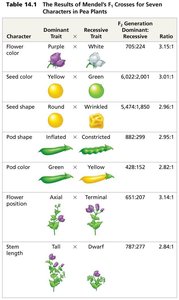
Table: Mendel's F2 Crosses for Seven Characters in Pea Plants
Character | Dominant Trait | Recessive Trait | F2 Generation Ratio |
|---|---|---|---|
Flower color | Purple | White | 3.15:1 |
Seed color | Yellow | Green | 3.01:1 |
Seed shape | Round | Wrinkled | 2.96:1 |
Pod shape | Inflated | Constricted | 2.95:1 |
Pod color | Green | Yellow | 3.14:1 |
Flower position | Axial | Terminal | 3.14:1 |
Stem length | Tall | Dwarf | 2.84:1 |
Mendel's Explanation: The Gene Concept
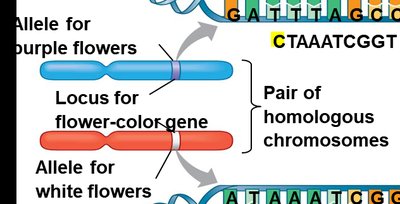
Gene: A heritable factor that determines a character.
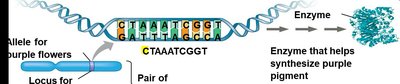
Allele: Alternative versions of a gene that account for variations in inherited characters.
Locus: The specific location of a gene on a chromosome.
Each organism inherits two alleles for each gene, one from each parent.
If alleles differ, the dominant allele determines appearance; the recessive allele is masked.

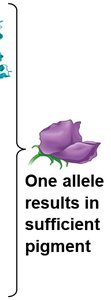
Dominant vs. Recessive Alleles
Dominant allele: Expressed in the phenotype even if only one copy is present.
Recessive allele: Expressed only when two copies are present (homozygous).
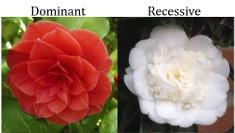
Mendel's Laws of Inheritance
Law of Segregation
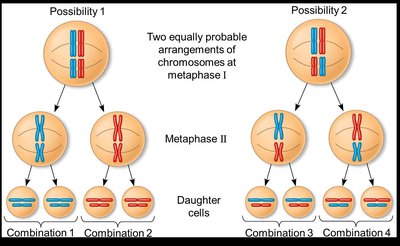
The two alleles for a heritable character separate (segregate) during gamete formation and end up in different gametes. Thus, each gamete carries only one allele for each gene.
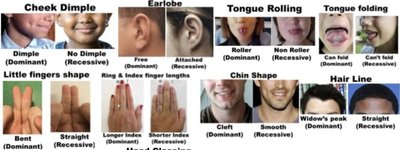
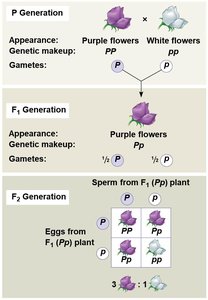
Genetic Vocabulary
Homozygous: Two identical alleles for a gene (e.g., PP or pp).
Heterozygous: Two different alleles for a gene (e.g., Pp).
Genotype: The genetic makeup of an organism.
Phenotype: The observable traits of an organism, including physical appearance and physiology.
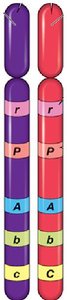
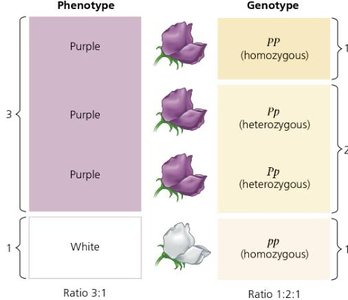
Testcross: Determining Unknown Genotypes
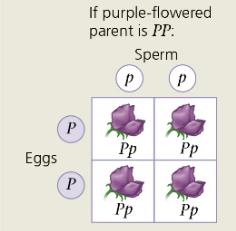
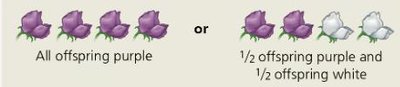
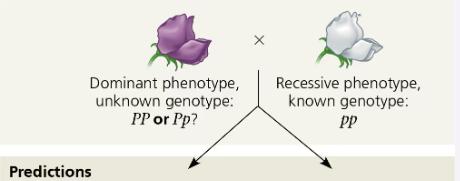
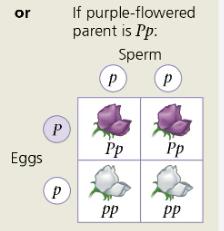
A testcross involves crossing an individual with a dominant phenotype (but unknown genotype) with a homozygous recessive individual. The offspring phenotypes reveal the unknown genotype.
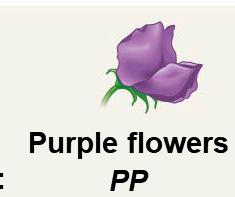
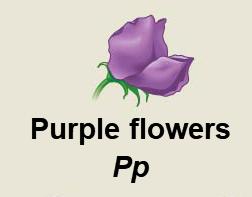

Law of Independent Assortment
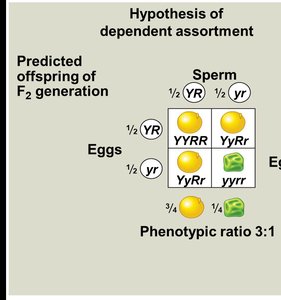
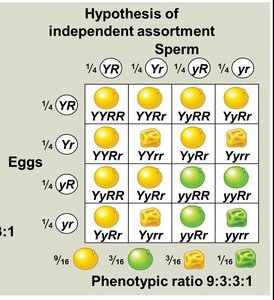
Allele pairs segregate independently of other pairs during gamete formation. This law applies to genes on different, non-homologous chromosomes or those far apart on the same chromosome. Genes located near each other on the same chromosome tend to be inherited together.

Probability in Genetics
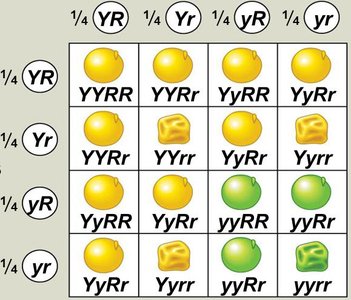
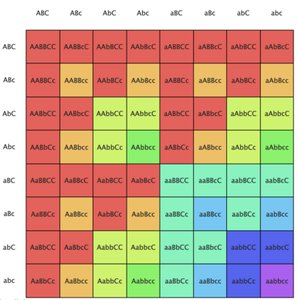
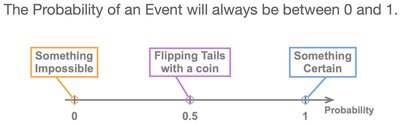
Punnett squares are used to calculate phenotypic ratios, but probability laws simplify calculations for complex crosses.
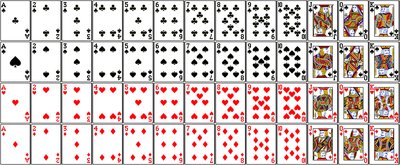
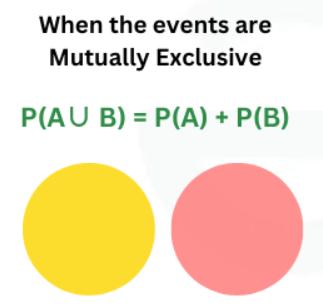
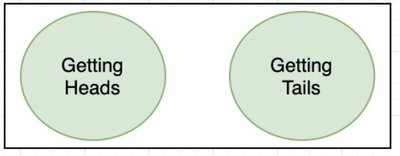
Addition Rule: Probability that one of two mutually exclusive events will occur is the sum of their individual probabilities.
Multiplication Rule: Probability that two independent events will occur together is the product of their individual probabilities.
Applying Probability to Genetic Crosses
For monohybrid crosses, the probability of each genotype can be calculated using the multiplication and addition rules.
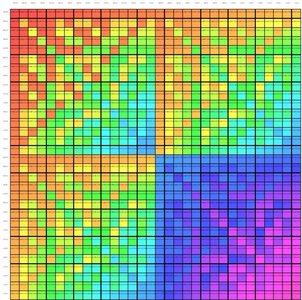
For dihybrid and trihybrid crosses, calculate the probability for each gene independently, then multiply the probabilities.
Example: Probability of YYRR in a dihybrid cross =
Importance of Sample Size
The larger the sample size in genetic experiments, the closer the observed results will be to the predicted ratios. Mendel's careful counting of thousands of offspring was crucial for validating his laws of inheritance.
Summary Table: Key Terms and Concepts
Term | Definition |
|---|---|
Gene | Heritable factor that determines a character |
Allele | Alternative version of a gene |
Locus | Location of a gene on a chromosome |
Homozygous | Two identical alleles for a gene |
Heterozygous | Two different alleles for a gene |
Genotype | Genetic makeup of an organism |
Phenotype | Observable traits of an organism |
Dominant | Allele that determines phenotype when present |
Recessive | Allele masked by dominant allele |
Conclusion
Mendel's principles of segregation and independent assortment, along with the use of probability, provide the foundation for understanding inheritance patterns. These concepts are essential for solving genetics problems and predicting the outcomes of genetic crosses.
