 Back
BackMendel and the Gene Idea: Foundations of Classical Genetics
Study Guide - Smart Notes
 Tailored notes based on your materials, expanded with key definitions, examples, and context.
Mendel and the Gene Idea
Introduction to Mendelian Genetics
Gregor Mendel, known as the "Father of Genetics," discovered the fundamental principles of heredity through experiments with garden pea plants. His work established the basis for classical genetics, demonstrating how traits are inherited from one generation to the next through discrete units called genes.
Mendel's Experimental Approach
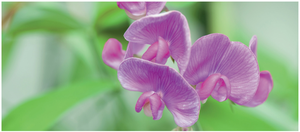
Choice of Organism: Mendel selected pea plants (Pisum sativum) due to their many varieties with distinct heritable features (characters), such as flower color, seed shape, and pod color. Each character had easily distinguishable variants, called traits.
Controlled Mating: Pea plants allowed Mendel to strictly control pollination, ensuring accurate tracking of inheritance patterns.
True-Breeding Varieties: Mendel used plants that, when self-pollinated, consistently produced offspring identical to themselves for a given trait (true-breeding).
Focus on Clear Contrasts: He tracked only characters that appeared in two distinct alternative forms (e.g., purple vs. white flowers).
Hybridization and Generations
In his experiments, Mendel crossed two contrasting, true-breeding varieties—a process called hybridization:
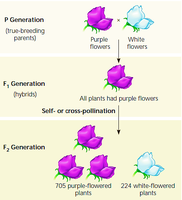
P Generation: The true-breeding parent plants.
F1 Generation: The first filial generation, consisting of hybrid offspring from the P generation cross.
F2 Generation: Produced when F1 individuals self-pollinate or cross-pollinate with other F1 hybrids.
The Law of Segregation
Mendel observed that when he crossed true-breeding purple-flowered and white-flowered plants, all F1 hybrids had purple flowers. However, self-pollination of F1 plants produced F2 offspring in a consistent ratio of approximately 3 purple-flowered plants to 1 white-flowered plant. This led to the formulation of the Law of Segregation:
Each individual has two alleles for each gene, which segregate (separate) during gamete formation.
Each gamete carries only one allele for each gene.
Fertilization restores the pair of alleles in the offspring.
Example: In the F2 generation, the 3:1 ratio of purple to white flowers demonstrates segregation of the flower color gene.
Mendel's Model of Inheritance
Mendel's model explained the patterns he observed:
Alternative versions of genes (alleles) account for variations in inherited characters.
For each character, an organism inherits two alleles, one from each parent.
If the two alleles differ, the dominant allele determines the organism's appearance; the recessive allele has no noticeable effect.
The two alleles for a heritable character segregate during gamete formation.
Genetic Vocabulary
Gene: A unit of heredity that encodes information for a specific trait.
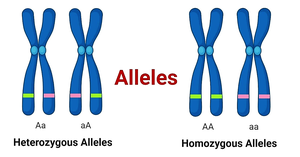
Allele: Alternative forms of a gene (e.g., purple vs. white flower color).
Homozygous: Having two identical alleles for a gene (e.g., PP or pp).
Heterozygous: Having two different alleles for a gene (e.g., Pp).
Dominant allele: Expressed in the phenotype even if only one copy is present.
Recessive allele: Expressed only when two copies are present.
Phenotype: Observable traits of an organism.
Genotype: Genetic makeup of an organism (combination of alleles).
Testcross
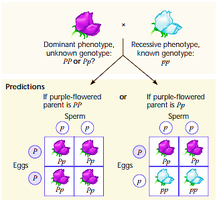
A testcross is used to determine the genotype of an individual with a dominant phenotype. By crossing this individual with a homozygous recessive plant, the resulting offspring phenotypes reveal whether the unknown genotype is homozygous dominant or heterozygous.
Results of Mendel's F1 Crosses for Seven Characters
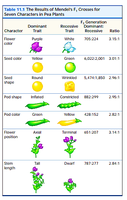
Mendel studied seven different characters in pea plants, each with two contrasting traits. The results consistently showed a 3:1 ratio of dominant to recessive traits in the F2 generation.
Character | Dominant Trait | Recessive Trait | F2 Generation Dominant:Recessive Ratio |
|---|---|---|---|
Flower color | Purple | White | 3.15 : 1 |
Seed color | Yellow | Green | 2.96 : 1 |
Seed shape | Round | Wrinkled | 2.96 : 1 |
Pod shape | Inflated | Constricted | 2.95 : 1 |
Pod color | Green | Yellow | 3.14 : 1 |
Flower position | Axial | Terminal | 3.14 : 1 |
Stem length | Tall | Dwarf | 2.84 : 1 |
Summary of Mendel's Contributions
Mendel's experiments established the concept of genes as discrete units of inheritance.
His laws of segregation and dominance form the foundation of classical genetics.
The 3:1 ratio observed in the F2 generation is a hallmark of single-gene inheritance with complete dominance.
Additional info: Mendel's work was not widely recognized until decades after his death, but it now underpins modern genetics and our understanding of heredity.
