 Back
Mendel and the Gene Idea: Foundations of Classical Genetics
Study Guide - Smart Notes
 Tailored notes based on your materials, expanded with key definitions, examples, and context.
Chapter 14: Mendel and the Gene Idea
Introduction to Mendelian Genetics
Mendelian genetics forms the basis of our understanding of heredity and inheritance. Gregor Mendel's experiments with garden peas in the mid-1800s led to the discovery of fundamental principles that explain how traits are passed from parents to offspring.
Principles of Natural Selection and Heredity
Darwin’s Observations and Inferences
Observation 1: Individuals in a population vary in their heritable characteristics.
Observation 2: Organisms produce more offspring than the environment can support.
Inference 1: Individuals well-suited to their environment tend to leave more offspring than others.
Inference 2: Over time, favorable traits accumulate in the population.
Natural selection depends on variability in heritable traits within a population.
Foundations of Modern Genetics
Pre-Mendelian Theories of Heredity
Before Mendel, the prevailing theory was the "blending" hypothesis, which suggested that parental traits mix in offspring. Mendel's experiments disproved this, showing that traits are inherited as discrete units.
Mendel’s Experimental Approach
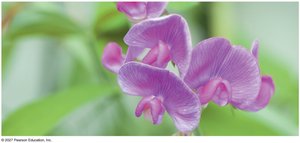
Mendel used garden peas (Pisum sativum) for his experiments due to their variety, short generation time, and controlled mating capabilities. He focused on characters with two distinct traits, such as flower color (purple or white).
Character: A heritable feature that varies among individuals (e.g., flower color).
Trait: Each variant for a character (e.g., purple or white flowers).
Advantages of Using Peas
Short generation time
Large numbers of offspring
Controlled mating (self-pollination or cross-pollination)
True-Breeding and Hybridization
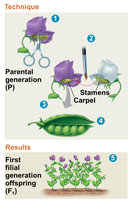
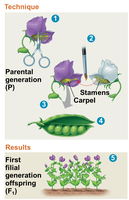
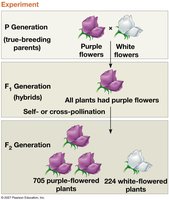
Mendel started with true-breeding plants (offspring identical to parents when self-pollinated). He crossed contrasting true-breeding varieties, a process called hybridization:
P generation: True-breeding parents
F1 generation: Hybrid offspring of the P generation
F2 generation: Offspring from self- or cross-pollination of F1 hybrids
Mendel’s Results and the Refutation of the Blending Hypothesis
When Mendel crossed purple and white-flowered plants, all F1 hybrids were purple. In the F2 generation, the white-flower trait reappeared, disproving the blending hypothesis. Mendel consistently observed a 3:1 ratio of purple to white flowers in the F2 generation.
Mendel’s Model of Inheritance
Key Concepts of Mendel’s Model
Alternative Versions of Genes (Alleles): Genes can exist in different forms called alleles. For example, the gene for flower color in peas has two alleles: one for purple and one for white.
Inheritance of Alleles: Each organism inherits two alleles for each gene, one from each parent. These alleles remain separate and do not blend.
Dominant and Recessive Alleles: If two alleles differ, the dominant allele determines the organism’s appearance, while the recessive allele has no noticeable effect but can be passed to offspring. Conventionally, dominant alleles are represented by uppercase letters (e.g., P for purple), and recessive alleles by lowercase (e.g., p for white).
Law of Segregation: The two alleles for a heritable character segregate during gamete formation, so each gamete carries only one allele for each gene.
Punnett Square and the 3:1 Ratio
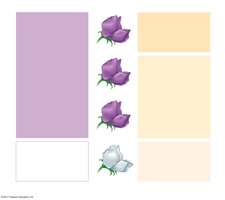
Mendel’s model explains the 3:1 ratio observed in the F2 generation. The Punnett square illustrates how alleles segregate and combine during fertilization:
Parent Genotype | Gametes | F1 Genotype |
|---|---|---|
PP (purple) | P | |
pp (white) | p | |
F1 Generation: All Pp (purple) | ||
F1 Gametes | P | p |
|---|---|---|
P | PP | Pp |
p | Pp | pp |
Resulting phenotypic ratio: 3 purple : 1 white | Genotype ratio: 1 PP : 2 Pp : 1 pp
Genetic Vocabulary
Key Terms
Homozygote: An organism with two identical alleles for a gene (e.g., PP or pp).
Heterozygote: An organism with two different alleles for a gene (e.g., Pp).
Phenotype: The physical appearance or observable trait (e.g., purple flowers).
Genotype: The genetic makeup or allele combination (e.g., PP, Pp, or pp).
Diploid: Cells with two alleles for each gene (somatic cells).
Haploid: Cells with one allele for each gene (gametes).
🧬 Dominant Allele: If the two alleles for a gene differ, the dominant allele is the one that determines the organism’s appearance (phenotype). This means that even if only one dominant allele is present, its trait will be visible. For example, in pea plants, the allele for purple flowers (P) is dominant, so plants with genotypes PP or Pp will have purple flowers.
🔬 Recessive Allele: The recessive allele is masked by the dominant allele and does not affect the organism’s appearance if a dominant allele is present. However, it can still be passed to offspring. The trait associated with the recessive allele only appears if both alleles are recessive (e.g., pp for white flowers in peas).
📝 Notation: Dominant alleles are represented by uppercase letters (e.g., P), while recessive alleles are represented by lowercase letters (e.g., p).
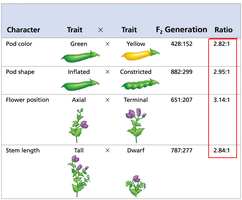
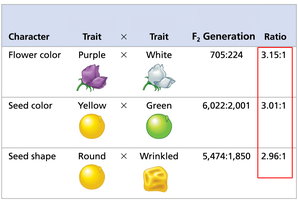
Summary Table: Mendel’s Seven Pea Plant Characters
Character | Trait | Trait | F2 Generation | Ratio |
|---|---|---|---|---|
Flower color | Purple | White | 705:224 | 3.15:1 |
Seed color | Yellow | Green | 6,022:2,001 | 3.01:1 |
Seed shape | Round | Wrinkled | 5,474:1,850 | 2.96:1 |
Pod color | Green | Yellow | 428:152 | 2.82:1 |
Pod shape | Inflated | Constricted | 882:299 | 2.95:1 |
Flower position | Axial | Terminal | 651:207 | 3.14:1 |
Stem length | Tall | Dwarf | 787:277 | 2.84:1 |
Conclusion
Mendel’s principles of heredity—based on discrete units (genes), dominance, segregation, and predictable ratios—form the foundation of classical genetics. These concepts are essential for understanding inheritance patterns in all sexually reproducing organisms.
