 Back
Mendel and the Gene Idea: Foundations of Modern Genetics
Study Guide - Smart Notes
 Tailored notes based on your materials, expanded with key definitions, examples, and context.
Chapter 14 – Mendel and the Gene Idea
Historical Perspectives on Inheritance
Before Mendel, several theories attempted to explain how traits were inherited, but these lacked experimental support and failed to explain observed patterns in offspring.
Blending Theory: Proposed that parental traits mix in offspring, resulting in intermediate characteristics. This theory could not explain the reappearance of traits after skipping generations or the persistence of variation.
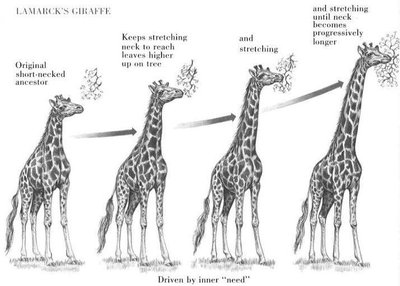
Lamarckian Inheritance: Suggested that acquired traits (e.g., a giraffe stretching its neck) could be passed to offspring. This lacked a biological mechanism and was later disproven.
Mendel’s Particulate Theory: Mendel proposed that parents pass discrete heritable units (now called genes) to offspring, which remain intact across generations. This explained the reappearance of traits and the maintenance of variation.
Gregor Mendel: The Father of Genetics
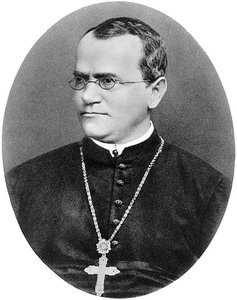
Mendel was an Austrian monk whose experiments with pea plants laid the foundation for modern genetics. He used a scientific approach, careful record-keeping, and quantitative analysis to uncover the laws of inheritance.
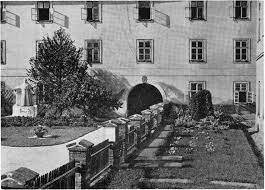
Worked at St. Thomas Abbey in Brno (now Czech Republic).
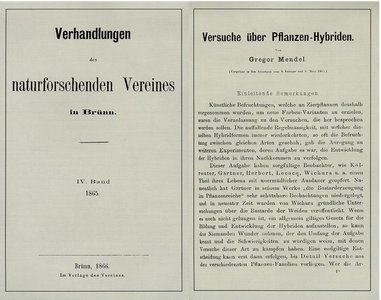
Published his findings in 1866, which were largely ignored until rediscovered in the early 20th century.
Mendel’s Experimental System: Why Peas?
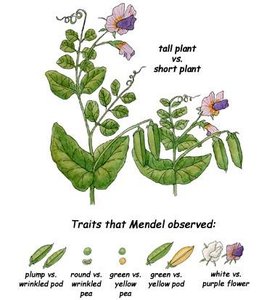
Mendel chose the garden pea (Pisum sativum) for its practical advantages and clear, easily distinguishable traits.
Short generation time and many offspring per mating.
Controlled pollination possible by hand.
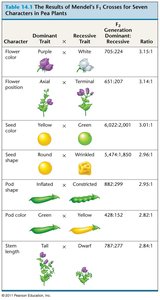
Selected seven characters, each with two distinct forms (e.g., flower color, seed shape).
Most traits were on different chromosomes, allowing independent inheritance.
Mendel’s Experimental Design and Terminology
Mendel used true-breeding parental lines and hybridization to study inheritance patterns.
P Generation: True-breeding parents.
F1 Generation: First filial generation, hybrids of P generation.
F2 Generation: Offspring of F1 self- or cross-pollination.
Character: A heritable feature (e.g., flower color).
Trait: A variant of a character (e.g., purple or white flowers).
Mendel’s Laws of Inheritance
Law of Segregation
Each individual has two alleles for each gene, which segregate during gamete formation so that each gamete receives only one allele. This explains the 3:1 ratio observed in F2 generations.
Allele: Alternative versions of a gene found at the same locus on homologous chromosomes.
Dominant allele: Determines phenotype in heterozygotes.
Recessive allele: Has no effect on phenotype in presence of dominant allele.
Punnett Square: A tool to predict genotype and phenotype ratios from a genetic cross.
Law of Independent Assortment
Alleles of different genes assort independently during gamete formation if they are on different chromosomes or far apart on the same chromosome. This leads to new combinations of traits in offspring.
Monohybrid cross: Cross between individuals heterozygous for one character.
Dihybrid cross: Cross between individuals heterozygous for two characters, producing a 9:3:3:1 phenotypic ratio in F2 generation if genes assort independently.
Probability in Genetics
Multiplication Rule: Probability of two independent events both occurring is the product of their individual probabilities.
Addition Rule: Probability of either of two mutually exclusive events occurring is the sum of their individual probabilities.
Extending Mendelian Genetics
Many inheritance patterns are more complex than Mendel’s simple dominant-recessive model.
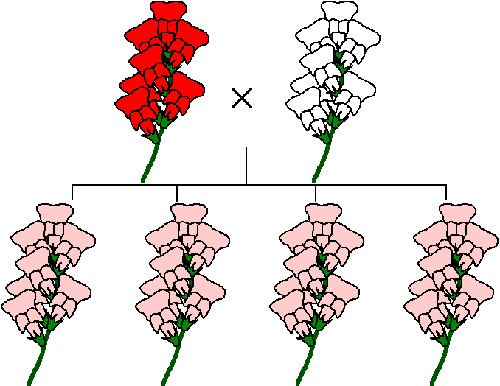
Incomplete Dominance: Heterozygotes show an intermediate phenotype (e.g., red x white flowers produce pink offspring).
Codominance: Both alleles are fully expressed in heterozygotes (e.g., AB blood type).
Multiple Alleles: More than two alleles exist for some genes (e.g., ABO blood group).
Pleiotropy: One gene affects multiple traits (e.g., sickle cell anemia).
Epistasis: One gene affects the expression of another gene (e.g., coat color in Labrador retrievers).
Polygenic Inheritance: Multiple genes contribute additively to a single trait (e.g., human skin color, height).
Nature and Nurture: Environmental Effects
Phenotype can be influenced by both genotype and environment. Traits affected by multiple genes and environmental factors are called multifactorial (e.g., heart disease, diabetes).
Human Genetics and Pedigree Analysis
Humans are not ideal for controlled genetic experiments, but inheritance patterns can be studied using pedigrees—family trees that track traits across generations.
Recessive Disorders: Only appear in homozygous individuals; carriers are heterozygous and phenotypically normal (e.g., cystic fibrosis, sickle cell anemia, PKU).
Dominant Disorders: Can appear in heterozygotes (e.g., Huntington’s disease, achondroplasia).
Genetic Testing: Includes carrier screening, prenatal testing (amniocentesis, chorionic villus sampling), and predictive testing for adult-onset disorders.
Summary Table: Mendel’s Seven Characters in Pea Plants
Character | Dominant Trait | Recessive Trait | F2 Ratio (Dominant:Recessive) |
|---|---|---|---|
Flower color | Purple | White | 3.15:1 |
Seed color | Yellow | Green | 3.01:1 |
Seed shape | Round | Wrinkled | 2.96:1 |
Pod shape | Inflated | Constricted | 2.95:1 |
Pod color | Green | Yellow | 2.82:1 |
Flower position | Axial | Terminal | 3.14:1 |
Stem length | Tall | Dwarf | 2.84:1 |
Key Equations
Probability of two independent events (A and B):
Probability of either event A or B occurring:
Glossary
Gene: A unit of heredity that encodes information for a specific trait.
Allele: Different forms of a gene.
Genotype: The genetic makeup of an organism.
Phenotype: The observable traits of an organism.
Homozygous: Having two identical alleles for a gene.
Heterozygous: Having two different alleles for a gene.
Carrier: An individual who is heterozygous for a recessive disorder allele.
