 Back
Mendel and the Gene Idea: Foundations of Classical Genetics
Study Guide - Smart Notes
 Tailored notes based on your materials, expanded with key definitions, examples, and context.
Genetics: The Study of Heredity and Variation
Definitions and Key Concepts
Genetics is the scientific study of heredity and variation. Heredity refers to the transmission of traits from one generation to the next, explaining why offspring resemble their parents more than unrelated individuals. Variation describes the differences in appearance that offspring show from their parents or siblings.
Heredity: Transmission of traits from parents to offspring.
Variation: Differences in traits among individuals.
Genetics: The study of heredity and variation.
Introduction to Mendelian Genetics
Gregor Mendel and His Experiments
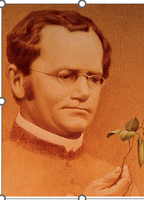
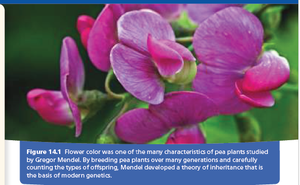
Gregor Mendel (1822–1884), known as the 'Father of Genetics', was an Austrian monk who discovered the fundamental laws of inheritance through experiments with pea plants. Mendel's work established the basis for modern genetics.
Pea plants: Used for their self-pollinating nature, variety of observable traits, and rapid generation time.
Dominant and recessive traits: Mendel identified these and formulated laws explaining heredity.
Mendel's Experimental Approach
Mendel tracked characters that occurred in two distinct alternative forms. A character is a heritable feature that varies among individuals, and each variant for a character is called a trait.
Characters with Two Traits
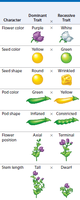
Mendel studied seven characters in pea plants, each with two contrasting traits.
Monohybrid Crosses and True Breeding
Monohybrid Crosses
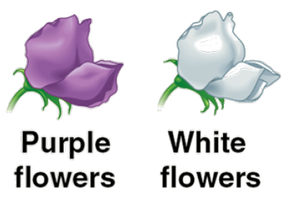
A monohybrid cross follows a single character, such as flower color (purple vs. white). The parental generation (P) consists of true-breeding plants.
True breeding: Plants that, when self-pollinated, produce offspring identical to themselves for a given trait.
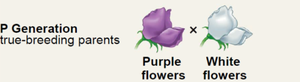
Results of Monohybrid Crosses
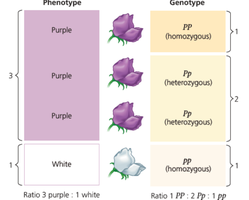
Crossing two F1 hybrids produces an F2 generation with a 3:1 ratio of dominant to recessive traits (e.g., 3 purple: 1 white).
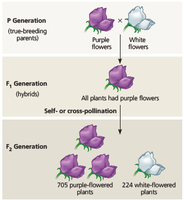
Results Across Seven Characters
Mendel observed the same 3:1 ratio in the F2 generation for all seven characters he studied.
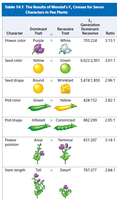
Mendel's Model and Genetic Vocabulary
Gene, Allele, and Locus
A gene is a length of DNA coding for a particular protein. An allele is an alternative form of a gene. The locus is the position of a gene on a chromosome. Homologous chromosomes carry the same genes but not necessarily the same alleles.
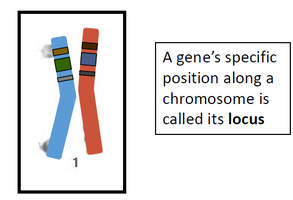
Transmission of Traits
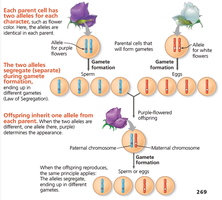
Alternative versions of a gene (alleles) account for different traits, such as purple or white flower color.
Genetic Vocabulary
Dominant allele: Represented by a capital letter; determines the organism’s appearance.
Recessive allele: Represented by a lowercase letter; masked by the dominant allele.
Homozygote: Pair of identical alleles (PP or pp).
Heterozygote: Pair of different alleles (Pp).
Genotype: Genetic makeup (e.g., PP, Pp, pp).
Phenotype: Observable trait (e.g., purple or white flowers).
Mendel's Laws of Inheritance
Law of Segregation
In diploid organisms, each individual inherits two alleles for each trait, one from each parent. The two alleles segregate during gamete formation, so each gamete carries only one allele for each gene.
Chromosomal Basis of Segregation
The segregation of alleles corresponds to the distribution of homologous chromosomes to different gametes during meiosis.
Punnett Squares
A Punnett square is a diagram used to predict the genotypes and phenotypes of offspring, visualizing how alleles combine during fertilization.
Monohybrid cross: Inheritance pattern of a single trait (e.g., Pp x Pp).
Dihybrid Crosses and Independent Assortment
Dihybrid Inheritance
Dihybrid crosses involve the inheritance of two different genes for different characters. If the genes are on different chromosomes, they assort independently; if on the same chromosome, they are linked and do not assort independently.
Law of Independent Assortment
Genes for different traits are inherited independently if they are located on different chromosomes. The phenotypic ratio for a dihybrid cross (F1 x F1) is 9:3:3:1.
Patterns of Inheritance
Dominance, Incomplete Dominance, and Codominance
Dominance: One allele masks the effect of another.
Incomplete dominance: Traits blend together, producing a new phenotype (e.g., red, pink, and white flowers in snapdragons).
Codominance: Both alleles affect the phenotype in separate, distinguishable ways (e.g., roan coat in cattle, ABO blood groups).
Multiple Alleles
A population may have more than two alleles for a gene, but an individual carries only two. The ABO blood group system is an example, with three alleles (IA, IB, i).
Epistasis and Polygenic Inheritance
Epistasis: One gene affects the expression of another gene (e.g., pigment deposition in pea plants).
Polygenic inheritance: Multiple genes contribute to a single trait (e.g., skin color, height).
Genetic Disorders and Pedigree Analysis
Recessively Inherited Disorders
Recessive allele: Disease manifests in homozygous recessive individuals (aa).
Examples: Sickle cell disease, cystic fibrosis, albinism.
Heterozygote advantage: Aa individuals may have increased survival (e.g., resistance to malaria in sickle cell carriers).
Dominantly Inherited Disorders
Dominant allele: Only one copy needed for the trait or disorder to appear (e.g., Huntington’s disease, achondroplasia).
Pedigree Analysis
Pedigree analysis is used to study inheritance patterns in humans, as controlled breeding experiments are not possible.
Chromosomal Basis of Inheritance
Karyotypes and Chromosomes
A karyotype is an ordered display of chromosomes from a cell. Homologous chromosomes are pairs that carry genes controlling the same inherited characters. Humans have 22 pairs of autosomes and one pair of sex chromosomes (XX female, XY male).
Sex-Linked Inheritance
Sex-linked genes exhibit unique patterns of inheritance, especially X-linked traits. Males are more frequently affected by X-linked recessive disorders (e.g., hemophilia, colorblindness).
Genetic Testing and Counseling
Genetic testing identifies carriers and affected individuals through blood tests, cheek cell sampling, fetal testing (ultrasound, amniocentesis, chorionic villus sampling), and newborn screening.
The Chromosomal Basis of Mendel’s Laws
Relationship Between Genes and Chromosomes
Mendelian inheritance has its physical basis in the behavior of chromosomes during meiosis, supporting the Law of Segregation and the Law of Independent Assortment.
Summary Table: Mendel's F1 Crosses for Seven Characters
Character | Dominant Trait | Recessive Trait | F1 Generation Dominant | F1 Generation Recessive | Ratio |
|---|---|---|---|---|---|
Flower color | Purple | White | 705 | 224 | 3.15:1 |
Seed color | Yellow | Green | 6,022 | 2,001 | 3.01:1 |
Seed shape | Round | Wrinkled | 5,474 | 1,850 | 2.96:1 |
Pod color | Green | Yellow | 8,212 | 2,299 | 3.57:1 |
Pod shape | Inflated | Constricted | 2,118 | 782 | 2.71:1 |
Flower position | Axial | Terminal | 6,415 | 2,017 | 3.18:1 |
Stem length | Tall | Dwarf | 787 | 277 | 2.84:1 |
Key Equations
Law of Segregation:
Monohybrid cross ratio:
Phenotype ratio:
Dihybrid cross ratio:
Additional info: Academic context was added to clarify definitions, inheritance patterns, and the significance of Mendel's laws. Tables and diagrams were recreated for clarity and completeness.
