 Back
Mendel and the Gene Idea: Laws of Inheritance and Probability
Study Guide - Smart Notes
 Tailored notes based on your materials, expanded with key definitions, examples, and context.
Mendel and the Gene Idea
Introduction to Mendelian Genetics
Mendelian genetics forms the foundation of classical genetics, describing how traits are inherited from one generation to the next. Gregor Mendel's experiments with pea plants led to the discovery of fundamental laws governing inheritance.
Gene: A unit of heredity that is transferred from parent to offspring and determines some characteristic of the offspring.
Allele: Different forms of a gene found at the same place on a chromosome.
True-breeding: Organisms that, when self-fertilized, produce offspring identical to themselves.
Law of Independent Assortment
Mendel's Second Law of Inheritance
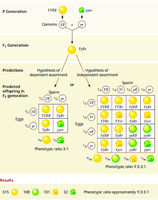
The Law of Independent Assortment states that each pair of alleles segregates independently of any other pair during gamete formation. Mendel discovered this law by following two characters at the same time in dihybrid crosses.
Dihybrid Cross: A cross between F1 dihybrids, heterozygous for two characters, used to determine whether two traits are inherited together or independently.
Independent Assortment: Genes on different chromosomes, or far apart on the same chromosome, assort independently during gamete formation.
Linked Genes: Genes located near each other on the same chromosome tend to be inherited together.
Example: Crossing two true-breeding parents differing in two characters produces dihybrids in the F1 generation. The results of Mendel’s dihybrid experiments are the basis for the law of independent assortment.
Probability Laws in Mendelian Inheritance
Application of Probability to Genetics
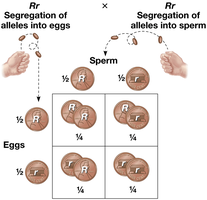
Mendel’s laws of segregation and independent assortment reflect the rules of probability. The outcome of one event does not affect the outcome of another, similar to coin tosses. The alleles of one gene segregate into gametes independently of another gene’s alleles.
Multiplication Rule: The probability that two independent events will both occur is the product of their individual probabilities.
Addition Rule: The probability that any one of two or more mutually exclusive events will occur is calculated by adding their individual probabilities.
Example: The addition rule can be used to figure out the probability that an F2 plant from a monohybrid cross will be heterozygous rather than homozygous.
Segregation of Alleles and Fertilization as Chance Events
Segregation of alleles and fertilization are random events, and their outcomes can be predicted using probability rules. This randomness is illustrated in Punnett squares, which show the possible combinations of alleles in offspring.
Comparison of Mendel's First and Second Laws
Law of Segregation vs. Law of Independent Assortment
Mendel’s first law, the Law of Segregation, states that two alleles for a gene separate during gamete formation. The second law, the Law of Independent Assortment, states that alleles of different genes assort independently during gamete formation.
Law of Segregation: Each individual has two alleles for each gene, and these alleles segregate during gamete formation so that each gamete carries only one allele for each gene.
Law of Independent Assortment: The segregation of alleles for one gene does not affect the segregation of alleles for another gene.
Mendel's Law | Description | Example |
|---|---|---|
Law of Segregation | Alleles for a gene separate during gamete formation | Monohybrid cross (single trait) |
Law of Independent Assortment | Alleles of different genes assort independently | Dihybrid cross (two traits) |
Key Equations
Probability Rules in Genetics
Multiplication Rule:
Addition Rule:
Summary
Mendel’s laws provide the basis for understanding inheritance patterns. The law of segregation explains how alleles for a single gene are separated, while the law of independent assortment describes how alleles of different genes are distributed independently. Probability rules help predict the outcomes of genetic crosses, and Punnett squares visually represent these principles.
