 Back
Mendel and the Gene Idea: Patterns and Extensions of Inheritance
Study Guide - Smart Notes
 Tailored notes based on your materials, expanded with key definitions, examples, and context.
Mendel and the Gene Idea
Introduction to Mendelian Genetics
Mendelian genetics forms the foundation of classical genetics, describing how traits are inherited from one generation to the next. Gregor Mendel's experiments with pea plants led to the formulation of key principles that explain the transmission of heritable traits.
Historical Context and Mendel's Experiments
Pre-Mendelian Theories of Inheritance
Blending Hypothesis: Proposed that offspring are a uniform blend of parental traits. This model could not explain traits that skip generations or the persistence of variation.
Particulate Hypothesis: Mendel's alternative, suggesting that traits are inherited as discrete units (genes) that remain intact across generations.
Gregor Mendel and the Pea Plant Experiments
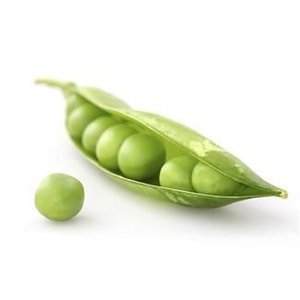
Mendel, trained in science and a monk, began his experiments in 1857 using Pisum sativum (pea plants).
Pea plants were ideal due to their many heritable characters, short generation time, and controlled fertilization.
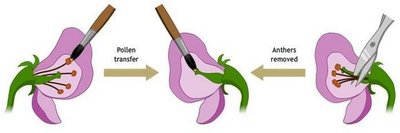
Experimental Design: Self- and Cross-Pollination
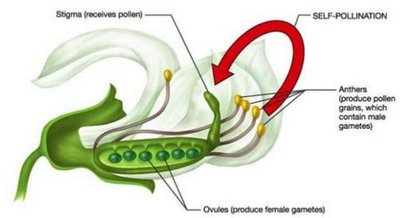
Self-pollination: Pollen from a flower fertilizes ovules of the same flower.
Cross-pollination: Pollen from one plant fertilizes ovules of another, allowing Mendel to control parental traits.
True-Breeding and Hybrid Crosses
True-breeding plants: Always produce offspring with the same trait when self-fertilized.
P Generation: Parental generation, true-breeding for a trait.
F1 Generation: First filial generation, all hybrids for the trait.
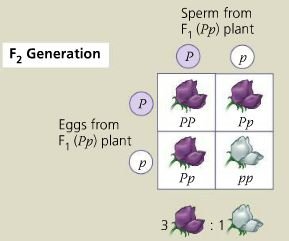
F2 Generation: Offspring of F1, where traits reappear in a 3:1 ratio.

Mendel's Laws of Inheritance
Law of Segregation
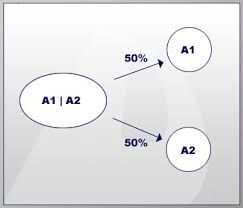
The Law of Segregation states that two alleles for a gene separate during gamete formation, so each gamete carries only one allele for each gene.
Each individual inherits two alleles, one from each parent.
If alleles differ, the dominant allele determines the phenotype.
Separation occurs during meiosis (homologous chromosomes separate).
Punnett Squares and Genetic Vocabulary
Punnett Square: Tool to predict offspring genotypes and phenotypes.
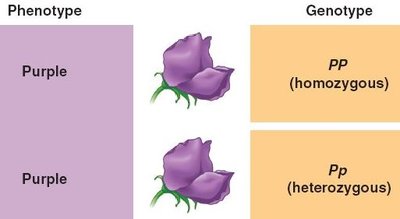
Genotype: Genetic makeup (e.g., PP, Pp, pp).
Phenotype: Observable trait (e.g., purple or white flowers).
Homozygous: Two identical alleles (PP or pp).
Heterozygous: Two different alleles (Pp).
Testcross
Used to determine the genotype of an individual with a dominant phenotype by crossing with a homozygous recessive.
If all offspring show the dominant trait, the parent is homozygous dominant; if a 1:1 ratio, the parent is heterozygous.
Law of Independent Assortment
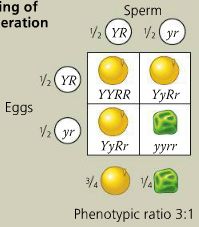
The Law of Independent Assortment states that alleles of different genes assort independently during gamete formation, provided the genes are on different chromosomes or far apart on the same chromosome.
Explains the inheritance of two or more traits simultaneously (dihybrid crosses).
F2 generation from dihybrid cross shows a 9:3:3:1 phenotypic ratio.
Extensions of Mendelian Genetics
Degrees of Dominance
Complete Dominance: Heterozygote is indistinguishable from dominant homozygote.
Incomplete Dominance: Heterozygote phenotype is intermediate between the two homozygotes (e.g., red x white = pink flowers).
Codominance: Both alleles are fully expressed in the heterozygote (e.g., AB blood type).
Multiple Alleles
Most genes have more than two alleles in the population (e.g., ABO blood group: IA, IB, i).
Pleiotropy
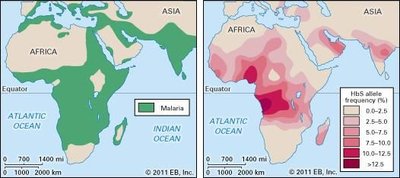
One gene affects multiple phenotypic traits (e.g., sickle cell anemia affects hemoglobin, resistance to malaria, and other symptoms).
Epistasis and Polygenic Inheritance
Epistasis: One gene affects the expression of another gene (e.g., coat color in Labrador retrievers).
Polygenic Inheritance: Multiple genes contribute to a single trait, often resulting in continuous variation (e.g., skin color, height).
Environmental Effects on Phenotype
Phenotype can be influenced by environmental factors such as temperature, nutrition, and sunlight (e.g., Himalayan rabbit fur color, human height).
Human Genetics and Mendelian Patterns
Recessively Inherited Disorders
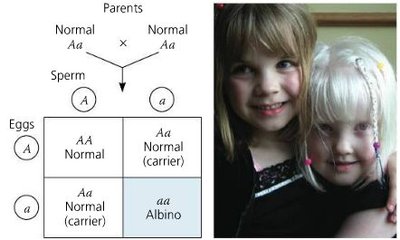
Caused by homozygosity for a recessive allele (e.g., cystic fibrosis, Tay-Sachs disease, sickle cell anemia).
Heterozygotes are typically healthy carriers.
Consanguineous mating increases the risk of recessive disorders.
Dominantly Inherited Disorders
Caused by a single copy of a dominant allele (e.g., achondroplasia, Huntington's disease).
Homozygosity for some dominant alleles can be lethal.
Pedigree Analysis
Pedigrees are diagrams that trace the inheritance of traits across generations, useful for studying human genetics.
Genetic Testing and Counseling
Includes carrier testing, preimplantation genetic diagnosis, fetal testing (amniocentesis, CVS), and newborn screening (e.g., PKU).
Summary Table: Mendelian Traits in Pea Plants
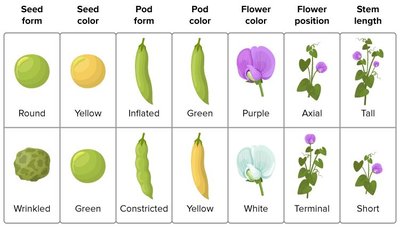
Character | Dominant Trait | Recessive Trait | F2 Generation Ratio |
|---|---|---|---|
Flower color | Purple | White | 3.15:1 |
Seed color | Yellow | Green | 3.01:1 |
Seed shape | Round | Wrinkled | 2.96:1 |
Pod shape | Inflated | Constricted | 2.82:1 |
Pod color | Green | Yellow | 2.82:1 |
Flower position | Axial | Terminal | 3.14:1 |
Stem length | Tall | Dwarf | 2.84:1 |
Key Equations and Concepts
Mendelian Monohybrid Cross Ratio: phenotypic ratio in F2 generation for dominant:recessive traits.
Dihybrid Cross Ratio: phenotypic ratio in F2 generation for two independently assorting traits.
Punnett Square: Visual representation of possible allele combinations from parental gametes.
Conclusion
Mendel's principles of segregation and independent assortment, along with extensions such as incomplete dominance, codominance, multiple alleles, pleiotropy, epistasis, and polygenic inheritance, provide a comprehensive framework for understanding genetic inheritance. Environmental factors and complex gene interactions further influence phenotypic outcomes, making genetics a dynamic and foundational field in biology.
