 Back
Mendel and the Gene Idea: Principles of Inheritance
Study Guide - Smart Notes
 Tailored notes based on your materials, expanded with key definitions, examples, and context.
Mendel and the Gene Idea
Introduction to Mendelian Genetics
Gregor Mendel's experiments with garden peas established the foundational principles of heredity, demonstrating how traits are transmitted from parents to offspring. His work led to the formulation of the laws of segregation and independent assortment, which underpin classical genetics.
Character: A heritable feature that varies among individuals (e.g., flower color).
Trait: Each variant for a character (e.g., purple or white flowers).
Blending hypothesis: The idea that genetic material from two parents blends together.
Particulate hypothesis: The idea that parents pass on discrete heritable units (genes).
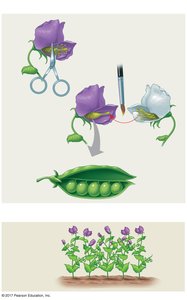
Hybridization: Mating two contrasting, true-breeding varieties.
Mendel's Experimental Approach
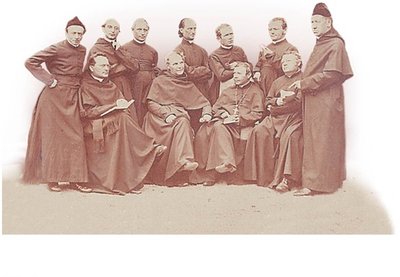
Mendel chose pea plants for their short generation time, large numbers of offspring, and the ability to control mating. He tracked characters that occurred in two distinct forms and used true-breeding plants to establish parental (P) generations.
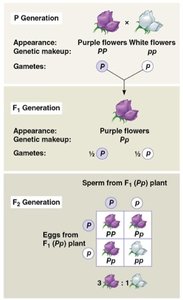
P generation: True-breeding parents.
F1 generation: First filial generation, hybrids.
F2 generation: Second filial generation, offspring of F1 self- or cross-pollination.
Dominant trait: Trait that appears in F1 hybrids.
Recessive trait: Trait masked in F1 but reappears in F2.
Mendel's Laws
Law of Segregation
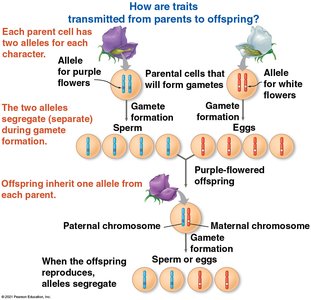
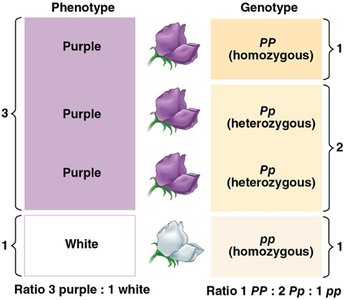
The law of segregation states that two alleles for a heritable character segregate during gamete formation, and end up in different gametes. This explains the 3:1 ratio observed in F2 generations.
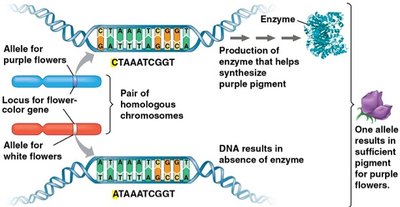
Allele: Alternative versions of a gene.
Genotype: Genetic makeup (e.g., PP, Pp, pp).
Phenotype: Observable trait (e.g., purple or white flowers).
Law of Independent Assortment
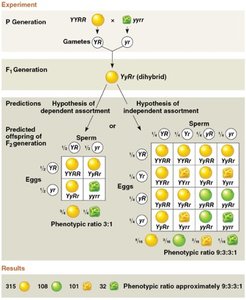
The law of independent assortment states that genes for different traits can segregate independently during the formation of gametes. This is observed in dihybrid crosses, where the phenotypic ratio is approximately 9:3:3:1.
Dihybrid cross: Cross between individuals heterozygous for two characters.
Phenotypic ratio: 9:3:3:1 for independent assortment.
Probability and Mendelian Inheritance
Rules of Probability
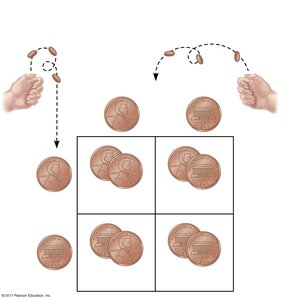
Mendelian inheritance follows the rules of probability. The outcome of genetic crosses can be predicted using mathematical principles, such as the multiplication and addition rules.
Multiplication rule: Probability of two independent events occurring together is the product of their probabilities.
Addition rule: Probability of either of two mutually exclusive events occurring is the sum of their probabilities.

Extensions of Mendelian Genetics
Degrees of Dominance
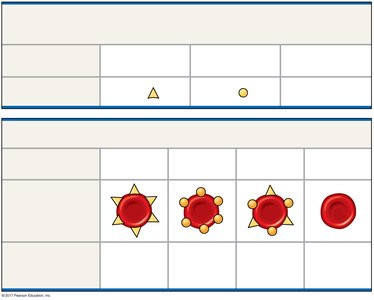
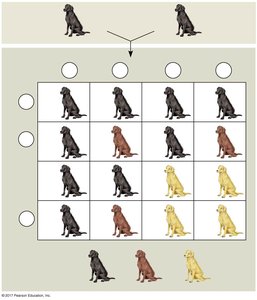
Inheritance patterns may deviate from simple Mendelian rules when alleles are not completely dominant or recessive, when a gene has more than two alleles, or when a gene produces multiple phenotypes.
Incomplete dominance: Heterozygotes have an intermediate phenotype.
Codominance: Both alleles are fully expressed in heterozygotes.
Multiple alleles: More than two alleles exist for a gene (e.g., ABO blood groups).
Epistasis: One gene affects the phenotype of another due to interaction of their gene products.
Human Genetics
Pedigree Analysis
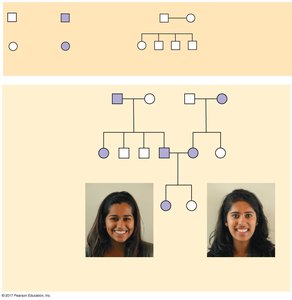
Pedigree analysis is used to study the inheritance of traits in humans. It involves charting the interrelationships of parents and children across generations to determine inheritance patterns.
Pedigree: Diagram showing the relationships and transmission of traits.
Carrier: Individual who carries a recessive allele but does not express the trait.
Recessively Inherited Disorders
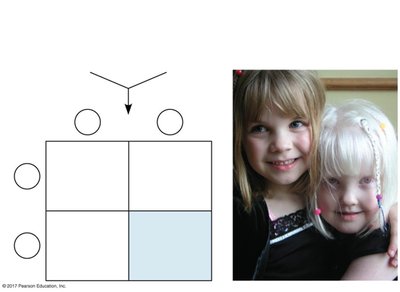
Many genetic disorders are inherited in a recessive manner. Individuals must inherit two copies of the mutant allele to express the disorder.
Albinism: A recessive condition characterized by lack of pigmentation in skin and hair.
Dominantly Inherited Disorders
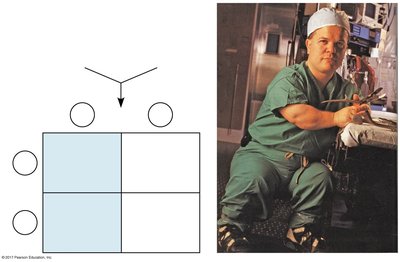
Some disorders are caused by dominant alleles. These are less common and often arise by mutation. Achondroplasia, a form of dwarfism, is caused by a rare dominant allele.
Achondroplasia: A dominant disorder resulting in dwarfism.
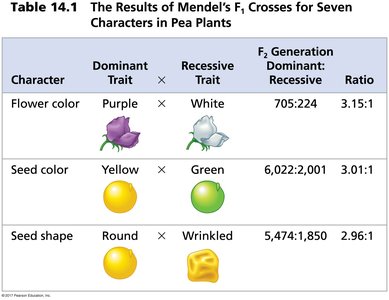
Summary Table: Mendel's F1 Crosses
Character | Dominant Trait | Recessive Trait | F2 Generation Dominant: Recessive | Ratio |
|---|---|---|---|---|
Flower color | Purple | White | 705:224 | 3.15:1 |
Seed color | Yellow | Green | 6,022:2,001 | 3.01:1 |
Seed shape | Round | Wrinkled | 5,474:1,850 | 2.96:1 |
Key Equations
Probability of YYRR:
Probability of YyRR:
Additional info: These notes expand on Mendel's principles, including definitions, examples, and applications relevant to college-level General Biology. All images included directly reinforce the concepts explained in the adjacent paragraphs.
