Back
Mendel and the Gene Idea: Principles of Inheritance
Study Guide - Smart Notes
 Tailored notes based on your materials, expanded with key definitions, examples, and context.
Chapter 14: Mendel and the Gene Idea
Introduction to Mendelian Genetics
Gregor Mendel's experiments with pea plants established the foundational principles of heredity. His quantitative approach allowed him to deduce laws that explain how traits are inherited from one generation to the next.
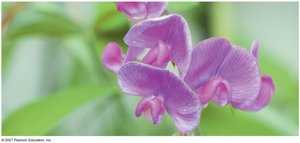
Character: A heritable feature that varies among individuals (e.g., flower color).
Trait: Each variant for a character (e.g., purple or white flowers).
True-breeding: Plants that produce offspring of the same variety when self-pollinated.
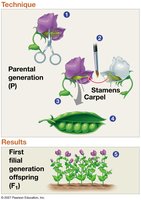
Hybridization: Mating two contrasting, true-breeding varieties.
Mendel’s Experimental Approach
Mendel chose pea plants for their short generation time, large number of offspring, and the ability to control mating. He tracked characters with two distinct forms and started with true-breeding varieties.
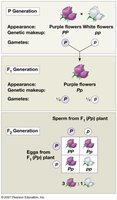
P Generation: True-breeding parents.
F1 Generation: Hybrid offspring of the P generation.
F2 Generation: Offspring from self- or cross-pollination of F1 hybrids.
The Law of Segregation
Mendel’s first law states that two alleles for a heritable character segregate during gamete formation and end up in different gametes. This explains the 3:1 ratio observed in F2 offspring.
Dominant trait: Trait that appears in F1 hybrids (e.g., purple flowers).
Recessive trait: Trait masked in F1 but reappears in F2 (e.g., white flowers).
Gene: Mendel’s “heritable factor” is now known as a gene.
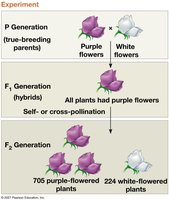
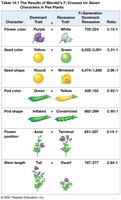
Table: Mendel’s Crosses for Seven Characters
This table summarizes Mendel’s results for seven pea plant characters, showing dominant and recessive traits and their ratios in the F2 generation.
Character | Dominant Trait | Recessive Trait | F2 Ratio |
|---|---|---|---|
Flower color | Purple | White | 3:1 |
Seed shape | Round | Wrinkled | 2.96:1 |
Seed color | Yellow | Green | 2.82:1 |
Pod shape | Inflated | Constricted | 2.84:1 |
Pod color | Green | Yellow | 2.83:1 |
Flower position | Axial | Terminal | 3.14:1 |
Stem length | Tall | Dwarf | 2.84:1 |
Mendel’s Model of Inheritance
Mendel proposed four concepts to explain inheritance:
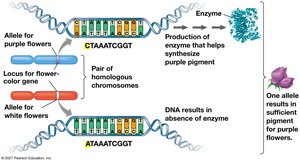
Alleles: Alternative versions of genes account for variations in inherited characters.
Inheritance: Each organism inherits two alleles, one from each parent.
Dominance: If alleles differ, the dominant allele determines appearance; the recessive allele is masked.
Segregation: The two alleles segregate during gamete formation.
Genetic Vocabulary
Understanding genetic terminology is essential for interpreting inheritance patterns.
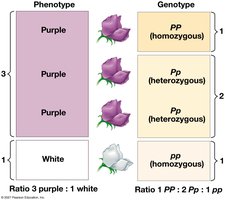
Homozygote: Two identical alleles for a gene.
Heterozygote: Two different alleles for a gene.
Phenotype: Physical appearance.
Genotype: Genetic makeup.
The Testcross
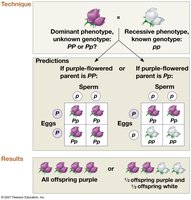
A testcross determines the genotype of an individual with a dominant phenotype by crossing it with a homozygous recessive individual. If any offspring display the recessive phenotype, the parent is heterozygous.
The Law of Independent Assortment
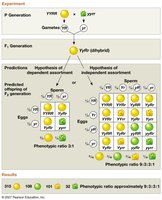
Mendel’s second law states that each pair of alleles segregates independently during gamete formation. This law applies to genes on different chromosomes or far apart on the same chromosome.
Monohybrid cross: Heterozygous for one character.
Dihybrid cross: Heterozygous for two characters.
Probability Laws in Genetics
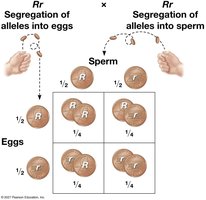
Mendelian inheritance follows the rules of probability. The multiplication rule calculates the probability of independent events occurring together, while the addition rule calculates the probability of mutually exclusive events.
Multiplication rule:
Addition rule:

Complex Patterns of Inheritance
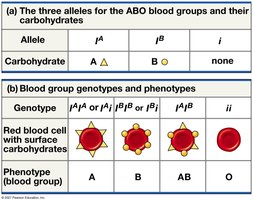
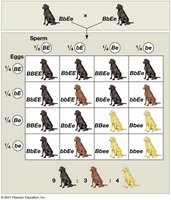
Inheritance patterns can be more complex than simple Mendelian genetics. These include incomplete dominance, codominance, multiple alleles, pleiotropy, epistasis, and polygenic inheritance.
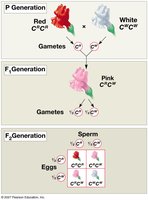
Incomplete dominance: Heterozygote phenotype is intermediate between two parental phenotypes.
Codominance: Both alleles affect the phenotype in separate, distinguishable ways.
Multiple alleles: More than two allelic forms exist in a population.
Pleiotropy: One gene affects multiple phenotypic characters.
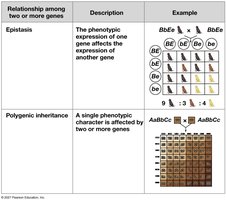
Epistasis: One gene affects the expression of another gene.
Polygenic inheritance: Multiple genes independently affect a single trait.
Environmental Impact on Phenotype
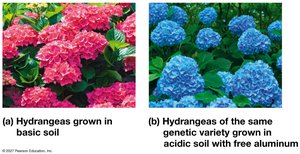
Phenotype can be influenced by environmental factors as well as genotype. Phenotypic plasticity describes the ability to produce different phenotypes under varying environmental conditions. Multifactorial traits depend on multiple genes and environmental influences.
Human Mendelian Genetics
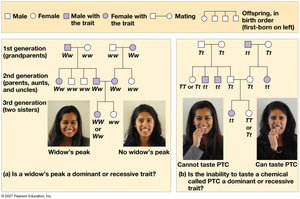
Many human traits follow Mendelian patterns, though humans are not ideal subjects for genetic research due to long generation times and ethical constraints. Pedigree analysis is used to study inheritance in families.
Recessive and Dominant Disorders
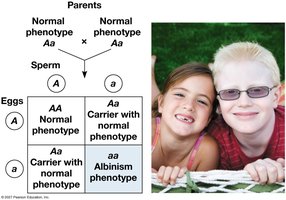
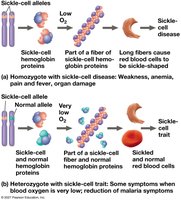
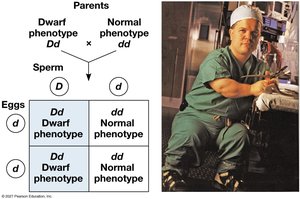
Recessively inherited disorders appear only in homozygous individuals, while carriers are heterozygous and phenotypically normal. Dominant disorders are rare and often arise by mutation.
Albinism: Recessive disorder characterized by lack of pigmentation.
Cystic fibrosis: Most common lethal genetic disease in the U.S., caused by defective chloride transport.
Sickle-cell disease: Caused by a single amino acid substitution in hemoglobin; heterozygotes have a selective advantage against malaria.
Achondroplasia: Dominant disorder causing dwarfism.
Huntington’s disease: Dominant, late-onset neurodegenerative disorder.
Multifactorial Disorders and Genetic Counseling
Many diseases, such as heart disease and cancer, have both genetic and environmental components. Genetic counseling and testing can provide information to prospective parents and detect genetic disorders in fetuses and newborns.
Summary Tables: Extensions to Mendelian Genetics
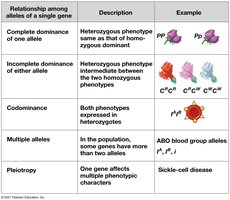
Key relationships among alleles and genes are summarized in the following tables:
Relationship among alleles | Description | Example |
|---|---|---|
Complete dominance | Heterozygote phenotype same as homozygous dominant | Purple flowers (Pp) |
Incomplete dominance | Heterozygote intermediate between two homozygotes | Pink snapdragons (CRCW) |
Codominance | Both phenotypes expressed in heterozygotes | ABO blood group (IAIB) |
Multiple alleles | More than two alleles in population | ABO blood group alleles |
Pleiotropy | One gene affects multiple characters | Sickle-cell disease |
Relationship among genes | Description | Example |
|---|---|---|
Epistasis | Phenotypic expression of one gene affects another | Labrador coat color |
Polygenic inheritance | Single character affected by two or more genes | Skin color, height |