 Back
Mendel and the Gene Idea: Principles of Inheritance
Study Guide - Smart Notes
 Tailored notes based on your materials, expanded with key definitions, examples, and context.
Chapter 14: Mendel and the Gene Idea
Introduction to Mendelian Genetics
Gregor Mendel's experiments with pea plants established the foundational principles of heredity, which are central to modern genetics. His scientific approach led to the identification of two key laws of inheritance: the law of segregation and the law of independent assortment.
Mendel’s Experimental Approach
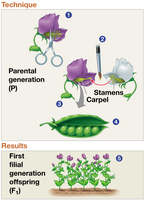
Mendel used a quantitative, experimental method to study heredity, focusing on characters (heritable features) and their traits (variants). He selected pea plants with distinct, alternative forms and began with true-breeding varieties to ensure consistent results.
Character: A heritable feature (e.g., flower color).
Trait: Variant of a character (e.g., purple or white flowers).
True-breeding: Plants that produce offspring identical to themselves when self-pollinated.
Hybridization: Mating two contrasting, true-breeding varieties.
P generation: True-breeding parental generation.
F1 generation: Hybrid offspring of the P generation.
F2 generation: Offspring from self- or cross-pollination of F1 hybrids.
Mendel’s Laws of Inheritance
The Law of Segregation
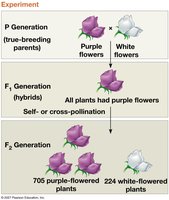
Mendel observed that when crossing true-breeding purple and white flowered plants, all F1 hybrids were purple, contradicting the blending theory. In the F2 generation, both purple and white flowers appeared in a 3:1 ratio, leading Mendel to deduce the law of segregation.
Law of Segregation: Two alleles for a gene segregate during gamete formation and reunite at random during fertilization.
Physical basis: Movement of chromosomes during meiosis.
Dominant trait: Trait that appears in the F1 generation (e.g., purple flowers).
Recessive trait: Trait masked in the F1 but reappears in the F2 (e.g., white flowers).
Punnett Square and Ratios
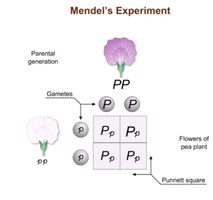
The Punnett square is a tool used to predict the genotypic and phenotypic ratios of offspring from a genetic cross. For a monohybrid cross between two heterozygous purple plants (Pp x Pp), the expected phenotypic ratio is 3 purple : 1 white.
Genotypic ratio: 1 PP : 2 Pp : 1 pp
Phenotypic ratio: 3 purple : 1 white
Genetic Vocabulary and Distinctions
Homozygous: Two identical alleles for a gene (e.g., PP or pp).
Heterozygous: Two different alleles for a gene (e.g., Pp).
Genotype: Genetic makeup of an organism.
Phenotype: Physical appearance of an organism.
Dominant vs. Recessive: Dominant alleles mask the effect of recessive alleles.
The Law of Independent Assortment
Mendel’s second law states that genes for different traits can segregate independently during the formation of gametes. This was demonstrated by dihybrid crosses, where two characters were followed simultaneously.
Monohybrid cross: Cross between individuals differing in one character.
Dihybrid cross: Cross between individuals differing in two characters.
Complex Patterns of Inheritance
Inheritance patterns can deviate from simple Mendelian genetics due to various factors:
Complete dominance: Heterozygote and dominant homozygote have identical phenotypes.
Incomplete dominance: Heterozygote phenotype is intermediate between parental phenotypes.
Codominance: Both alleles affect the phenotype in separate, distinguishable ways.
Multiple alleles: More than two alleles exist for a gene (e.g., ABO blood group).
Pleiotropy: One gene affects multiple phenotypic traits.
Epistasis: One gene affects the expression of another gene.
Polygenic inheritance: Multiple genes independently affect a single trait.
Environmental Impact on Phenotype
The environment can influence the expression of genetic traits, leading to phenotypic plasticity. Multifactorial traits depend on both genetic and environmental factors.
Pedigree Analysis and Human Genetics
Pedigrees are family trees used to track the inheritance of traits across generations. They help predict the probability of specific phenotypes and identify carriers of genetic disorders.
Recessively inherited disorders: Only appear in individuals homozygous for the allele (e.g., cystic fibrosis, albinism).
Dominantly inherited disorders: Caused by dominant alleles (e.g., achondroplasia, Huntington’s disease).
Carrier: Heterozygous individual carrying a recessive allele but phenotypically normal.
Genetic Testing and Counseling
Genetic testing can identify carriers and affected individuals, enabling informed decisions about reproduction. Fetal testing methods include amniocentesis and chorionic villus sampling.
Summary Table: Mendel’s Pea Plant Characters
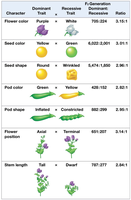
The table below summarizes the dominant and recessive traits Mendel studied, along with the observed ratios in the F2 generation.
Character | Dominant Trait | Recessive Trait | F2 Generation Dominant | F2 Generation Recessive | Ratio |
|---|---|---|---|---|---|
Flower color | Purple | White | 705 | 224 | 3.15:1 |
Seed color | Yellow | Green | 6,024 | 2,001 | 3.01:1 |
Seed shape | Round | Wrinkled | 5,474 | 1,850 | 2.96:1 |
Pod color | Green | Yellow | 428 | 152 | 2.82:1 |
Pod shape | Inflated | Constricted | 882 | 299 | 2.95:1 |
Flower position | Axial | Terminal | 651 | 207 | 3.14:1 |
Stem length | Tall | Dwarf | 787 | 277 | 2.84:1 |
Key Equations
Probability of genotype in monohybrid cross:
Phenotypic ratio in F2 generation:
Example: Testcross
A testcross is used to determine the genotype of an individual with a dominant phenotype by crossing it with a homozygous recessive individual. If any offspring display the recessive phenotype, the mystery parent must be heterozygous.
Conclusion
Mendel’s laws of inheritance form the basis of classical genetics, explaining how traits are passed from parents to offspring. These principles are essential for understanding genetic variation, inheritance patterns, and the molecular basis of heredity.
