 Back
Mendel and the Gene Idea: Principles of Heredity and Patterns of Inheritance
Study Guide - Smart Notes
 Tailored notes based on your materials, expanded with key definitions, examples, and context.
Mendel and the Gene Idea
Introduction to Mendelian Genetics
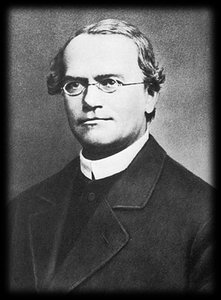
The study of heredity began with Gregor Mendel, who used garden peas to uncover the fundamental principles of genetic inheritance. Mendel's experiments established the basis for understanding how traits are transmitted from parents to offspring.
Mendel's Experimental Approach
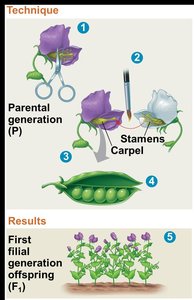
Mendel selected pea plants for their diverse varieties and practical advantages, such as short generation times, large numbers of offspring, and controlled mating. He focused on heritable features called characters (e.g., flower color), which have variations known as traits (e.g., purple or white flowers). The physical appearance of an organism is its phenotype.
True-breeding: Plants that consistently produce offspring with the same trait.
Hybridization: Mating two contrasting, true-breeding varieties.
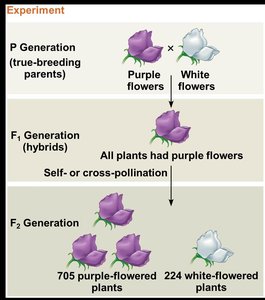
P generation: True-breeding parents.
F1 generation: Hybrid offspring of the P generation.
F2 generation: Offspring from self- or cross-pollination of F1 hybrids.
Results of Mendel's Crosses
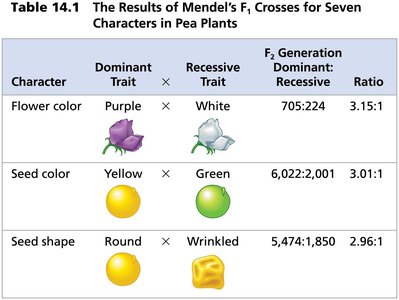
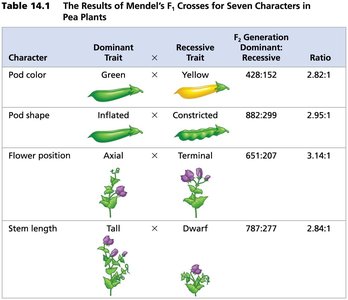
Mendel observed a consistent 3:1 ratio of dominant to recessive traits in the F2 generation. He tracked seven characters, each with two distinct traits.
Character | Dominant Trait | Recessive Trait | F2 Ratio |
|---|---|---|---|
Flower color | Purple | White | 3.15:1 |
Seed color | Yellow | Green | 3.01:1 |
Seed shape | Round | Wrinkled | 2.96:1 |
Pod color | Green | Yellow | 2.82:1 |
Pod shape | Inflated | Constricted | 2.95:1 |
Flower position | Axial | Terminal | 3.14:1 |
Stem length | Tall | Dwarf | 2.84:1 |
Mendel's Model of Inheritance
Key Concepts and Terminology
Mendel proposed four concepts to explain the patterns of inheritance:
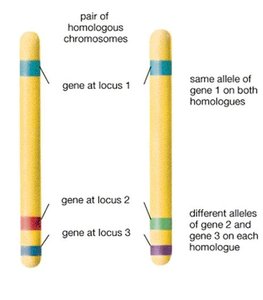
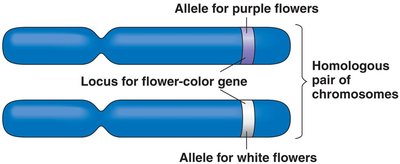
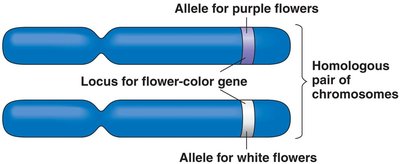
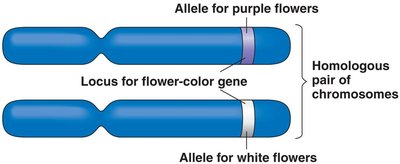
Alleles: Alternative versions of a gene that account for variations in inherited characters. Each gene resides at a specific locus on a chromosome.
Genotype: The combination of alleles for a character (e.g., PP, Pp, pp).
Homozygous: Organism with two identical alleles for a gene.
Heterozygous: Organism with two different alleles for a gene.
Dominant allele: Determines the organism's appearance.
Recessive allele: Has no noticeable effect on appearance when paired with a dominant allele.
The Law of Segregation
The two alleles for a heritable character segregate during gamete formation, resulting in each gamete carrying only one allele. This explains the 3:1 ratio observed in the F2 generation.
At fertilization, offspring inherit one allele from each parent.
Meiosis ensures each gamete receives one copy of each gene.
Punnett Squares and Ratios
Punnett squares are used to predict the possible combinations of alleles in offspring and to determine phenotypic and genotypic ratios.
Capital letters represent dominant alleles; lowercase letters represent recessive alleles.
Genotypic ratio for F2: 1 PP : 2 Pp : 1 pp
Phenotypic ratio for F2: 3 purple : 1 white
Extensions of Mendelian Genetics
Incomplete Dominance
In incomplete dominance, the phenotype of heterozygotes is intermediate between the two parental phenotypes. Complete dominance occurs when the heterozygote and dominant homozygote have identical phenotypes.
Codominance
In codominance, both alleles are equally expressed in the phenotype. For example, MN blood group individuals express both M and N molecules on red blood cells.
Multiple Alleles
Some genes have more than two alleles, such as the human blood group gene, which has three alleles (A, B, O).
Pleiotropy
Pleiotropy occurs when one gene affects multiple traits. For example, the gene for flower color in peas also affects seed coating color; albinism affects skin, hair, and eye color.
Epistasis
Epistasis is when a gene at one locus alters the expression of a gene at another locus. For example, in coat color, one gene determines pigment presence, while another determines color.
Polygenic Inheritance
Polygenic inheritance involves multiple genes contributing to a single trait, often resulting in quantitative variation (e.g., human skin color).
Human Genetics and Pedigree Analysis
Pedigree Charts
A pedigree is a diagram showing the occurrence of heritable traits across generations. It helps determine the mode of inheritance and calculate genotype probabilities, especially for genetic diseases.
Recessively and Dominantly Inherited Disorders
Recessive disorders: Most affected individuals are born to carrier parents (e.g., Tay-Sachs disease).
Dominant disorders: Affected individuals have at least one dominant allele (e.g., Achondroplasia).
Key Terms and Definitions
Homologous chromosomes: Chromosome pairs with the same genes at corresponding loci.
Locus: Specific location of a gene on a chromosome.
Allele: Alternative form of a gene.
Character: Heritable feature (e.g., flower color).
Trait: Variant of a character (e.g., purple or white flowers).
Summary of Mendel's Laws
Law of Segregation: Alleles separate during gamete formation.
Law of Independent Assortment: Genes for different traits assort independently during gamete formation.
These laws were formulated based on Mendel's careful experiments and analysis of pea plant crosses.
Practice and Application
Use Punnett squares to predict offspring ratios.
Distinguish between dominant/recessive, homozygous/heterozygous, genotype/phenotype.
Interpret pedigree charts for inheritance patterns.
Understand genetic screening and counseling methods.
Additional info: This guide expands on brief points from the original materials, providing academic context and definitions for clarity and completeness.
