 Back
Ch 14 - Mendel and the Gene Idea (F26 Bernhardt)
Study Guide - Smart Notes
 Tailored notes based on your materials, expanded with key definitions, examples, and context.
Mendel and the Gene Idea
Introduction to Mendelian Genetics
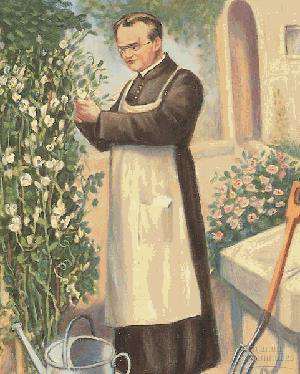
Gregor Mendel's experiments with pea plants established the foundational principles of inheritance, explaining how traits are passed from parents to offspring. His work disproved the 'blending' hypothesis and supported the 'particulate' hypothesis, which states that parents pass discrete heritable units—genes—to their offspring.
Blending Hypothesis: Genetic material from two parents mixes, but cannot explain traits skipping generations.
Particulate Hypothesis: Parents pass on genes, allowing traits to reappear after several generations.
Mendel's Success: Used pea plants with distinct traits, large offspring numbers, and controlled crosses.
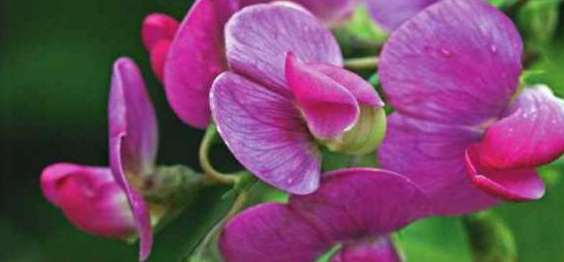
Experimental Approach and Terminology
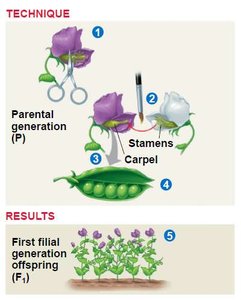
Mendel used a scientific approach to identify two laws of inheritance by breeding garden peas. He selected characters with clear, alternative forms and started with true-breeding varieties.
Character: A heritable feature (e.g., flower color).
Trait: A variant of a character (e.g., purple or white flowers).
True-breeding: Plants that produce offspring of the same variety when self-pollinated.
Hybridization: Crossing two true-breeding varieties.
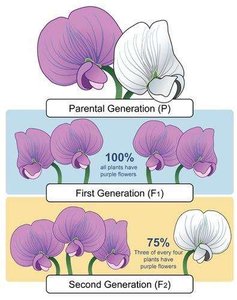
P Generation: True-breeding parents.
F1 Generation: Hybrid offspring of the P generation.
F2 Generation: Offspring of F1 plants.
The Law of Segregation
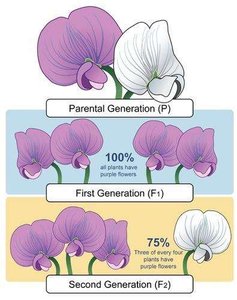
Mendel observed that when crossing true-breeding purple and white flowered pea plants, all F1 hybrids were purple. When F1 hybrids were crossed, the F2 generation showed a 3:1 ratio of purple to white flowers, supporting the law of segregation.
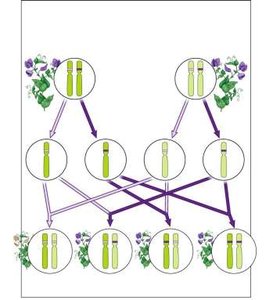
Law of Segregation: The two alleles for a character separate during gamete formation, so each gamete receives only one allele.
Dominant Trait: The trait that appears in the F1 generation (purple).
Recessive Trait: The trait that reappears in the F2 generation (white).
Mendel's Model: Four Related Concepts
To explain the 3:1 ratio, Mendel developed a model with four key concepts:
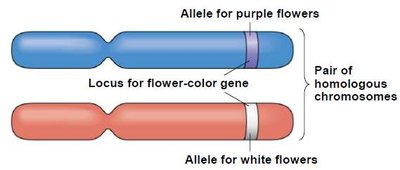
Alleles: Alternative versions of a gene explain variation in inherited characters.
Inheritance: Each organism inherits two alleles, one from each parent.
Dominance: If alleles differ, the dominant allele determines appearance; the recessive allele has no visible effect.
Law of Segregation: The two alleles separate during gamete formation.
Phenotype vs. Genotype
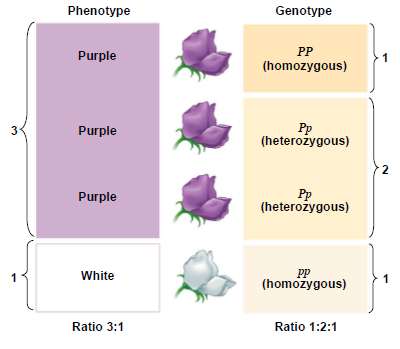
An organism's traits (phenotype) do not always reveal its genetic makeup (genotype) due to dominant and recessive allele interactions. For example, both PP and Pp genotypes produce purple flowers, but only pp produces white flowers.
Homozygous: Two identical alleles (PP or pp).
Heterozygous: Two different alleles (Pp).
Genotype: Genetic makeup (e.g., PP, Pp, pp).
Phenotype: Observable traits (e.g., purple or white flowers).
Testcross and Probability in Genetics
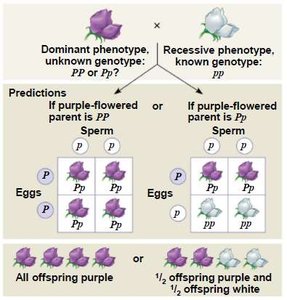
A testcross helps determine the genotype of an individual with a dominant phenotype by crossing it with a homozygous recessive. Mendel's laws reflect the rules of probability, which can be applied to predict genetic outcomes.
Testcross: Cross with a homozygous recessive to reveal the genotype.
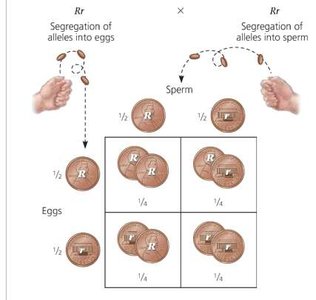
Multiplication Rule: Probability of two independent events occurring together is the product of their probabilities.
Addition Rule: Probability of an event occurring in multiple ways is the sum of their probabilities.
The Law of Independent Assortment
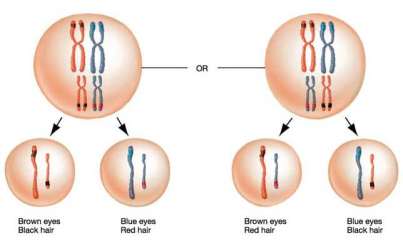
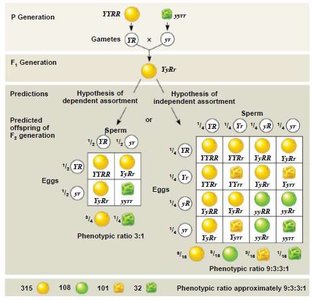
Mendel's law of independent assortment states that each pair of alleles segregates independently during gamete formation. This applies to genes on different chromosomes or far apart on the same chromosome.
Monohybrid Cross: Heterozygous for one character (Pp × Pp).
Dihybrid Cross: Heterozygous for two characters (YyRr × YyRr).
Independent Assortment: Alleles of each gene sort separately.
Extending Mendelian Genetics
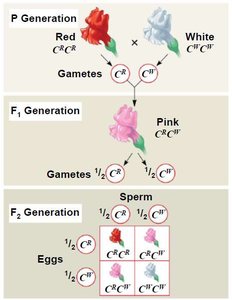
Inheritance patterns may deviate from simple Mendelian rules in several situations, including incomplete dominance, codominance, multiple alleles, pleiotropy, epistasis, and polygenic inheritance.
Incomplete Dominance: Heterozygotes show intermediate phenotype (e.g., pink snapdragons).
Codominance: Both alleles affect phenotype in separate ways (e.g., ABO blood groups).
Multiple Alleles: More than two alleles exist for a gene (e.g., ABO blood groups).
Pleiotropy: One gene affects multiple traits (e.g., sickle-cell disease).
Epistasis: One gene affects the expression of another (e.g., Labrador coat color).
Polygenic Inheritance: Multiple genes contribute to a single trait (e.g., height, skin color).
Environmental Impact on Phenotype
Phenotype can be influenced by environmental factors as well as genotype. The same genotype may produce different phenotypes depending on environmental conditions.
Norm of Reaction: Range of phenotypes produced by a genotype in different environments.
Example: Hydrangea flower color varies with soil acidity.
Human Genetics and Pedigrees
Many human traits follow Mendelian patterns of inheritance. Pedigrees are used to track traits across generations, especially for recessively and dominantly inherited disorders.
Pedigree: Family tree showing trait inheritance.
Recessively Inherited Disorders: Show up only in homozygous individuals (e.g., albinism, cystic fibrosis).
Dominantly Inherited Disorders: Caused by dominant alleles (e.g., achondroplasia).
Consanguineous Matings: Increase the chance of rare recessive disorders.
Multifactorial Disorders: Genetic and environmental components (e.g., heart disease, diabetes).
Genetic Testing and Counselling
Genetic counselling and testing help prospective parents assess the risk of inherited disorders. Fetal testing and newborn screening are used to detect genetic conditions early.
Genetic Counselling: Uses family history and genetic tests to inform parents.
Fetal Testing: Includes ultrasound, maternal blood tests, amniocentesis, and chorionic villus sampling.
Newborn Screening: Routine blood tests for genetic disorders.
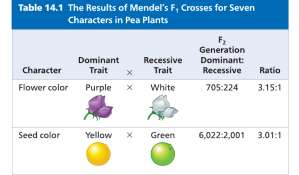
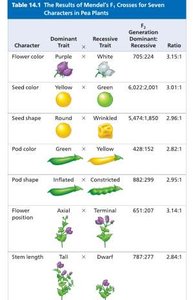
Summary Table: Mendel's F1 Crosses for Seven Characters
The table below summarizes Mendel's results for seven pea plant characters, showing dominant and recessive traits and their ratios in the F2 generation.
Character | Dominant Trait | Recessive Trait | F2 Generation Ratio |
|---|---|---|---|
Flower color | Purple | White | 3.15:1 |
Seed color | Yellow | Green | 3.01:1 |
Seed shape | Round | Wrinkled | 2.96:1 |
Pod color | Green | Yellow | 2.82:1 |
Pod shape | Inflated | Constricted | 2.91:1 |
Flower position | Axial | Terminal | 3.14:1 |
Stem length | Tall | Dwarf | 2.84:1 |
Key Equations
Multiplication Rule:
Addition Rule:
Genotypic Ratio (Monohybrid Cross):
Phenotypic Ratio (Monohybrid Cross):
Dihybrid Cross Ratio:
