Back
Mendel and the Gene Idea: Study Notes for General Biology
Study Guide - Smart Notes
 Tailored notes based on your materials, expanded with key definitions, examples, and context.
Chapter 14: Mendel and the Gene Idea
Introduction to Mendelian Genetics
Gregor Mendel's experiments with pea plants established the foundational principles of heredity. His quantitative approach and careful selection of experimental organisms allowed him to deduce laws that govern genetic inheritance.
Character: A heritable feature that varies among individuals (e.g., flower color).
Trait: Each variant for a character (e.g., purple or white flowers).
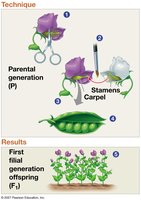
Advantages of Pea Plants: Short generation time, large numbers of offspring, and controlled mating (self- or cross-pollination).
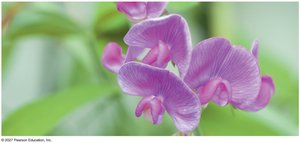
Mendel’s Experimental Approach
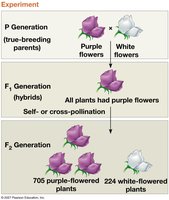
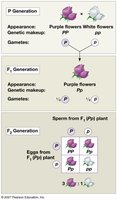
Mendel tracked characters with two distinct forms and used true-breeding varieties. He performed hybridization by mating contrasting varieties, defining parental (P), first filial (F1), and second filial (F2) generations.
True-breeding: Plants that produce offspring identical to themselves when self-pollinated.
Hybridization: Mating of two contrasting, true-breeding varieties.
The Law of Segregation
Mendel’s first law states that two alleles for a heritable character segregate during gamete formation, resulting in offspring with predictable ratios of traits.
Dominant trait: Trait that appears in the F1 generation (e.g., purple flowers).
Recessive trait: Trait masked in the F1 but reappears in the F2 generation (e.g., white flowers).
Observed ratio: Approximately 3:1 in the F2 generation.
Mendel’s Model of Inheritance
Mendel proposed four concepts to explain inheritance patterns:
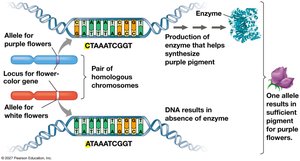
Alleles: Alternative versions of genes account for variations in inherited characters.
Inheritance: Each organism inherits two alleles, one from each parent.
Dominance: If alleles differ, the dominant allele determines appearance; the recessive allele is masked.
Segregation: Alleles separate during gamete formation.
Genetic Vocabulary
Understanding genetic terminology is essential for interpreting inheritance patterns.
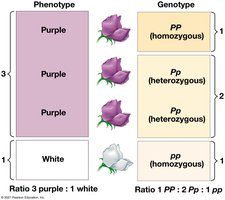
Homozygote: Organism with two identical alleles for a gene.
Heterozygote: Organism with two different alleles for a gene.
Phenotype: Physical appearance.
Genotype: Genetic makeup.
The Testcross
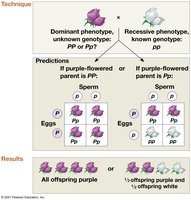
A testcross determines the genotype of an individual with a dominant phenotype by crossing it with a homozygous recessive individual.
If any offspring display the recessive phenotype, the parent is heterozygous.
The Law of Independent Assortment
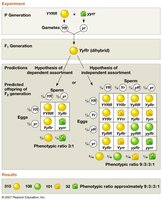
Mendel’s second law states that alleles of different genes assort independently during gamete formation, leading to genetic variation.
Monohybrid cross: Cross between heterozygotes for one character.
Dihybrid cross: Cross between heterozygotes for two characters.
This law applies to genes on different chromosomes or far apart on the same chromosome.
Probability Laws in Genetics
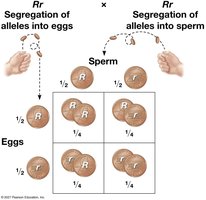
Mendelian inheritance follows the rules of probability, similar to coin tossing.
Multiplication rule: Probability of two independent events occurring together is the product of their probabilities.
Addition rule: Probability of one of several mutually exclusive events is the sum of their probabilities.

Complex Patterns of Inheritance
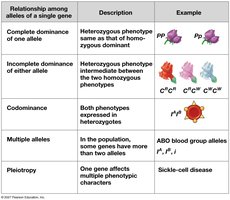
Inheritance patterns can be more complex than simple Mendelian genetics, including incomplete dominance, codominance, multiple alleles, and pleiotropy.
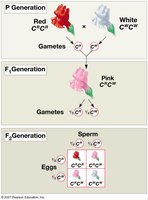
Incomplete dominance: Heterozygote phenotype is intermediate between two homozygotes.
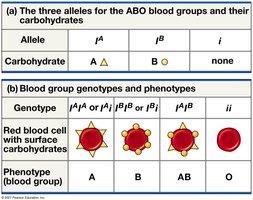
Codominance: Both alleles affect the phenotype in distinguishable ways.
Multiple alleles: More than two allelic forms exist in a population (e.g., ABO blood groups).
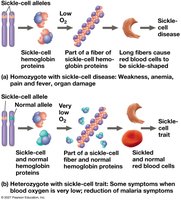
Pleiotropy: One gene affects multiple phenotypic characters.
Inheritance Involving Two or More Genes
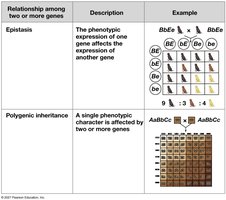
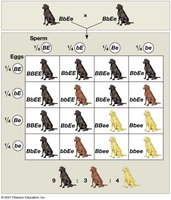
Some traits are determined by interactions between two or more genes, such as epistasis and polygenic inheritance.
Epistasis: Expression of one gene affects the expression of another gene (e.g., coat color in Labradors).
Polygenic inheritance: Multiple genes independently affect a single trait (e.g., height, skin color).
Environmental Impact on Phenotype
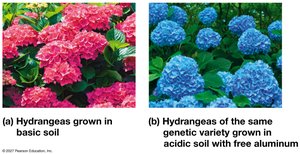
Phenotype can be influenced by environmental factors as well as genotype, especially for polygenic traits.
Phenotypic plasticity: Ability to produce different phenotypes under varying environmental conditions.
Multifactorial traits: Traits influenced by multiple genes and environmental factors.
Human Mendelian Genetics
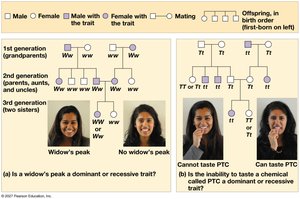
Many human traits follow Mendelian patterns, though humans are not ideal subjects for genetic research due to long generation times and ethical constraints.
Pedigree analysis: Family trees used to study inheritance across generations.
Recessive and Dominant Disorders
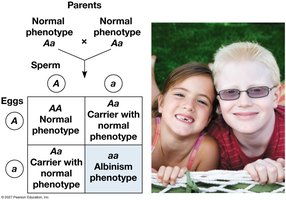
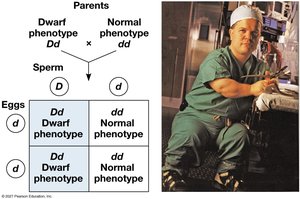
Genetic disorders can be caused by recessive or dominant alleles. Recessive disorders require two copies of the allele, while dominant disorders require only one.
Recessive disorders: Albinism, cystic fibrosis, sickle-cell disease.
Dominant disorders: Achondroplasia, Huntington’s disease.
Carriers: Heterozygous individuals who carry a recessive allele but are phenotypically normal.
Multifactorial Disorders and Genetic Counseling
Many diseases have both genetic and environmental components. Genetic counseling and testing can help prospective parents assess risks.
Examples: Heart disease, cancer, alcoholism, mental illnesses.
Genetic counseling: Provides information about genetic risks and testing options.
Summary Tables
Key relationships among alleles and genes are summarized in the following tables:
Relationship among alleles of a single gene | Description | Example |
|---|---|---|
Complete dominance | Heterozygous phenotype same as that of homozygous dominant | Pp (purple flowers) |
Incomplete dominance | Heterozygous phenotype intermediate between two homozygotes | CRCW (pink snapdragons) |
Codominance | Both phenotypes expressed in heterozygotes | ABO blood group alleles |
Multiple alleles | More than two alleles in population | ABO blood group alleles |
Pleiotropy | One gene affects multiple phenotypic characters | Sickle-cell disease |
Relationship among two or more genes | Description | Example |
|---|---|---|
Epistasis | Phenotypic expression of one gene affects the expression of another gene | Labrador coat color |
Polygenic inheritance | Single phenotypic character affected by two or more genes | Human skin color |