 Back
BackMendel and the Gene: Mono-, Di-, and Trihybrid Crosses
Study Guide - Smart Notes
 Tailored notes based on your materials, expanded with key definitions, examples, and context.
Mendel and the Gene: Mono-, Di-, and Trihybrid Crosses
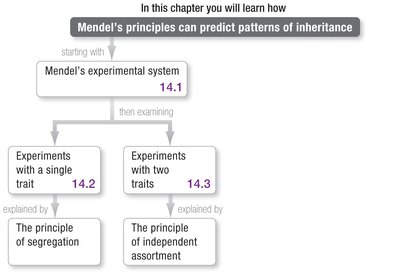
Introduction to Mendelian Genetics
Gregor Mendel, known as the founder of genetics, conducted pioneering experiments with garden peas (Pisum sativum) to understand how traits are inherited from one generation to the next. His systematic approach and careful record-keeping laid the foundation for the field of transmission genetics, which studies the passage of genetic traits from parents to offspring.
Transmission genetics investigates how traits are passed on through generations.
Mendel's work challenged two prevailing hypotheses: blending inheritance and inheritance of acquired characteristics.
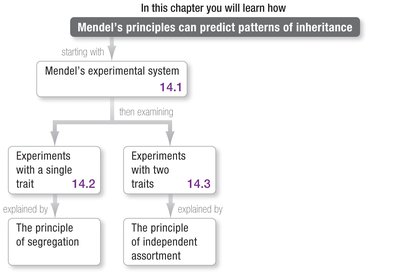
Key Terms in Mendelian Genetics
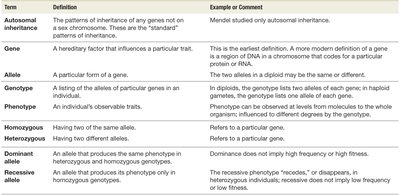
Understanding Mendel's experiments requires familiarity with several key terms:
Term | Definition | Example or Comment |
|---|---|---|
Gene | A hereditary factor that influences a particular trait. | A segment of DNA coding for a protein or RNA. |
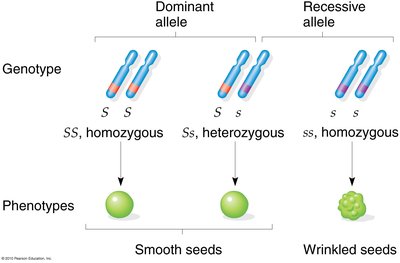
Allele | A particular form of a gene. | Alleles can be the same or different in a diploid organism. |
Genotype | Listing of the alleles of particular genes in an individual. | RR, Rr, or rr for seed shape in peas. |
Phenotype | An individual's observable traits. | Round or wrinkled seeds. |
Homozygous | Having two of the same allele. | RR or rr. |
Heterozygous | Having two different alleles. | Rr. |
Dominant allele | An allele that produces the same phenotype in heterozygotes and homozygotes. | R (round seed shape). |
Recessive allele | An allele that produces its phenotype only in homozygous individuals. | r (wrinkled seed shape). |

Mendel's Model Organism: The Garden Pea
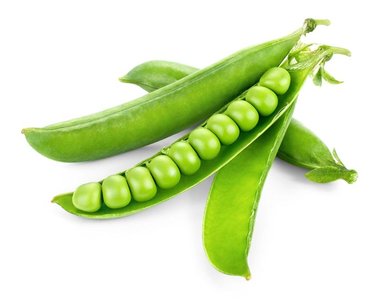
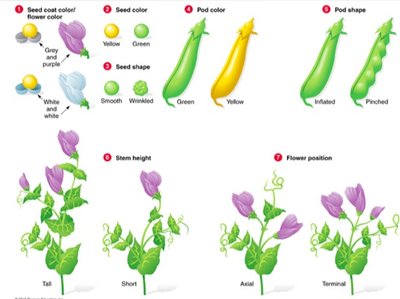
Mendel selected the garden pea as his model organism due to its suitability for controlled breeding experiments. Peas are inexpensive, easy to grow, have a short generation time, produce many seeds, and exhibit many polymorphic traits.
Polymorphic traits: Traits that appear in multiple forms (e.g., seed color, seed shape).
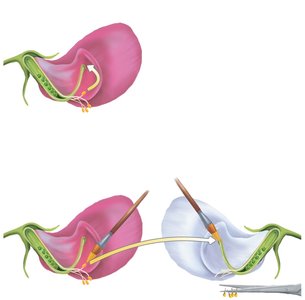
Ability to control mating: Peas can self-fertilize or be cross-fertilized.
Experimental Design: Self-Fertilization and Cross-Fertilization
Mendel used two main breeding methods:
Self-fertilization: The plant's own pollen fertilizes its ovules, producing genetically similar offspring.
Cross-fertilization: Pollen from one plant fertilizes the ovules of another, allowing for controlled genetic crosses.
True-Breeding (Pure Lines) vs. Hybrids
Mendel distinguished between true-breeding lines and hybrids:
True-breeding (pure lines): Individuals that produce offspring identical to themselves when self-fertilized; homozygous for the trait.
Hybrids: Offspring from crosses between true-breeding parents with different phenotypes; heterozygous for the trait.
Monohybrid Crosses and Mendel's First Law
A monohybrid cross examines the inheritance of a single trait. Mendel crossed true-breeding plants with different phenotypes (e.g., round vs. wrinkled seeds) and observed the resulting generations:
F1 generation: All offspring showed the dominant phenotype (round seeds).
F2 generation: The recessive phenotype (wrinkled seeds) reappeared in a 3:1 ratio (dominant:recessive).
Reciprocal Crosses
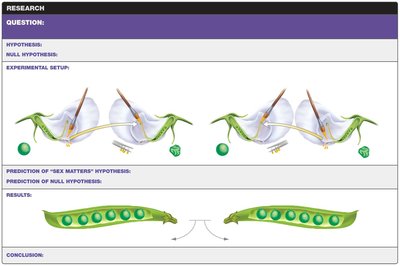
Reciprocal crosses test whether the inheritance of a trait depends on whether the genetic determinant comes from the male or female parent. Mendel found that the results were the same regardless of which parent contributed the trait, indicating that inheritance is not sex-dependent for autosomal traits.
Mendel's Model of Heredity
Mendel proposed that traits are determined by discrete units called genes, which exist in different forms called alleles. Each individual inherits two alleles for each gene, one from each parent. The dominant allele masks the effect of the recessive allele in heterozygotes.
Homozygous: Two identical alleles (RR or rr).
Heterozygous: Two different alleles (Rr).
Punnett Squares: Predicting Genetic Crosses
Punnett squares are used to predict the genotypes and phenotypes of offspring from genetic crosses. Each box represents a possible genotype resulting from the combination of parental gametes.
For a cross between two homozygotes (RR x rr), all F1 offspring are heterozygous (Rr) and display the dominant phenotype.
For a cross between two heterozygotes (Rr x Rr), the F2 generation shows a 3:1 phenotypic ratio and a 1:2:1 genotypic ratio.
Test Crosses
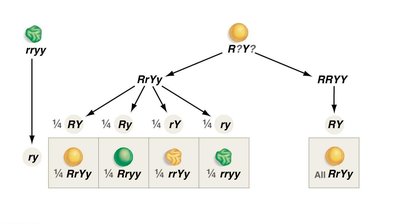
A test cross is used to determine the genotype of an individual with a dominant phenotype by crossing it with a homozygous recessive individual. The phenotypes of the offspring reveal whether the unknown parent is homozygous dominant or heterozygous.
Mendel's First Law: The Principle of Segregation
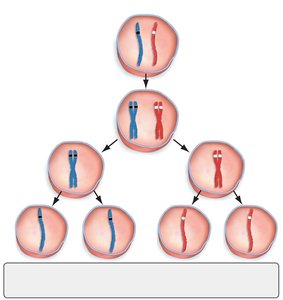
The Principle of Segregation states that the two alleles for a gene segregate during the formation of gametes, so each gamete carries only one allele for each gene. This occurs during anaphase I of meiosis.
Explains the 3:1 ratio observed in the F2 generation of monohybrid crosses.
Dihybrid Crosses and Mendel's Second Law
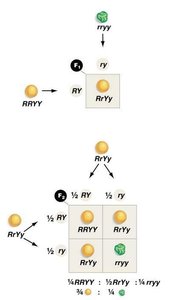
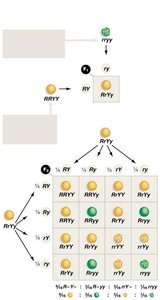
A dihybrid cross examines the inheritance of two traits simultaneously. Mendel crossed plants homozygous for two traits (e.g., round yellow seeds x wrinkled green seeds) and observed the F2 generation.
Tested two hypotheses: independent assortment (alleles of different genes assort independently) and dependent assortment (alleles are inherited together).
Results supported independent assortment, with a 9:3:3:1 phenotypic ratio in the F2 generation.
Mendel's Second Law: The Principle of Independent Assortment
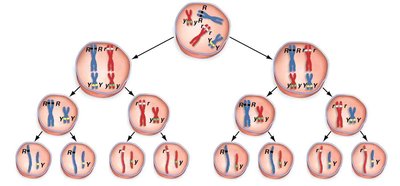
The Principle of Independent Assortment states that alleles of different genes assort independently of one another during gamete formation, provided the genes are on different chromosomes. This explains the variety of genetic combinations observed in offspring from dihybrid crosses.
Each pair of alleles segregates independently during meiosis.
Results in new combinations of traits in the F2 generation.
Summary Table: Mendel's Experimental Results
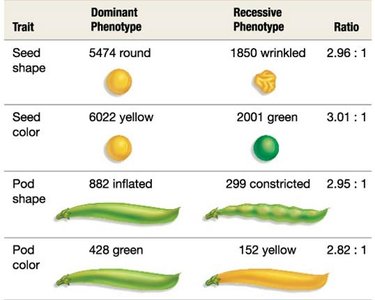
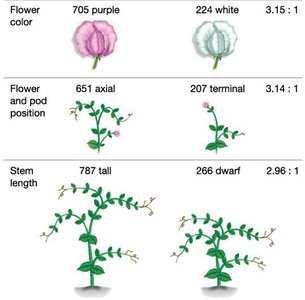
Mendel's experiments with peas revealed consistent inheritance patterns for multiple traits, summarized in the table below:
Trait | Dominant Phenotype | Recessive Phenotype | Ratio |
|---|---|---|---|
Seed shape | Round | Wrinkled | 2.96:1 |
Seed color | Yellow | Green | 3.01:1 |
Pod shape | Inflated | Constricted | 2.95:1 |
Pod color | Green | Yellow | 2.82:1 |
Flower color | Purple | White | 3.15:1 |
Flower and pod position | Axial | Terminal | 3.14:1 |
Stem length | Tall | Dwarf | 2.96:1 |
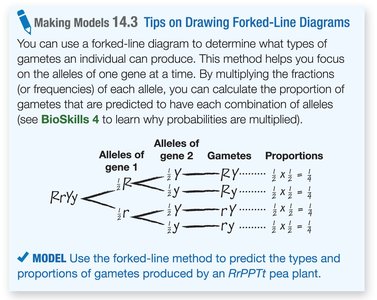
Visualizing Genetic Crosses: Forked-Line Diagrams
Forked-line diagrams help visualize the types and proportions of gametes produced by individuals with multiple heterozygous genes. By multiplying the probabilities of each allele, one can predict the expected genotypic ratios in offspring.
Conclusion
Mendel's principles of segregation and independent assortment form the foundation of classical genetics. His experiments with peas demonstrated that inheritance is governed by discrete units (genes) that segregate and assort independently, leading to predictable patterns in offspring.
