 Back
Mendel and the Gene: Principles of Inheritance
Study Guide - Smart Notes
 Tailored notes based on your materials, expanded with key definitions, examples, and context.
Chapter 14: Mendel and the Gene
Introduction to Mendelian Genetics
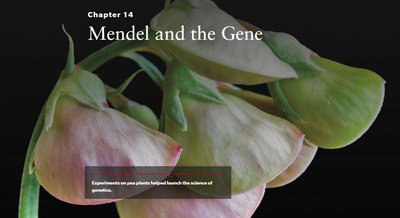
Gregor Mendel's experiments with pea plants established the foundational principles of inheritance, launching the science of genetics. His systematic approach and use of model organisms allowed him to uncover how traits are transmitted from one generation to the next.
14.1 Mendel’s Studies of Inheritance
Rationale for Mendel's Studies
Heredity is the transmission of traits from parents to offspring.
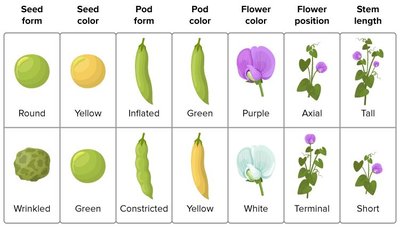
A trait is any observable characteristic of an individual, such as flower color or seed shape.
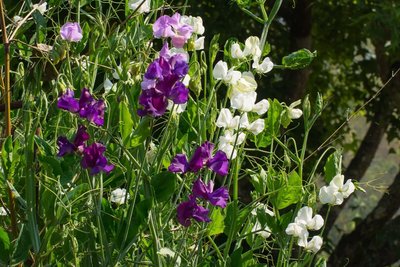
Mendel chose pea plants (Pisum sativum) for their distinct, easily observable traits and ability to self- or cross-pollinate.
Historical Hypotheses of Inheritance
Blending inheritance: Parental traits blend together in offspring, producing intermediate forms.
Inheritance of acquired characteristics: Traits acquired during an organism’s life are passed to offspring.
Mendel’s work disproved both, showing that traits are inherited as discrete units.
Why Pea Plants Were a Good Model System
Pea plants have many distinct traits (e.g., flower color, seed shape, pod color).
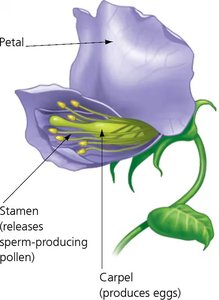
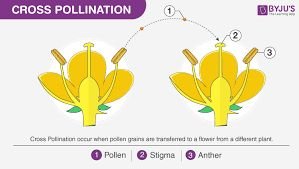
They can self-fertilize or be cross-pollinated, allowing controlled breeding experiments.
Short generation time and large number of offspring facilitate statistical analysis.
Mendel’s Experimental Approach
Mendel began with purebred (homozygous) parental plants (P generation).
He crossed these to produce the first filial (F1) generation, then self- or cross-pollinated F1 plants to produce the F2 generation.
He tracked the inheritance of specific traits across generations.
Key Genetics Terms
Allele: An alternative version of a gene.
Dominant allele: Expressed in the phenotype when present (represented by a capital letter).
Recessive allele: Masked by dominant allele (represented by a lowercase letter).
Homozygous (purebred): Two identical alleles (e.g., PP or pp).
Heterozygous (hybrid): Two different alleles (e.g., Pp).
Genotype: The genetic makeup (e.g., PP, Pp, pp).
Phenotype: The observable trait (e.g., purple or white flowers).
14.2 Monohybrid Crosses and the Principle of Segregation
Monohybrid Crosses
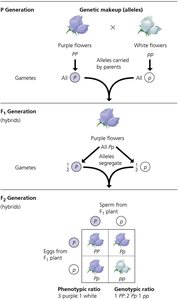
A monohybrid cross examines the inheritance of a single trait. Mendel’s results showed that traits do not blend but segregate according to specific ratios.
Particulate Inheritance Hypothesis
Hereditary determinants (genes) act as discrete, unchanging particles.
Genes do not blend or change through use; they are passed intact to offspring.
Principle of Segregation
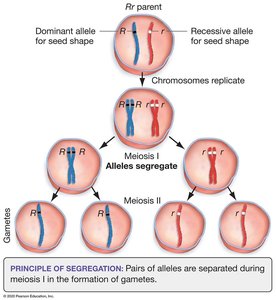
Each individual has two alleles for each gene, which segregate during gamete formation.
Each gamete receives only one allele.
Example: In a cross between two heterozygotes (Pp × Pp), the F2 generation shows a 3:1 phenotypic ratio (purple:white).
14.3 Dihybrid Crosses and the Principle of Independent Assortment
Dihybrid Crosses
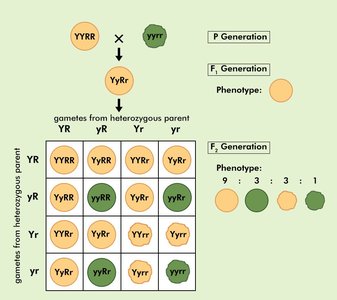
Dihybrid crosses track the inheritance of two traits simultaneously. Mendel used these to test whether traits are inherited independently.
Principle of Independent Assortment
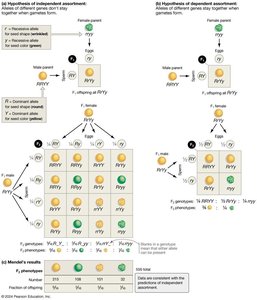
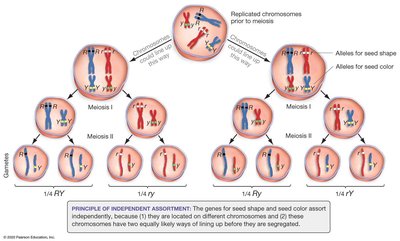
Alleles of different genes assort independently during gamete formation if they are on different chromosomes.
Dihybrid crosses produce a 9:3:3:1 phenotypic ratio in the F2 generation.
Testcross and Evidence for Independent Assortment
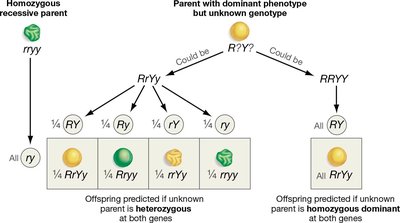
A testcross of a dihybrid (YyRr × yyrr) produces four phenotypes in a 1:1:1:1 ratio, supporting independent assortment.
14.4 Chromosomal Basis of Inheritance
Meiosis and Mendel’s Principles
The behavior of chromosomes during meiosis explains the principles of segregation and independent assortment.
Alleles segregate during meiosis I, and different chromosome pairs assort independently.
X-linked Inheritance
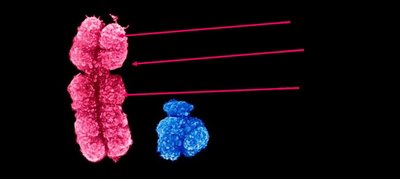
Some genes are located on sex chromosomes (X or Y), leading to sex-linked inheritance patterns.
Punnett squares can be used to predict outcomes of X-linked crosses.

14.5 Extensions of Mendel’s Rules
Linkage
Linkage: Genes located close together on the same chromosome tend to be inherited together and do not assort independently.
Multiple Allelism
More than two alleles can exist for a gene in a population (e.g., ABO blood types: IA, IB, i).
Genotypes for blood types:
Type A: IAIA or IAi
Type B: IBIB or IBi
Type AB: IAIB
Type O: ii
Dominance Relationships
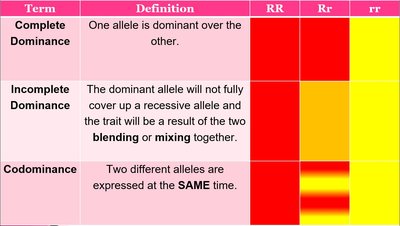
Complete dominance: One allele completely masks the other in heterozygotes.
Incomplete dominance: Heterozygotes show an intermediate phenotype (e.g., red × white flowers produce pink).
Codominance: Both alleles are fully expressed in heterozygotes (e.g., AB blood type).
Term | Definition | RR | Rr | rr |
|---|---|---|---|---|
Complete Dominance | One allele is dominant over the other. | Red | Red | White |
Incomplete Dominance | Trait is a blend of both alleles. | Red | Pink | White |
Codominance | Both alleles are expressed equally. | Red | Red/White | White |
Environmental Effects on Phenotype
Phenotype is influenced by both genotype and environment (e.g., temperature affecting fur color in Himalayan rabbits).
Pleiotropy and Gene Interaction
Pleiotropy: One gene influences multiple traits.
Gene interaction: Multiple genes can interact to affect a single trait (epistasis).
Quantitative Inheritance
Traits like height or color intensity show continuous variation and are controlled by multiple genes (polygenic inheritance).
Nilsson-Ehle’s model explains the normal distribution of such traits.
14.6 Pedigree Analysis
Using Pedigrees to Deduce Inheritance Patterns
Pedigrees are diagrams that show the inheritance of traits in families.
They help determine whether a trait is autosomal or X-linked, and dominant or recessive.
Mode of Inheritance | Pattern in Pedigree |
|---|---|
Autosomal Dominant | Appears in every generation; both sexes equally affected |
Autosomal Recessive | May skip generations; both sexes equally affected |
X-linked Dominant | More females affected; affected fathers pass to all daughters |
X-linked Recessive | More males affected; affected mothers pass to all sons |
Example: A pedigree showing inheritance of freckles can be analyzed to determine the mode of transmission (e.g., autosomal dominant if freckles appear in every generation).
Additional info: This guide expands on the provided notes with definitions, examples, and tables for clarity and completeness, following the structure of a modern biology textbook.
