 Back
Mendel and the Gene: Principles of Inheritance
Study Guide - Smart Notes
 Tailored notes based on your materials, expanded with key definitions, examples, and context.
Introduction to Mendel and the Gene
Historical Foundations of Genetics
Genetics is the branch of biology that focuses on the inheritance of traits from one generation to the next. Gregor Mendel's experiments with garden peas laid the groundwork for the chromosome theory of inheritance, which was later formalized by Sutton and Boveri. This theory asserts that genes are located on chromosomes and are transmitted through meiosis.
Heredity: The transmission of traits from parents to offspring.
Trait: Any characteristic of an individual.
Two early hypotheses: Blending inheritance (traits blend in offspring) and inheritance of acquired characteristics (traits modified through use are passed on).
Mendel’s Experimental System
The Garden Pea as a Model Organism
Mendel chose the garden pea (Pisum sativum) for its practicality and suitability for controlled breeding experiments. Peas are inexpensive, easy to grow, have a short generation time, and produce many seeds. They also exhibit several polymorphic traits, making them ideal for genetic studies.
Model organisms are species used for research whose findings can be generalized to other species.
Polymorphic traits: Traits that appear in two or more distinct forms (e.g., purple vs. white flowers).
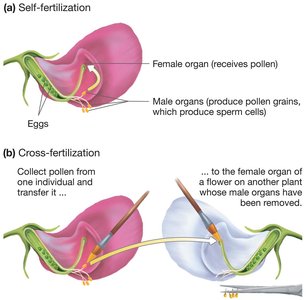
Controlling Matings in Peas
Peas can self-fertilize, but Mendel controlled matings by removing male organs to prevent self-pollination and transferring pollen from one plant to another, a process called cross-fertilization.
Traits Studied by Mendel
Mendel focused on seven easily recognizable traits, each with two distinct phenotypes: seed shape, seed color, pod shape, pod color, flower color, flower and pod position, and stem length. He worked with pure lines (true-breeding lines) and created hybrids by crossing different pure lines.
Key Terms in Mendelian Genetics
Term | Definition | Example/Comment |
|---|---|---|
Gene | Hereditary factor influencing a trait | Region of DNA coding for a protein or RNA |
Allele | Particular form of a gene | Diploids may have same or different alleles |
Genotype | Listing of alleles in an individual | Diploids: two alleles/gene; haploids: one |
Phenotype | Observable traits of an individual | Influenced by genotype and environment |
Homozygous | Two of the same allele | e.g., RR or rr |
Heterozygous | Two different alleles | e.g., Rr |
Dominant allele | Expressed in heterozygotes and homozygotes | Not necessarily most common |
Recessive allele | Expressed only in homozygotes | Hidden in heterozygotes |
Pure line | Individuals always produce same phenotype | Homozygous for gene in question |
Hybrid | Offspring from parents with different genotypes | Heterozygous |
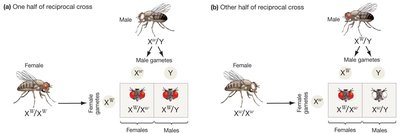
Reciprocal cross | Cross with reversed parental phenotypes | Tests if sex influences inheritance |
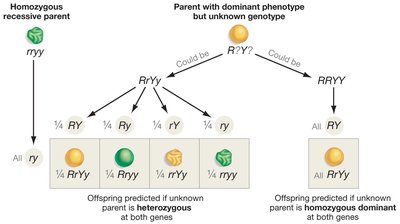
Testcross | Cross with homozygous recessive | Determines unknown genotype |
X-linked/Y-linked | Gene on X or Y chromosome | Different inheritance patterns in sexes |
Mendel’s Experiments with a Single Trait
Monohybrid Crosses
Mendel crossed pure lines differing in one trait (e.g., round vs. wrinkled seeds). All F1 offspring had the dominant phenotype, contradicting blending inheritance. When F1 plants self-pollinated, the recessive trait reappeared in the F2 generation in a 3:1 ratio.
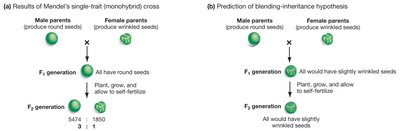
Reciprocal Crosses
To test if inheritance was influenced by parent sex, Mendel performed reciprocal crosses. The results were identical, indicating that inheritance was not affected by whether the trait came from the male or female parent.
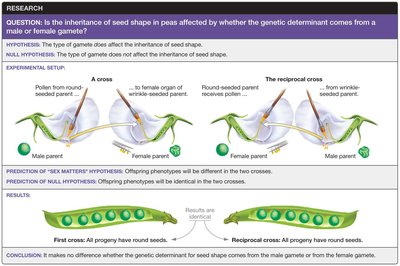
Particulate Inheritance
Mendel proposed that hereditary determinants (genes) do not blend but act as discrete, unchanging particles. Each individual has two alleles for each gene, and the combination of these alleles (genotype) determines the phenotype.
The Principle of Segregation
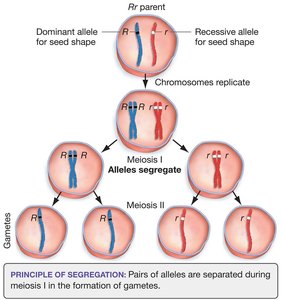
This principle states that the two alleles for each gene segregate during gamete formation, so each gamete carries only one allele for each gene. This explains the 3:1 ratio observed in the F2 generation.
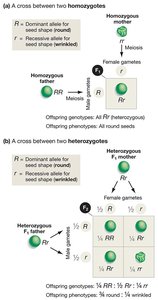
Punnett Squares
Punnett squares are used to predict the genotypes and phenotypes of offspring from genetic crosses. Each unique gamete genotype from one parent is written along the top, and those from the other parent along the side. The boxes are filled in to show possible offspring combinations.
Mendel’s Experiments with Two Traits
Dihybrid Crosses and Independent Assortment
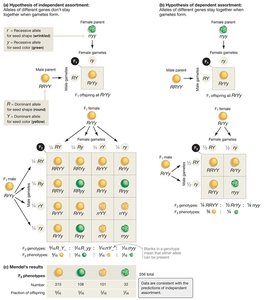
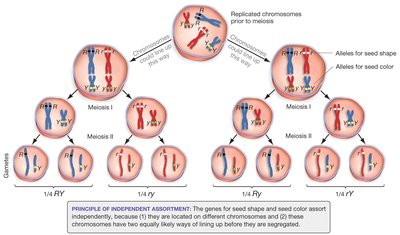
Mendel performed dihybrid crosses to determine if alleles of different genes segregate together or independently. His results supported the principle of independent assortment: alleles of different genes are transmitted independently, resulting in a 9:3:3:1 phenotypic ratio in the F2 generation.
Testcrosses
A testcross involves crossing an individual with a dominant phenotype (but unknown genotype) with a homozygous recessive individual. The phenotypes of the offspring reveal the genotype of the unknown parent.
The Chromosome Theory of Inheritance
Genes on Chromosomes
The chromosome theory of inheritance links Mendel’s principles to the behavior of chromosomes during meiosis. Genes are located on chromosomes at specific loci, and the physical separation of alleles during meiosis I explains the principle of segregation.
Sex Linkage and Chromosome Theory
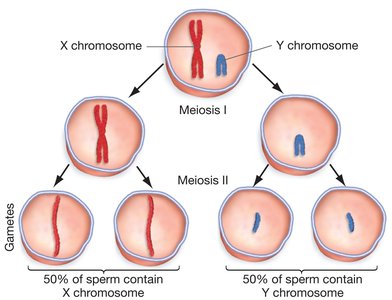
Sex chromosomes (X and Y) determine gender in many species. Genes located on these chromosomes exhibit sex-linked inheritance patterns. For example, the gene for white eye color in Drosophila melanogaster is X-linked, as demonstrated by reciprocal crosses.
Extending Mendel’s Rules
Linkage and Crossing Over
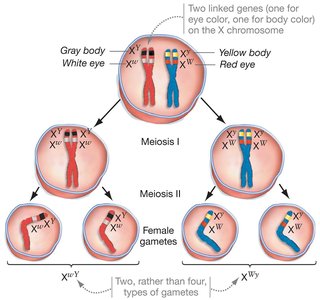
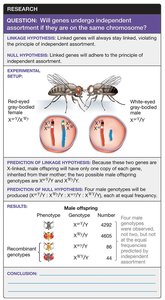
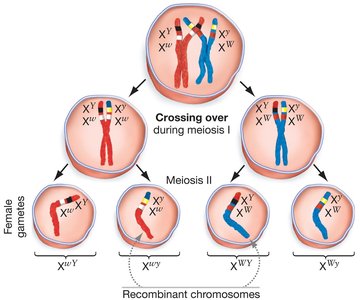
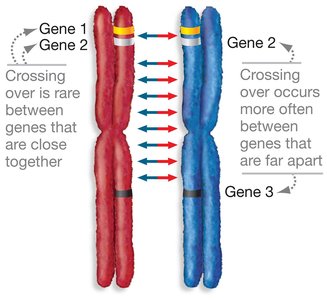
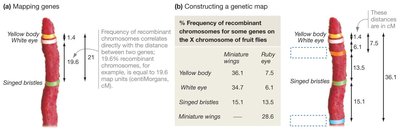
Genes located on the same chromosome tend to be inherited together (linkage). However, crossing over during meiosis can separate linked genes, resulting in genetic recombination. The frequency of recombination can be used to map the relative positions of genes on a chromosome.
Multiple Alleles, Codominance, and Incomplete Dominance
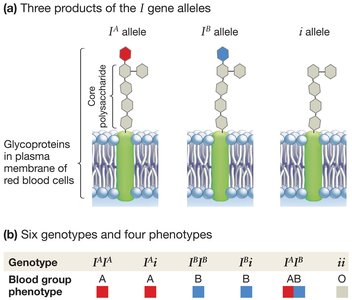
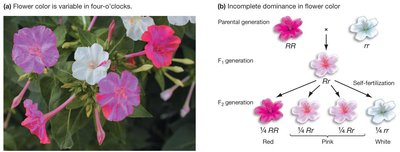
Many genes have more than two alleles (multiple allelism). Some alleles are codominant (both phenotypes are expressed in heterozygotes), while others show incomplete dominance (heterozygotes have an intermediate phenotype).
Pleiotropy and Gene Interactions
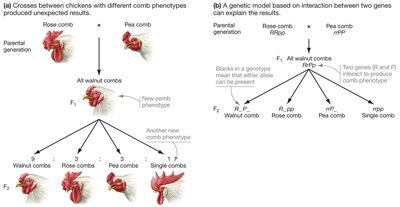
Pleiotropy occurs when a single gene affects multiple traits. Gene interactions, such as epistasis, occur when the expression of one gene is influenced by one or more other genes. For example, the H gene affects the expression of ABO blood types.
Environmental Effects and Quantitative Traits
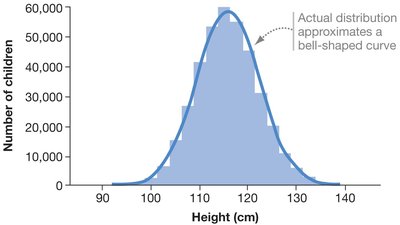
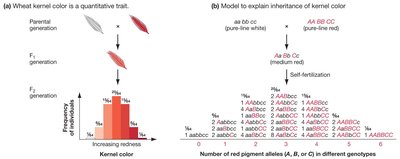
Most phenotypes are influenced by both genotype and environment. Quantitative traits, such as height, show continuous variation and are often influenced by many genes (polygenic inheritance). These traits typically display a normal distribution in populations.
Applying Mendel’s Rules to Human Inheritance
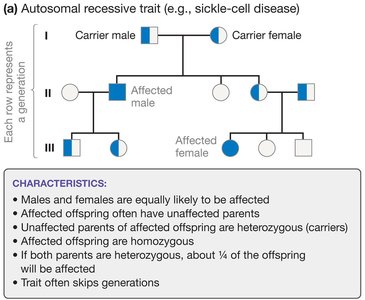
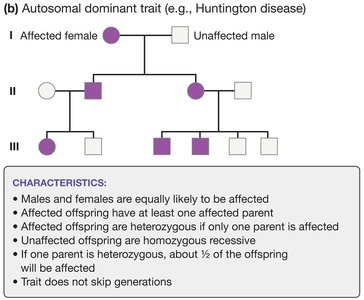
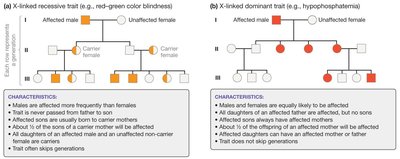
Pedigree Analysis
Pedigrees are used to study the inheritance of traits in humans. They can reveal whether a trait is autosomal or sex-linked, and whether it is dominant or recessive.
Autosomal Recessive and Dominant Traits
Autosomal recessive traits: Individuals must be homozygous recessive to express the trait. Carriers are heterozygous and do not show the trait. Example: sickle cell disease.
Autosomal dominant traits: Only one copy of the dominant allele is needed to express the trait. Example: Huntington disease.
Sex-Linked Traits
X-linked recessive traits: More common in males; females must be homozygous to express the trait. Example: red–green color blindness.
X-linked dominant traits: Rare; affected males pass the trait to all daughters but no sons. Example: hypophosphatemia.
Y-linked traits: Very few; mostly related to male sexual development.
Summary Table: Exceptions and Extensions to Mendel’s Rules
Type of Inheritance | Definition | Comments |
|---|---|---|
Sex linkage | Gene on a sex chromosome | Different patterns in males and females |
Linkage | Genes on the same chromosome | Do not assort independently |
Codominance | Heterozygotes show both phenotypes | More than two phenotypes possible |
Incomplete dominance | Heterozygotes have intermediate phenotype | Common pattern |
Multiple allelism | More than two alleles for a locus | More than two phenotypes possible |
Pleiotropy | One gene affects many traits | Common in genetics |
Polygenic trait | Trait influenced by many genes | Continuous variation |
Gene–gene interaction | Phenotype depends on alleles of other genes | Leads to variable phenotypes |
Epistasis | Alleles of one gene mask another | Unexpected phenotypes |
Environmental effects | Phenotype influenced by environment | Same genotype, different phenotypes |
