 Back
Mendel and the Gene: Principles of Inheritance
Study Guide - Smart Notes
 Tailored notes based on your materials, expanded with key definitions, examples, and context.
Chapter 14: Mendel and the Gene
Introduction to Mendelian Genetics
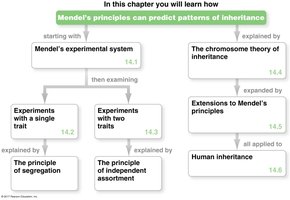
Mendelian genetics forms the foundation of classical genetics, describing how traits are inherited from one generation to the next. Gregor Mendel's experiments with the garden pea (Pisum sativum) established the basic rules of inheritance, which were later explained by the Chromosomal Theory of Inheritance.
Heredity: The transmission of traits from parents to offspring.
Trait: Any inherited characteristic, as opposed to learned characteristics.
Genetics: The branch of biology focusing on the inheritance of traits.
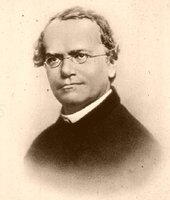
Gregor Mendel: The Father of Genetics
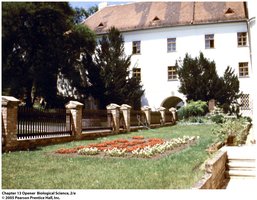
Gregor Mendel was an Austrian monk who studied heredity in the 1800s. His work at a monastery dedicated to agricultural improvement led to the discovery of fundamental genetic principles.
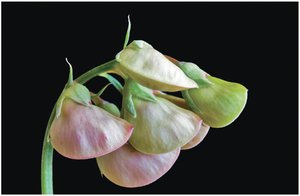
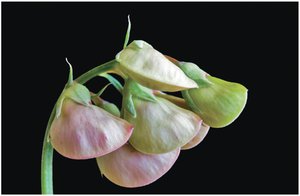
Model Organism: Mendel used the garden pea (Pisum sativum) for its ease of propagation, short reproductive cycle, and large sample size.
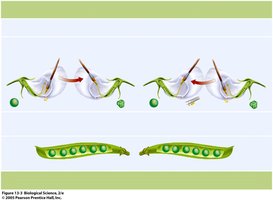
Controlled Mating: Peas are normally self-pollinating, but Mendel could control mating through artificial pollination.
Mendel’s Experimental System
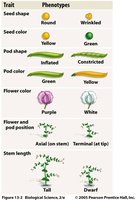
Mendel selected seven traits in peas, each with two distinct phenotypes, allowing clear observation of inheritance patterns. He established pure (true-breeding) lines to ensure consistency in his experiments.
Pure Lines: Produce offspring identical to parents, enabling controlled crosses and hybrid production.
Phenotype: Observable physical expression of a genotype.
Mendel’s Experiments with a Single Trait (Monohybrid Crosses)
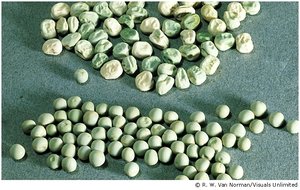
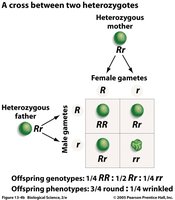
Mendel first studied the inheritance of a single trait, such as seed shape (round vs. wrinkled). He observed that crossing pure lines produced hybrids, and self-fertilization of hybrids resulted in a 3:1 ratio in the F2 generation.
Dominant Trait: The trait visible in F1 hybrids.
Recessive Trait: The trait reappearing in the F2 generation.
Genotype: The alleles an individual has for a trait (e.g., RR, Rr, rr).
Principle of Segregation
Mendel proposed the principle of segregation to explain the 3:1 ratio observed in the F2 generation. During gamete formation, alleles are separated into different daughter cells, and fertilization restores the diploid state.
Homozygous: Having two copies of the same allele (e.g., RR or rr).
Heterozygous: Having different alleles for a trait (e.g., Rr).
Punnett Squares and Probability
Punnett squares are diagrams used to predict expected genotypes and phenotypes from genetic crosses. The rules of probability are fundamental to these predictions.
Multiplication Rule: Probability of two independent events occurring together is the product of their individual probabilities.
Addition Rule: Probability of an event occurring in more than one way is the sum of the probabilities of each way.
Principle of Independent Assortment (Dihybrid Crosses)
Mendel extended his experiments to two traits, observing that alleles of different genes assort independently during gamete formation, as long as the genes are on different chromosomes.
Dihybrid Cross: Follows the inheritance of two traits simultaneously.
Independent Assortment: Each pair of alleles segregates independently of other pairs.
The Chromosomal Theory of Inheritance
The Chromosomal Theory of Inheritance explains how genetic information is transmitted via chromosomes. The behavior of chromosomes during meiosis accounts for Mendel’s rules.
Genes: Located on chromosomes.
Meiosis: Causes patterns of inheritance observed by Mendel.
Extensions to Mendel’s Principles
Further research revealed exceptions and extensions to Mendel’s rules, including gene linkage, incomplete dominance, codominance, multiple alleles, pleiotropy, environmental effects, gene-gene interactions, and polygenic inheritance.
Gene Linkage: Genes located on the same chromosome are inherited together unless separated by crossing over.
Incomplete Dominance: Heterozygotes show intermediate phenotypes.
Codominance: Both alleles are fully expressed in heterozygotes.
Multiple Alleles: More than two alleles exist for a gene, resulting in polymorphism.
Pleiotropy: One gene affects multiple traits.
Environmental Effects: Phenotype can be influenced by environmental factors.
Gene-Gene Interaction: Expression of one gene is affected by others.
Polygenic Inheritance: Multiple genes contribute to a trait, resulting in continuous variation.
Applying Mendel’s Rules to Human Inheritance
Pedigrees are used to study inheritance in humans. Traits can be autosomal recessive, autosomal dominant, or X-linked, each with distinct inheritance patterns.
Autosomal Recessive: Trait expressed only in homozygous recessive individuals (e.g., cystic fibrosis).
Autosomal Dominant: Trait expressed in both homozygous and heterozygous dominants (e.g., Huntington’s disease).
X-linked: Trait seen predominantly in males, often skips generations (e.g., hemophilia).
Summary Table: Mendelian Principles and Extensions
Principle | Description | Example |
|---|---|---|
Segregation | Alleles separate during gamete formation | Monohybrid cross (3:1 ratio) |
Independent Assortment | Alleles of different genes assort independently | Dihybrid cross (9:3:3:1 ratio) |
Gene Linkage | Genes on same chromosome inherited together | Linked genes in Drosophila |
Incomplete Dominance | Intermediate phenotype in heterozygotes | Four-o'clock flowers |
Codominance | Both alleles expressed in heterozygotes | ABO blood type |
Polygenic Inheritance | Multiple genes contribute to trait | Human height |
