 Back
Mendel and the Gene: Principles of Inheritance
Study Guide - Smart Notes
 Tailored notes based on your materials, expanded with key definitions, examples, and context.
Chapter 14: Mendel and the Gene
Introduction to Mendel and the Gene
Gregor Mendel's experiments with garden peas established the foundation for the chromosome theory of inheritance, linking genetic information transmission to meiosis. Genetics is the branch of biology focused on inheritance, and Mendel's work clarified how traits are passed from one generation to the next.
Mendel’s Experimental System
Mendel sought to understand heredity—the transmission of traits from parents to offspring. At the time, two main hypotheses existed: blending inheritance (traits blend in offspring) and inheritance of acquired characteristics (traits modified by use are passed on). Mendel chose garden peas as his model organism due to their practicality and polymorphic traits.
Model organism: Species used for research, practical to work with, and conclusions can be applied to other species.
Polymorphic traits: Traits that appear in two or more distinct forms (e.g., purple vs. white flowers).
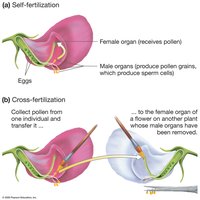
Controlling Matings in Peas
Peas normally self-fertilize, but Mendel controlled matings by removing male organs and using pollen from one flower to fertilize another, a process called cross-fertilization.
Traits Studied by Mendel
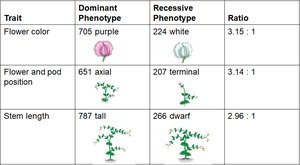
Mendel examined seven easily recognizable traits, each with two distinct phenotypes. He worked with pure lines (true-breeding) and created hybrids by mating different pure lines.
Trait | Dominant Phenotype | Recessive Phenotype | Ratio |
|---|---|---|---|
Flower color | 705 purple | 224 white | 3.15 : 1 |
Flower and pod position | 651 axial | 207 terminal | 3.14 : 1 |
Stem length | 787 tall | 266 dwarf | 2.96 : 1 |
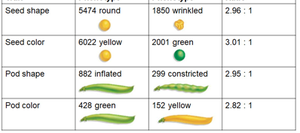
Seed shape | 5474 round | 1850 wrinkled | 2.96 : 1 |
Seed color | 6022 yellow | 2001 green | 3.01 : 1 |
Pod shape | 882 inflated | 299 constricted | 2.95 : 1 |
Pod color | 428 green | 152 yellow | 2.82 : 1 |
Mendel’s Experiments with a Single Trait (Monohybrid Cross)
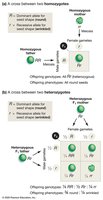
Mendel crossed pure lines differing in one trait (e.g., round vs. wrinkled seeds). All F1 offspring had the dominant phenotype, contradicting blending inheritance. The F2 generation showed a 3:1 ratio of dominant to recessive phenotypes.
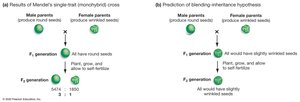
Dominant and Recessive Traits
Dominant trait: Phenotype that appears in heterozygotes.
Recessive trait: Phenotype that is masked in heterozygotes.
Monohybrid cross: Mating between parents with two different genetic determinants for the same trait.
Reciprocal Crosses
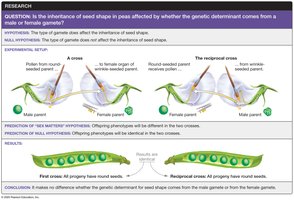
Reciprocal crosses test whether gender influences inheritance. Results were identical, showing that inheritance is not affected by the parent’s gender.
Particulate Inheritance
Mendel proposed that hereditary determinants act as discrete, unchanging particles (genes), not blending or changing through use.
Genes, Alleles, and Genotypes
Gene: Hereditary determinant for a trait.
Allele: Different versions of a gene.
Genotype: Combination of alleles in an individual.
The Principle of Segregation
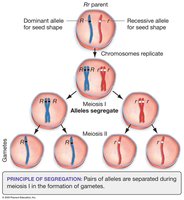
Each individual has two alleles for each gene, which segregate into different gametes during meiosis. This explains the 3:1 ratio in F2 generations.
Homozygous: Two copies of the same allele (RR or rr).
Heterozygous: Two different alleles (Rr).
Predicting Offspring Genotypes and Phenotypes with a Punnett Square
Punnett squares are used to predict the proportions of offspring genotypes and phenotypes by arranging gamete genotypes from each parent.
Mendel’s Experiments with Two Traits (Dihybrid Cross)
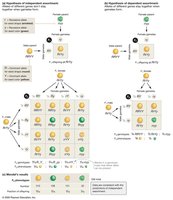
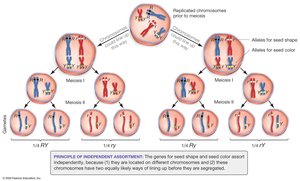
Mendel used dihybrid crosses to test whether alleles of different genes segregate together or independently. His results supported the principle of independent assortment, with a 9:3:3:1 ratio of phenotypes.
Testcrosses
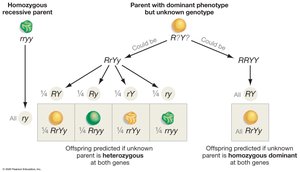
A testcross involves crossing a parent with a dominant phenotype (unknown genotype) with a parent contributing only recessive alleles. The offspring’s phenotypes reveal the unknown genotype.
The Chromosome Theory of Inheritance
The chromosome theory of inheritance, proposed by Sutton and Boveri, states that genes are located on chromosomes at specific loci. Physical separation of alleles during meiosis I explains Mendel’s principle of segregation.
Probability in Genetics
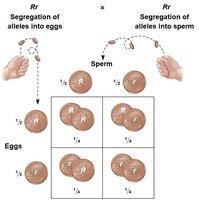
Mendel’s laws reflect the rules of probability. The multiplication rule calculates the probability of independent events occurring together, while the addition rule calculates the probability of exclusive events.
Multiplication rule:
Addition rule:
Testing the Chromosome Theory: Sex Linkage
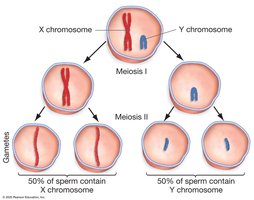
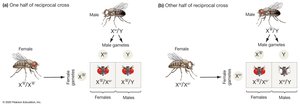
Studies in Drosophila revealed sex chromosomes (X and Y) and sex-linked inheritance. X-linked genes are located on the X chromosome, and Y-linked genes are on the Y chromosome. Autosomal genes are on non-sex chromosomes.
Extending Mendel’s Rules
Some traits do not follow Mendel’s ratios due to linkage, multiple alleles, codominance, incomplete dominance, pleiotropy, gene interaction, and environmental effects.
Linkage
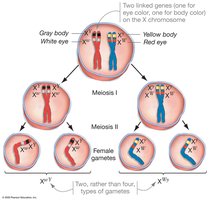
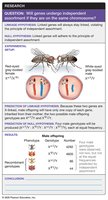
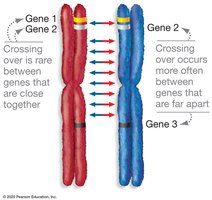
Linkage is the tendency of genes located on the same chromosome to be inherited together. Linked genes do not always assort independently.
Crossing Over and Genetic Recombination
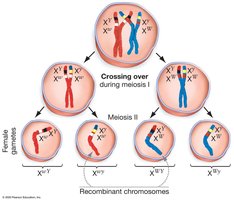
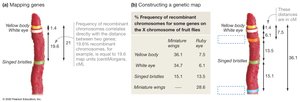
Crossing over during meiosis can separate linked genes, resulting in recombinant offspring. The frequency of recombination estimates the distance between genes and is used to create genetic maps.
Multiple Allelism
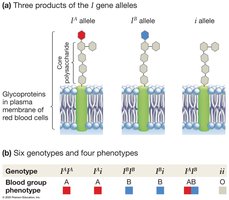
Some genes have more than two alleles in a population. For example, the ABO blood group in humans has three common alleles (IA, IB, i).
Codominance and Incomplete Dominance
Codominance: Both alleles are expressed in heterozygotes (e.g., AB blood type).
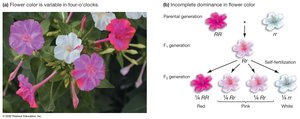
Incomplete dominance: Heterozygotes have an intermediate phenotype (e.g., pink flowers from red and white parents).
Pleiotropy
Some genes affect multiple traits, a phenomenon known as pleiotropy. For example, Marfan syndrome is caused by a single gene mutation affecting many phenotypes.
Gene Interaction and Epistasis
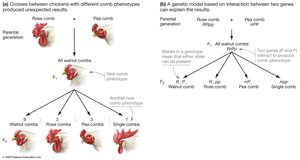
Two or more genes can interact to influence a single trait. Epistasis occurs when the expression of one gene is masked by another gene’s genotype.
Environmental Effects
Phenotypes are often influenced by both genotype and environment. For example, individuals with phenylketonuria (PKU) can develop normally if placed on a low-phenylalanine diet.
Quantitative Traits
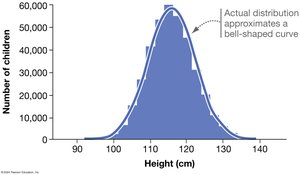
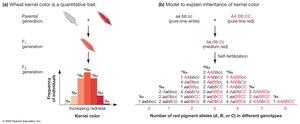
Traits that vary continuously (quantitative traits) are influenced by many genes and environmental factors. These traits often show a normal distribution.
Applying Mendel’s Rules to Human Inheritance
Pedigrees are used to analyze the mode of transmission for traits in humans, distinguishing between autosomal and sex-linked, and dominant or recessive inheritance.
Autosomal Recessive Traits
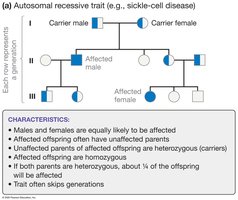
Traits appear only in homozygous individuals. Carriers are heterozygous and do not show the trait. Example: sickle cell disease.
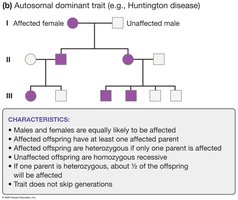
Autosomal Dominant Traits
Traits appear in both homozygous and heterozygous individuals. Example: Huntington disease.
X-Linked Recessive Traits
More common in males; females must be homozygous to express the trait. Example: red–green color blindness.
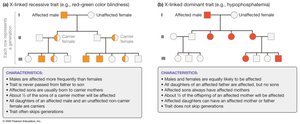
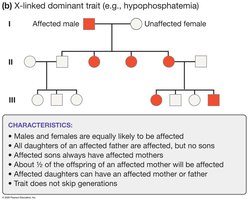
X-Linked Dominant Traits
Rare; affected males pass the trait to all daughters but not sons. Example: hypophosphatemia.
Y-Linked Traits
Very few genes are on the Y chromosome, mostly involved in male sexual development. No other known human Y-linked traits.
