 Back
Mendel and the Gene: Principles of Inheritance
Study Guide - Smart Notes
 Tailored notes based on your materials, expanded with key definitions, examples, and context.
Chapter 14: Mendel and the Gene
Introduction to Mendel and the Gene
Gregor Mendel's experiments with garden peas established the foundation for the chromosome theory of inheritance. Genetics, the study of heredity, investigates how traits are transmitted from one generation to the next. Sutton and Boveri later linked inheritance to meiosis, asserting that genes are located on chromosomes.
14.1 Mendel’s Experimental System
Mendel sought to understand heredity—the transmission of traits from parents to offspring. At the time, two hypotheses existed: blending inheritance (traits blend in offspring) and inheritance of acquired characteristics (traits modified by use are passed on). Mendel chose garden peas as a model organism due to their practicality and polymorphic traits.
Model organism: Species used for research, practical to work with, and conclusions can be generalized.
Polymorphic traits: Traits that appear in two or more distinct forms (e.g., purple vs. white flowers).
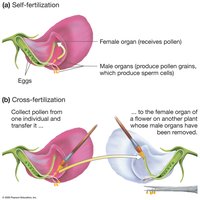
How Did Mendel Control Matings?
Peas normally self-fertilize, but Mendel controlled matings by removing male organs and using pollen from one flower to fertilize another, a process called cross-fertilization.
What Traits Did Mendel Study?
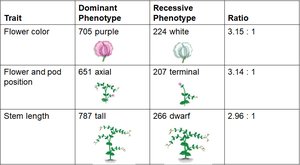
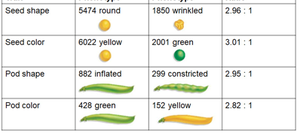
Mendel studied seven easily recognizable traits, each with two distinct phenotypes. He worked with pure lines (true-breeding) and created hybrids by mating different pure lines.
Phenotype: Observable features of an individual.
Pure lines: Plants that produce offspring identical to themselves when self-fertilized.
Hybrid: Offspring from mating two different pure lines.
Trait | Dominant Phenotype | Recessive Phenotype | Ratio |
|---|---|---|---|
Flower color | 705 purple | 224 white | 3.15 : 1 |
Flower and pod position | 651 axial | 207 terminal | 3.14 : 1 |
Stem length | 787 tall | 266 dwarf | 2.96 : 1 |
Seed shape | 5474 round | 1850 wrinkled | 2.96 : 1 |
Seed color | 6022 yellow | 2001 green | 3.01 : 1 |
Pod shape | 882 inflated | 299 constricted | 2.95 : 1 |
Pod color | 428 green | 152 yellow | 2.82 : 1 |
14.2 Mendel’s Experiments with a Single Trait
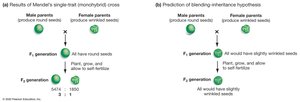
Mendel's first experiments involved crossing pure lines differing in one trait (monohybrid cross). All F1 offspring had the dominant phenotype, contradicting blending inheritance. The F2 generation showed a 3:1 ratio of dominant to recessive phenotypes.
Dominant trait: Phenotype that appears in heterozygotes.
Recessive trait: Phenotype that is masked in heterozygotes.
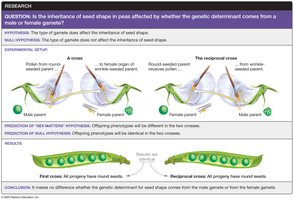
A Reciprocal Cross
Mendel performed reciprocal crosses to test if gender influenced inheritance. Results were identical, indicating that inheritance was not affected by the parent’s gender.
Particulate Inheritance
Mendel proposed that hereditary determinants act as discrete, unchanging particles (genes), not blending or changing through use.
Genes, Alleles, and Genotypes
Gene: Hereditary determinant for a trait.
Allele: Different versions of a gene.
Genotype: Combination of alleles in an individual.
The Principle of Segregation
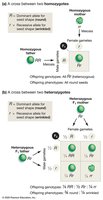
Mendel’s principle of segregation states that two members of each gene pair segregate into different gametes during egg and sperm formation. Homozygous individuals have two identical alleles; heterozygous individuals have two different alleles.
Predicting Offspring Genotypes and Phenotypes with a Punnett Square
Punnett squares are used to predict offspring genotypes and phenotypes by arranging gamete genotypes and calculating proportions.
14.3 Mendel’s Experiments with Two Traits
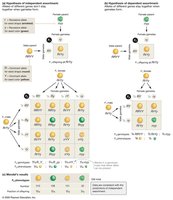
Mendel used dihybrid crosses to test whether alleles of different genes segregate together or independently. His results supported the principle of independent assortment, predicting a 9:3:3:1 ratio in the F2 generation.
Independent assortment: Alleles of different genes are transmitted independently.
Dependent assortment: Transmission of one allele depends on another.
Using a Testcross to Confirm Predictions
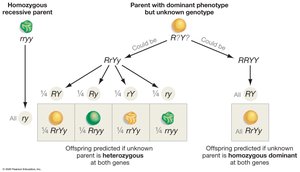
A testcross involves crossing a parent with a dominant phenotype (unknown genotype) with a parent contributing only recessive alleles. The offspring’s phenotypes reveal the unknown genotype.
14.4 The Chromosome Theory of Inheritance
The chromosome theory of inheritance arose from observations of meiosis. Genes are located on chromosomes at specific loci, and physical separation of alleles during meiosis I explains Mendel’s principle of segregation.
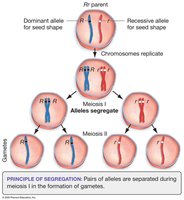
Meiosis Explains Mendel’s Principles
Genes for different traits assort independently at meiosis I because they are located on different nonhomologous chromosomes.
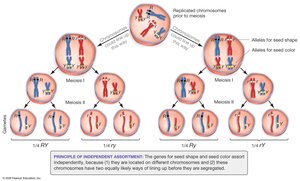
Rules of Probability in Genetics
Multiplication rule: Probability of two independent events occurring together is the product of their individual probabilities.
Addition rule: Probability of any one of two or more exclusive events is the sum of their individual probabilities.
These rules are applied to predict outcomes of genetic crosses.
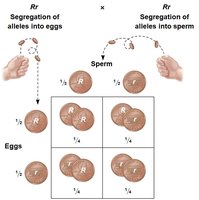
Solving Genetics Problems with Probability
Multicharacter crosses are equivalent to multiple independent monohybrid crosses. Probabilities for each character are calculated separately and multiplied.
Testing the Chromosome Theory of Inheritance
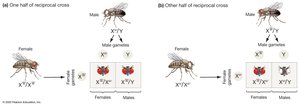
Drosophila melanogaster (fruit fly) was used as a model organism. Morgan’s experiments with eye color mutations revealed sex-linked inheritance.
The Discovery of Sex Chromosomes
Stevens discovered X and Y chromosomes. Females have two X chromosomes; males have one X and one Y.
Sex Linkage and the Chromosome Theory of Inheritance
Genes located on sex chromosomes exhibit sex-linked inheritance. X-linked genes are on the X chromosome; Y-linked genes are on the Y chromosome. Autosomal genes are on non-sex chromosomes.
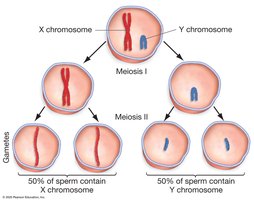
14.5 Extending Mendel’s Rules
Some traits do not conform to Mendel’s ratios due to linkage, multiple alleles, codominance, incomplete dominance, pleiotropy, gene interaction, and environmental effects.
Linkage
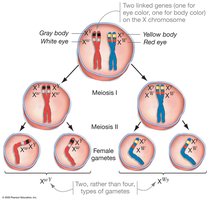
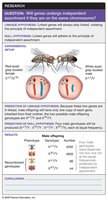
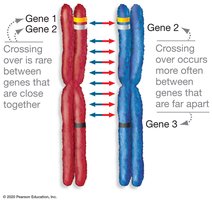
Linkage is the tendency of genes located on the same chromosome to be inherited together. Linked genes do not always assort independently.
The Role of Crossing Over
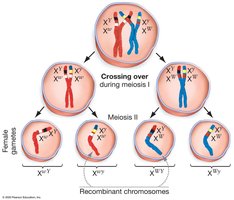
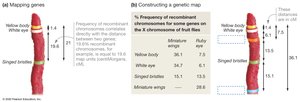
Crossing over during meiosis I can separate linked genes, resulting in recombinant genotypes. The frequency of recombination is used to estimate gene distance and construct genetic maps.
Multiple Allelism
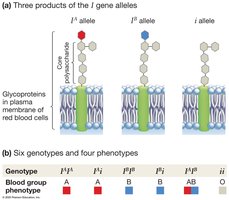
Genes can have more than two alleles in a population. For example, the ABO blood group in humans has three common alleles (IA, IB, i).
Codominance and Incomplete Dominance
Codominance: Both alleles are fully expressed in heterozygotes (e.g., AB blood type).
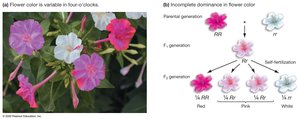
Incomplete dominance: Heterozygotes have an intermediate phenotype (e.g., pink flowers from red and white parents).
Pleiotropy
Some genes affect multiple traits. For example, Marfan syndrome is caused by a single gene mutation affecting various phenotypes.
Gene Interaction and Epistasis
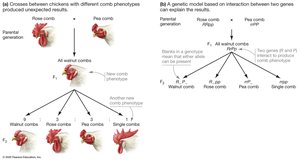
Two or more genes can interact to influence a single trait. Epistasis occurs when the expression of one gene is masked by another gene’s genotype.
Environmental Effects
Phenotypes are often influenced by environmental factors as well as genotypes. For example, individuals with phenylketonuria (PKU) can develop normally with a low-phenylalanine diet.
Quantitative Traits
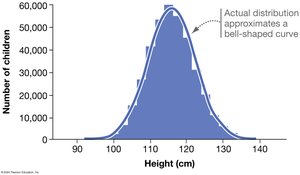
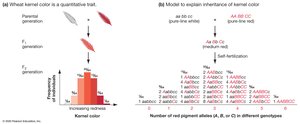
Traits that vary continuously (quantitative traits) are influenced by many genes and environmental factors. These traits often show a normal distribution.
14.6 Applying Mendel’s Rules to Human Inheritance
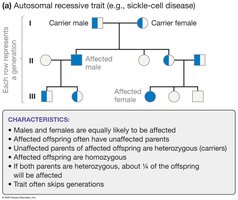
Pedigrees are used to analyze inheritance patterns in humans. Traits can be autosomal or sex-linked, and dominant or recessive.
Autosomal Recessive Traits
Individuals with autosomal recessive traits must be homozygous. Carriers are heterozygous and do not show the trait. Example: sickle cell disease.
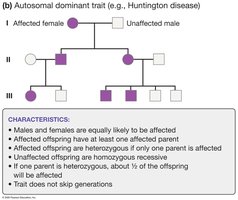
Autosomal Dominant Traits
Individuals with autosomal dominant traits can be homozygous or heterozygous. Example: Huntington disease.
X-Linked Recessive Traits
X-linked recessive traits are more common in males. Example: red–green color blindness.
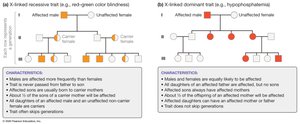
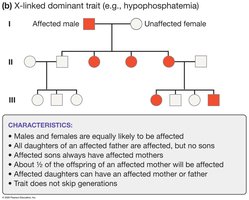
X-Linked Dominant Traits
X-linked dominant traits are rare. Affected males pass the trait to all daughters but not sons. Example: hypophosphatemia.
Y-Linked Traits
Y-linked traits are very rare and mostly involve male sexual development.
Additional info: Academic context was added to clarify definitions, examples, and explanations for each topic. Tables and images were included only when directly relevant to the explanation.
