Back
Mendel and the Gene: Principles of Heredity and Patterns of Inheritance
Study Guide - Smart Notes
 Tailored notes based on your materials, expanded with key definitions, examples, and context.
Chapter 14: Mendel and the Gene
Introduction to Mendelian Genetics
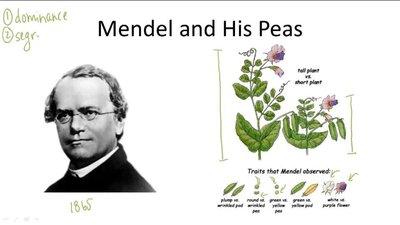
Gregor Mendel's experiments with pea plants established the foundational principles of heredity. His systematic and quantitative approach led to the discovery of two fundamental laws: the Law of Segregation and the Law of Independent Assortment. These laws explain how traits are inherited from one generation to the next and how genetic variation arises.

Key Terms and Concepts
Heredity: The transmission of traits from parents to offspring.
Trait: A specific characteristic, such as flower color or seed shape.
Gene: A unit of heredity that encodes information for a trait.
Allele: Alternative versions of a gene.
Locus: The specific location of a gene on a chromosome.
Chromosome: A structure that carries genetic information.
Genotype: The genetic makeup of an organism.
Phenotype: The observable traits of an organism.
Carrier: An individual who has one copy of a recessive allele.
True-breeding: Organisms that produce offspring identical to themselves when self-fertilized.
P, F1, F2 Generations: Parental, first filial, and second filial generations in genetic crosses.
Homozygous: Having two identical alleles for a gene.
Heterozygous: Having two different alleles for a gene.
Dominant/Recessive: Dominant alleles mask the effect of recessive alleles.
Complete dominance, incomplete dominance, codominance: Types of allele interactions.
Law of Segregation: Mendel's first law; alleles separate during gamete formation.
Law of Independent Assortment: Mendel's second law; allele pairs segregate independently.
Monohybrid/Dihybrid: Crosses involving one or two traits.
Pleiotropy: One gene affects multiple traits.
Epistasis: One gene affects the expression of another gene.
Polygenic: Multiple genes contribute to a trait.
Pedigree: Diagram showing inheritance patterns in families.
Early Theories of Heredity
Before Mendel, the "blending" hypothesis suggested that parental traits mixed in offspring. Mendel's "particulate" hypothesis proposed that genes retain their identity across generations, explaining the reappearance of traits after skipping generations.

Mendel's Experimental Approach
Mendel chose pea plants for their variety, true-breeding traits, self- and cross-fertilization capability, short generation time, and large offspring numbers. He tracked traits across three generations: P (parental), F1 (first filial), and F2 (second filial).
Tracking Traits Across Generations
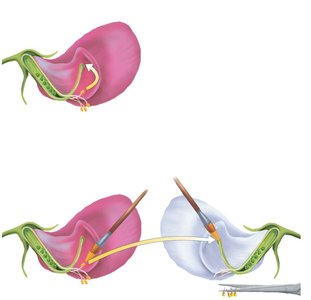
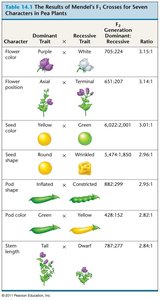
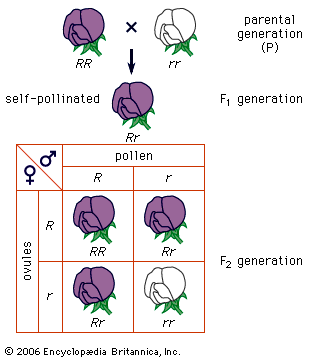
Mendel mated true-breeding varieties (P generation) to produce F1 hybrids, which were then selfed or crossed to produce F2 offspring. He observed consistent ratios, such as 3:1 for dominant to recessive traits in F2.
Mendel's Laws and Observations
The Law of Segregation (First Law)
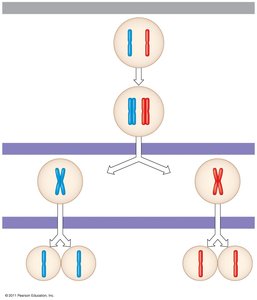
Each organism inherits two alleles for each gene, one from each parent. These alleles segregate during gamete formation, so each gamete receives only one allele. This explains the 3:1 ratio observed in F2 generations.
The Law of Independent Assortment (Second Law)
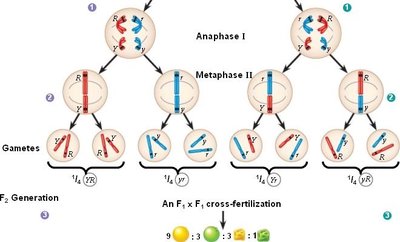
Allele pairs for different genes segregate independently during gamete formation. This law applies to genes on different chromosomes or those far apart on the same chromosome. Dihybrid crosses reveal a 9:3:3:1 phenotypic ratio in F2.
Genotype and Phenotype
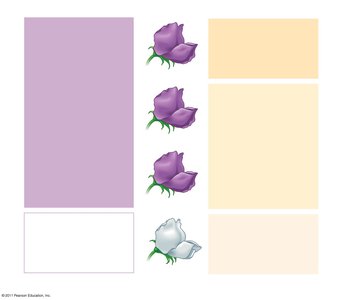
The genotype is the genetic composition, while the phenotype is the observable trait. Homozygous individuals have identical alleles; heterozygous individuals have different alleles. Dominant alleles mask recessive alleles in heterozygotes.
Punnett Squares and Test Crosses
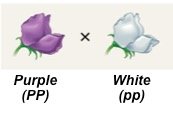
Punnett squares are diagrams used to predict the outcome of genetic crosses. A test cross involves breeding an individual with a dominant phenotype to a homozygous recessive tester to determine the unknown genotype.
Probability in Mendelian Inheritance
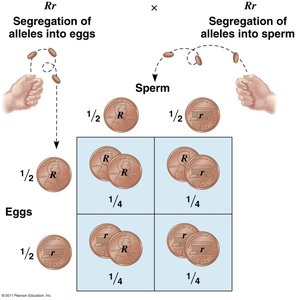
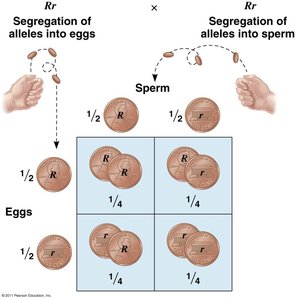
Mendelian inheritance follows the laws of probability. The multiplication rule calculates the probability of independent events occurring together, while the addition rule calculates the probability of mutually exclusive events.
Multiplication Rule:
Addition Rule:

Applications and Examples
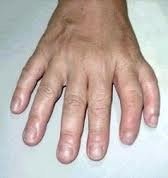
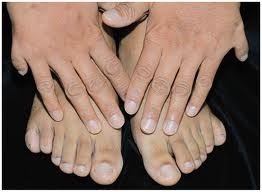
Polydactyly: A dominant trait that is not the most common in the population.
Freckles: Dominant allele results in freckles if present.
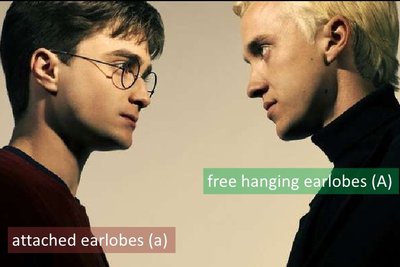
Attached vs. Detached Earlobes: Used to illustrate test crosses and inheritance patterns.
Albinism: Recessive trait; probability calculations for offspring genotypes.

Summary
Mendel's scientific approach revealed two laws of inheritance: the Law of Segregation and the Law of Independent Assortment. These laws, along with the principles of probability, form the basis for understanding genetic inheritance and predicting patterns in offspring.