 Back
BackMendelian and Non-Mendelian Genetics: Principles, Patterns, and Extensions
Study Guide - Smart Notes
 Tailored notes based on your materials, expanded with key definitions, examples, and context.
Genetics: Foundations and Terminology
Key Terms in Genetics
Genetics is the study of heredity and the variation of inherited characteristics. Understanding genetics requires mastery of foundational terminology:
Gene: A segment of DNA that encodes information for a specific trait.
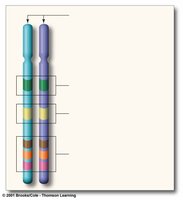
Allele: Different forms of a gene found at the same locus on homologous chromosomes.
Genotype: The genetic makeup of an organism (the set of alleles).
Phenotype: The observable physical or physiological traits of an organism, determined by its genotype and environment.
Homozygous: Having two identical alleles for a gene.
Heterozygous: Having two different alleles for a gene.
Dominant: An allele that masks the expression of another allele in a heterozygote.
Recessive: An allele whose expression is masked by a dominant allele in a heterozygote.
Theories of Inheritance: Historical Perspectives
Early Theories
Before Mendel, several theories attempted to explain inheritance:
Blending Inheritance: Suggested that offspring are a 'blend' of parental traits.
Pangenesis (Darwin): Proposed that all parts of the body contribute to gametes.
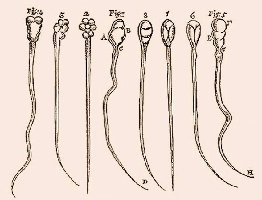
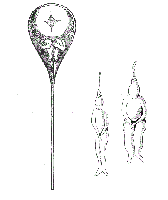
Preformationism: Early microscopists believed sperm or eggs contained a miniature human (homunculus).
Gregor Mendel and the Birth of Modern Genetics
Mendel's Experiments and Model Organism
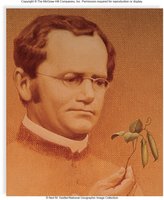
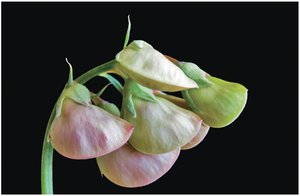
Gregor Mendel, an Austrian monk, used garden pea plants (Pisum sativum) to study inheritance. He applied statistical analysis and probability to biological experiments, leading to the particulate theory of inheritance.
Peas were ideal due to their short generation time, ease of cultivation, and distinct traits.
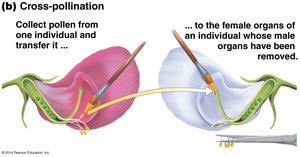
Mendel controlled pollination to produce true-breeding lines and hybrids.
Mendel's Experimental Design
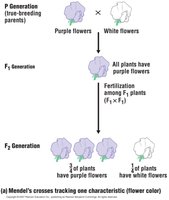
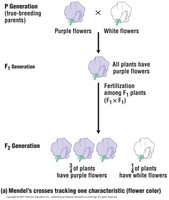
Experiment 1: Crossed true-breeding plants with alternate phenotypes (e.g., purple x white flowers).
Experiment 2: Self-fertilized F1 hybrids to produce F2 generation and analyzed trait ratios.
Dominant and Recessive Traits
Dominant alleles mask recessive alleles in heterozygotes.
Recessive traits reappear in the F2 generation, indicating they are not lost but masked.
Dominance does not imply superiority or frequency in the population.
Mendel's Principles
Particulate Inheritance
Mendel concluded that hereditary factors (now called genes) are discrete units that do not blend but are inherited intact from generation to generation.
Principle of Segregation
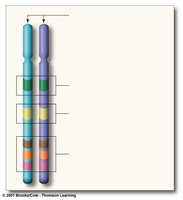
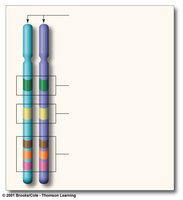
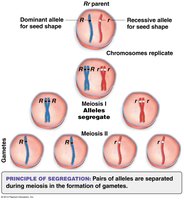
Each individual has two alleles for each gene, which segregate during gamete formation so that each gamete receives only one allele. Fertilization restores the diploid state.
Modern terms: Alleles are located on homologous chromosomes and segregate during meiosis.
Genotype and Phenotype
Genotype: The allelic composition (e.g., AA, Aa, aa).
Phenotype: The observable trait (e.g., purple or white flowers).
Genotype determines phenotype, but environmental factors can also play a role.
Punnett Square Analysis
Punnett squares are used to predict the possible genotypes and phenotypes of offspring from a genetic cross.
List all possible gametes from each parent.
Combine gametes to determine offspring genotypes.
Dihybrid Crosses and Independent Assortment
Dihybrid Crosses
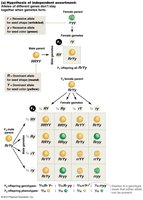
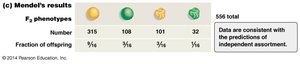
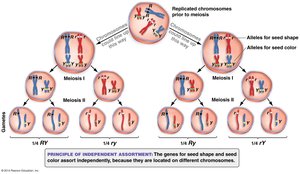
When considering two traits at once (e.g., seed color and shape), Mendel found that traits are inherited independently if they are on different chromosomes.
Crossing YyRr x YyRr yields a 9:3:3:1 phenotypic ratio in the F2 generation.
Probability in Genetics
The probability of a particular genotype is the product of the probabilities for each gene independently (the multiplication rule).
For example, the probability of kkllmm in KkLlMm x KkLlMm is .
Testcrosses
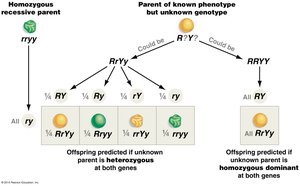
A testcross is used to determine the genotype of an individual with a dominant phenotype by crossing it with a homozygous recessive individual.
Chromosomal Basis of Mendel's Principles
Segregation and Independent Assortment
Alleles segregate during meiosis I as homologous chromosomes separate.
Independent assortment occurs when genes are on different chromosomes, leading to genetic variation.
Extensions to Mendelian Genetics
Incomplete Dominance
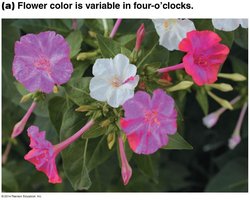
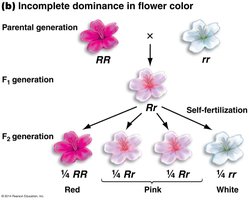
Heterozygotes display an intermediate phenotype between the two homozygotes (e.g., pink flowers from red and white parents).
Multiple Allelism and Co-dominance
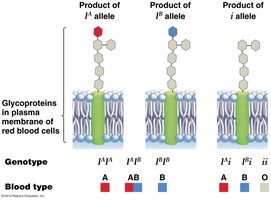
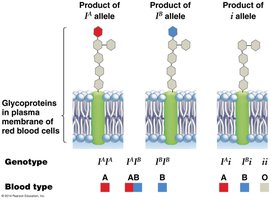
Some genes have more than two alleles in the population. In co-dominance, both alleles are expressed equally (e.g., AB blood type).
Pleiotropy
A single gene can affect multiple traits (e.g., sickle cell disease affects hemoglobin structure and malaria resistance).
Gene Interactions (Epistasis)
The expression of one gene can be affected by another gene (e.g., Labrador retriever coat color).
Gene-by-Environment Interactions
Environmental factors such as nutrition, light, and temperature can influence gene expression and phenotype.
Organelle Genomes
Genes in mitochondria and chloroplasts are inherited maternally and can affect phenotypes.
Polygenic Inheritance
Traits controlled by multiple genes (quantitative traits) show continuous variation (e.g., human skin color, height).
Human Genetics and Pedigree Analysis
Studying Human Genes
Human genetic studies rely on pedigree analysis and genomic techniques due to ethical and practical limitations in controlled breeding.
Patterns of Inheritance in Humans
Autosomal Dominant: Trait appears in every generation; only one mutant allele needed (e.g., Huntington disease).
Autosomal Recessive: Trait often skips generations; two mutant alleles needed (e.g., cystic fibrosis).
X-Linked Recessive: More common in males; females need two mutant alleles, males only one (e.g., red-green color blindness).
X-Linked Dominant: Affects both sexes; males pass trait to all daughters but not sons (e.g., hypophosphatemia).
Inheritance Pattern | Genotype Requirement | Example Disorder |
|---|---|---|
Autosomal Dominant | One mutant allele (Aa or AA) | Huntington Disease |
Autosomal Recessive | Two mutant alleles (aa) | Cystic Fibrosis |
X-Linked Recessive | One mutant allele in males (XaY), two in females (XaXa) | Hemophilia A |
X-Linked Dominant | One mutant allele (XAXa or XAY) | Hypophosphatemia |
Pedigree Symbols
Circle: Female
Square: Male
Shaded: Affected individual
Half-shaded: Carrier (for recessive traits)
Horizontal line: Mating
Vertical line: Offspring
Distinguishing Inheritance Patterns
X-linked recessive traits affect more males than females.
Autosomal traits affect both sexes equally.
X-linked dominant traits are passed from affected fathers to all daughters but not sons.
Additional info: These notes integrate foundational Mendelian genetics with modern extensions, including chromosomal theory, gene interactions, and human genetic analysis, providing a comprehensive overview suitable for college-level biology students.
