Back
BackMendelian Genetics and Chromosomal Basis of Inheritance: Study Notes
Study Guide - Smart Notes
 Tailored notes based on your materials, expanded with key definitions, examples, and context.
Genetic Variation and Chromosome Behavior
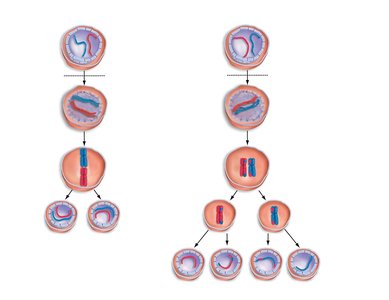
Mitosis vs. Meiosis
Mitosis and meiosis are two distinct processes of cell division that play crucial roles in growth, development, and reproduction. Mitosis results in two genetically identical diploid cells, while meiosis produces four genetically unique haploid cells, essential for sexual reproduction.
Mitosis: Involves a single division, producing two diploid daughter cells identical to the parent cell.
Meiosis: Involves two consecutive divisions (meiosis I and II), resulting in four haploid cells with half the chromosome number of the parent cell.
Genetic Variation: Meiosis introduces genetic diversity through crossing over and independent assortment.
Applications: Meiosis is fundamental for gamete formation in sexually reproducing organisms.
Independent Assortment and Crossing Over
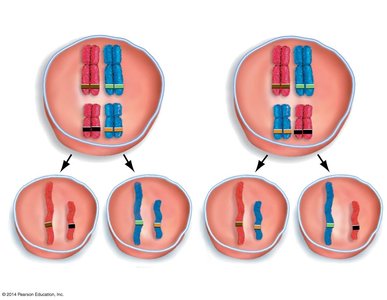
During meiosis I, homologous chromosomes can align in different orientations, leading to independent assortment. Additionally, crossing over between homologous chromosomes increases genetic variation among gametes.
Independent Assortment: The random orientation of homologous chromosome pairs during metaphase I results in different combinations of maternal and paternal chromosomes in gametes.
Crossing Over: Homologous chromosomes exchange genetic material during prophase I, creating new allele combinations.
Result: Each gamete contains a unique set of genetic information.
Genetic Variation from Meiosis and Fertilization
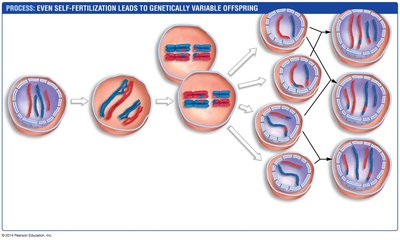
Even self-fertilization can produce genetically variable offspring due to the processes of crossing over and independent assortment during meiosis. Fertilization further increases genetic diversity by combining gametes from different parents.
Gamete Diversity: Each gamete produced by meiosis is genetically unique.
Fertilization: Random fusion of gametes from two parents results in offspring with novel genetic combinations.
Significance: Genetic variation is essential for evolution and adaptation in populations.
Mendelian Genetics: Principles and Experiments
Mendel’s Experimental System
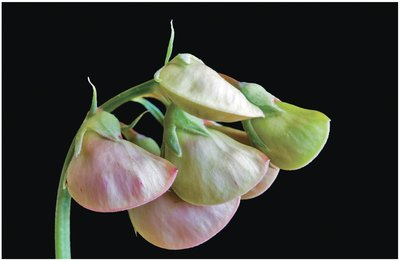
Gregor Mendel used the garden pea (Pisum sativum) as a model organism to study inheritance. Peas are ideal due to their distinct traits, ease of cultivation, and ability to self- or cross-pollinate.
Model Organism: Peas have easily observable traits and controlled mating.
Traits Studied: Seed shape, seed color, flower color, pod shape, pod color, flower position, and stem length.
Overview of Mendel’s Principles
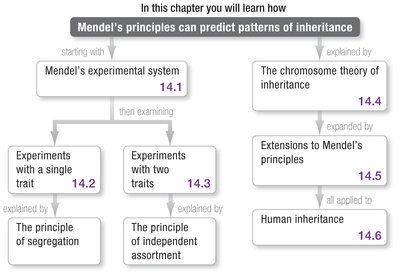
Mendel’s experiments led to the formulation of key principles that predict patterns of inheritance. These include the principle of segregation and the principle of independent assortment.
Principle of Segregation: Each individual has two alleles for each gene, which segregate during gamete formation.
Principle of Independent Assortment: Alleles of different genes assort independently during gamete formation.
Self-Pollination and Cross-Pollination
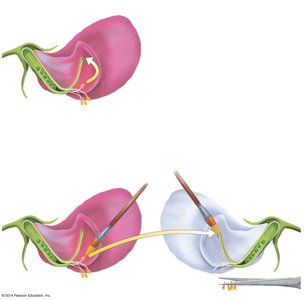
Mendel controlled pollination in pea plants to study inheritance patterns. Self-pollination involves pollen transfer within the same flower, while cross-pollination transfers pollen between different plants.
Self-Pollination: Ensures genetic consistency within a line.
Cross-Pollination: Allows for the combination of different traits and analysis of inheritance patterns.
Monohybrid and Dihybrid Crosses
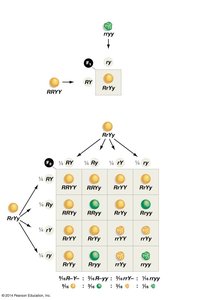
Mendel performed crosses involving one trait (monohybrid) and two traits (dihybrid) to observe inheritance patterns and test his hypotheses.
Monohybrid Cross: Involves parents differing in one trait; F1 generation is uniform, F2 shows a 3:1 ratio of dominant to recessive phenotypes.
Dihybrid Cross: Involves parents differing in two traits; F2 generation shows a 9:3:3:1 phenotypic ratio, supporting independent assortment.
Testcross and Genotype Determination
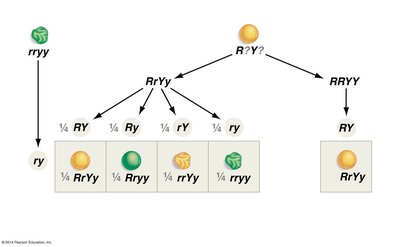
A testcross is used to determine the genotype of an individual with a dominant phenotype by crossing it with a homozygous recessive individual.
Purpose: To reveal whether the individual is homozygous dominant or heterozygous.
Interpretation: Offspring phenotypes indicate the genotype of the tested parent.
Principle of Segregation
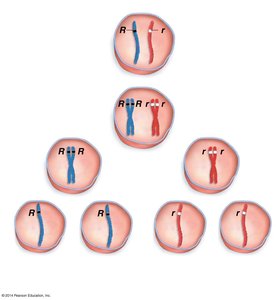
The principle of segregation states that the two alleles for a gene segregate during gamete formation, so each gamete carries only one allele for each gene.
Mechanism: Occurs during anaphase I of meiosis when homologous chromosomes separate.
Result: Offspring inherit one allele from each parent.
Principle of Independent Assortment
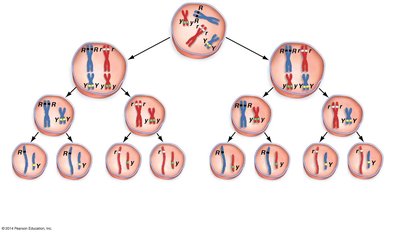
The principle of independent assortment states that alleles of different genes are distributed independently of one another during gamete formation, provided the genes are on different chromosomes.
Genetic Basis: Random alignment of chromosome pairs during metaphase I of meiosis.
Result: Increases genetic variation in offspring.
Mendel’s Experimental Results
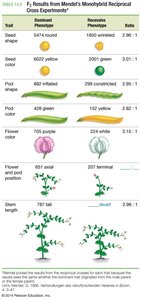
Mendel’s experiments with pea plants produced consistent ratios in the F2 generation, supporting his principles of inheritance.
Trait | Dominant Phenotype | Recessive Phenotype | Ratio |
|---|---|---|---|
Seed shape | Round | Wrinkled | 2.96:1 |
Seed color | Yellow | Green | 3.01:1 |
Pod shape | Inflated | Constricted | 2.95:1 |
Pod color | Green | Yellow | 3.01:1 |
Flower color | Purple | White | 3.15:1 |
Flower position | Axial | Terminal | 3.14:1 |
Stem length | Tall | Dwarf | 2.84:1 |
Mendel’s Model and Conclusions
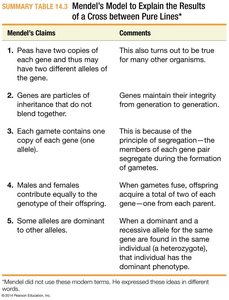
Mendel’s model explained the results of his crosses and established the foundation for modern genetics.
Mendel’s Claims | Comments |
|---|---|
Peas have two copies of each gene and thus may have two different alleles of the gene. | This is also true for many other organisms. |
Genes are particles of inheritance that do not blend together. | Genes maintain their integrity from generation to generation. |
Each gamete contains one copy of each gene (one allele). | This is because of the principle of segregation. |
Males and females contribute equally to the genotype of their offspring. | When gametes fuse, offspring acquire a total of two alleles, one from each parent. |
Some alleles are dominant to other alleles. | When a dominant and a recessive allele for the same gene are found in the same individual, the dominant phenotype is observed. |
Extensions and Applications of Mendelian Genetics
Model Organisms in Genetics: Drosophila melanogaster
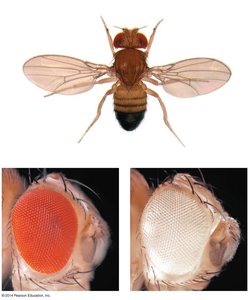
The fruit fly, Drosophila melanogaster, is a widely used model organism in genetics due to its short generation time, large number of offspring, and easily observable traits.
Traits Studied: Eye color, body color, wing shape, etc.
Applications: Used to study inheritance patterns, gene linkage, and chromosomal behavior.
Sex-Linked Inheritance
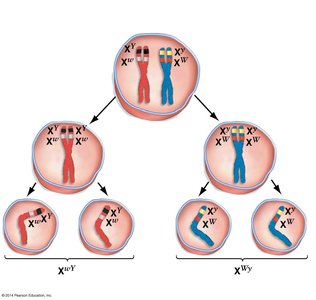
Some genes are located on sex chromosomes (X or Y), leading to sex-linked inheritance patterns. X-linked traits are more commonly expressed in males due to their single X chromosome.
X-Linked Traits: Traits determined by genes on the X chromosome.
Example: Eye color in fruit flies is an X-linked trait.
Gene Linkage and Recombination
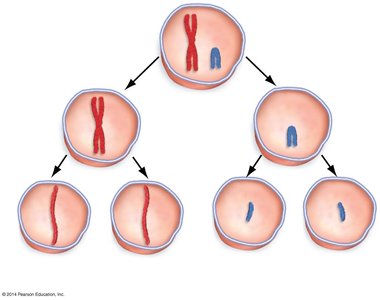
Genes located close together on the same chromosome tend to be inherited together, a phenomenon known as linkage. However, crossing over during meiosis can produce recombinant chromosomes, leading to new allele combinations.
Linked Genes: Do not assort independently unless separated by crossing over.
Genetic Recombination: The production of offspring with combinations of traits differing from either parent.
Genetic Mapping
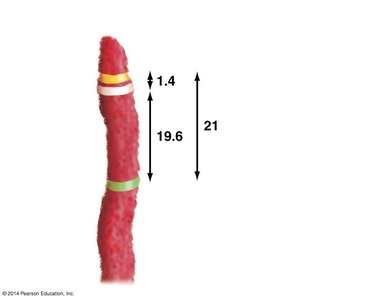
The frequency of recombination between genes can be used to map their relative positions on a chromosome. The unit of measurement is the map unit or centiMorgan (cM).
Genetic Distance: Higher recombination frequency indicates greater distance between genes.
Application: Used to construct genetic maps of chromosomes.
Multiple Allelism and Blood Types
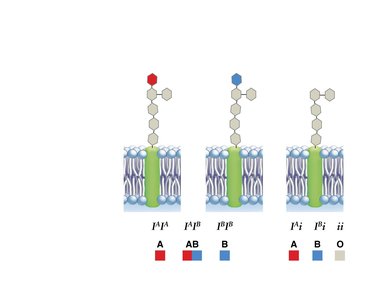
Some genes have more than two alleles in the population, a phenomenon known as multiple allelism. The ABO blood group system in humans is a classic example.
Alleles: IA, IB, and i determine blood type (A, B, AB, O).
Codominance: Both IA and IB are expressed in individuals with genotype IAIB (blood type AB).
Incomplete Dominance
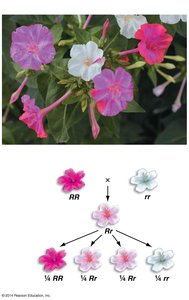
In incomplete dominance, the heterozygote exhibits a phenotype intermediate between the two homozygotes. An example is flower color in four-o’clocks (Mirabilis jalapa).
Phenotype: Red (RR), white (rr), and pink (Rr) flowers.
Significance: Demonstrates that dominance is not always complete.
Polygenic (Multigenic) Traits
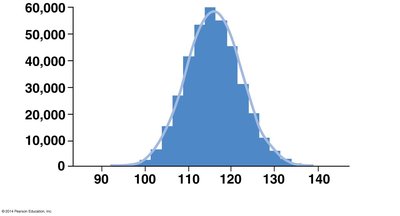
Some traits are controlled by multiple genes, resulting in continuous variation. Human height is a classic example of a polygenic trait, showing a bell-shaped distribution in the population.
Polygenic Inheritance: Multiple genes contribute additively to a single trait.
Distribution: Traits show continuous variation rather than discrete categories.