 Back
BackMendelian Genetics and Extensions: Principles, Patterns, and Human Applications
Study Guide - Smart Notes
 Tailored notes based on your materials, expanded with key definitions, examples, and context.
Introduction to Mendelian Genetics
Overview of Mendel's Experiments
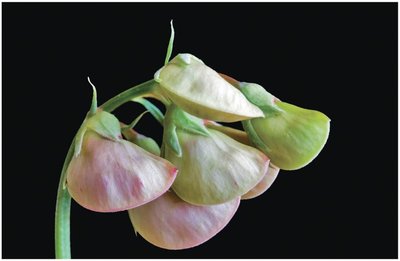
Gregor Mendel's work with pea plants established the foundational principles of inheritance, now known as Mendelian genetics. His experiments revealed how traits are passed from one generation to the next through discrete units called genes.
Model Organism: Mendel used Pisum sativum (pea plants) due to their easily observable traits and controlled mating.
Traits Studied: Seed shape, seed color, flower color, pod shape, pod color, flower position, and plant height.
Mendel's Laws of Inheritance
Law of Segregation and Law of Independent Assortment
Mendel's experiments led to two key principles: the Law of Segregation and the Law of Independent Assortment.
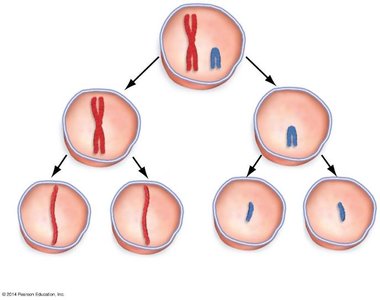
Law of Segregation: Each individual has two alleles for each gene, which segregate during gamete formation so that each gamete carries only one allele for each gene.
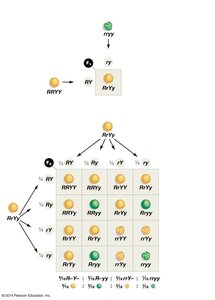
Law of Independent Assortment: Alleles of different genes assort independently of one another during gamete formation, leading to genetic variation.
Mendel's Model Summarized
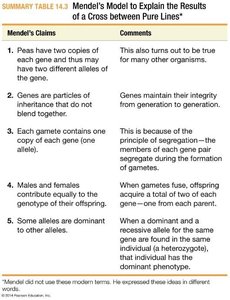
The table below summarizes Mendel's claims and their implications for inheritance:
Mendel's Claims | Comments |
|---|---|
1. Peas have two copies of each gene and thus may have two different alleles of the gene. | This also turns out to be true for many other organisms. |
2. Genes are particles of inheritance that do not blend together. | Genes maintain their integrity from generation to generation. |
3. Each gamete contains one copy of each gene (one allele). | This is because of the principle of segregation—the members of each gene pair segregate during the formation of gametes. |
4. Males and females contribute equally to the genotype of their offspring. | When gametes fuse, offspring acquire a total of two of each gene—one from each parent. |
5. Some alleles are dominant to other alleles. | When a dominant and a recessive allele for the same gene are found in the same individual (a heterozygote), the individual has the dominant phenotype. |
Extension of Mendelian Principles
Gene Linkage and Crossing Over
Not all genes assort independently. Genes located close together on the same chromosome are said to be linked and tend to be inherited together. However, crossing over during meiosis can separate linked genes, creating recombinant genotypes.
Gene Linkage: Linked genes violate the principle of independent assortment.
Crossing Over: The exchange of genetic material between homologous chromosomes during meiosis increases genetic diversity.
Sex-Linked Inheritance
X-Linked Traits in Drosophila
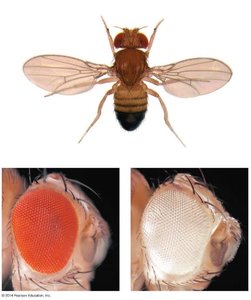
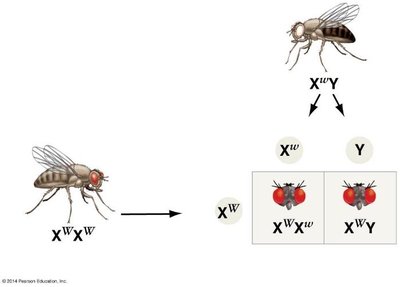
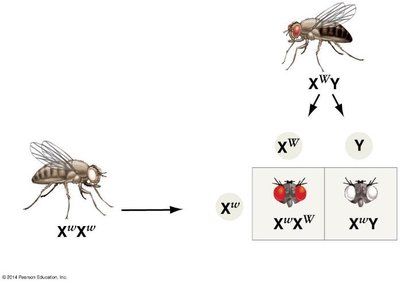
Some traits are linked to sex chromosomes, such as the X chromosome in fruit flies (Drosophila melanogaster). Eye color in Drosophila is a classic example of X-linked inheritance.
Wild Type vs. Mutant: Red eyes are wild type; white eyes are mutant and X-linked recessive.
Reciprocal Crosses: Crossing males and females with different eye colors demonstrates the inheritance pattern.
Multiple Alleles and Codominance
ABO Blood Groups
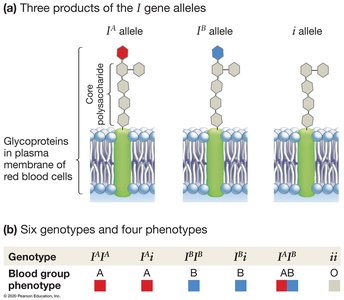
Some genes have more than two alleles in the population, leading to multiple possible phenotypes. The ABO blood group system in humans is a classic example, involving three alleles: IA, IB, and i.
Codominance: Both IA and IB are expressed in the AB phenotype.
Multiple Allelism: More than two alleles exist for the gene in the population.
Non-Mendelian Inheritance Patterns
Incomplete Dominance
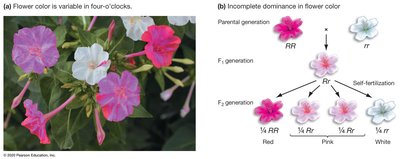
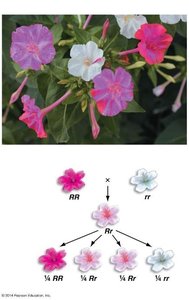
In incomplete dominance, the heterozygote displays a phenotype intermediate between the two homozygotes. An example is flower color in four-o’clocks (Mirabilis jalapa), where crossing red and white flowers produces pink offspring.
Genotypic Ratio: 1:2:1 for RR (red), Rr (pink), and rr (white).
Polygenic (Multigenic) Traits
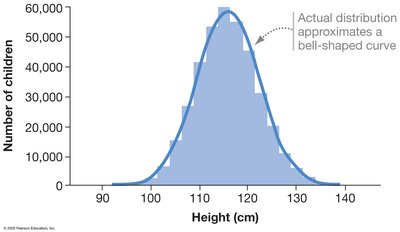
Some traits are controlled by multiple genes, resulting in continuous variation. Human height is a classic example, showing a bell-shaped distribution in the population.
Polygenic Inheritance: Multiple genes contribute additively to a single trait.
Continuous Variation: Traits such as height, skin color, and intelligence show a range of phenotypes.
Genetics and Human Disease
Autosomal and Sex-Linked Inheritance in Humans
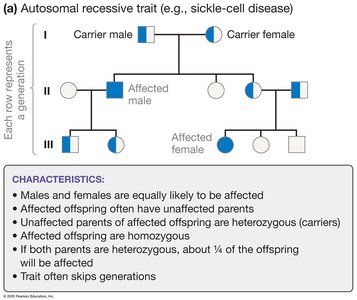
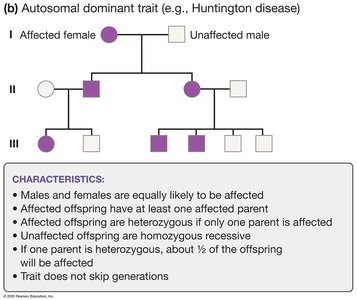
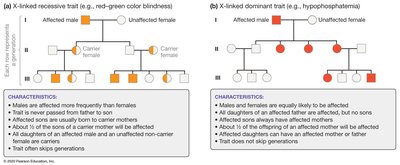
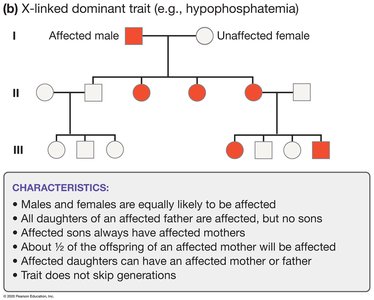
Human genetic diseases can be inherited in autosomal dominant, autosomal recessive, X-linked dominant, or X-linked recessive patterns. Pedigree analysis helps determine the mode of inheritance.
Autosomal Recessive: Both alleles must be mutated for the trait to appear (e.g., sickle-cell disease).
Autosomal Dominant: Only one mutated allele is needed for the trait to appear (e.g., Huntington's disease).
X-Linked Recessive: More common in males; females are typically carriers (e.g., red-green color blindness).
X-Linked Dominant: Affected fathers pass the trait to all daughters but not sons (e.g., hypophosphatemia).
Summary Table: Mendel's Model
The following table summarizes Mendel's model and its implications for inheritance:
Mendel's Claims | Comments |
|---|---|
1. Peas have two copies of each gene and thus may have two different alleles of the gene. | This also turns out to be true for many other organisms. |
2. Genes are particles of inheritance that do not blend together. | Genes maintain their integrity from generation to generation. |
3. Each gamete contains one copy of each gene (one allele). | This is because of the principle of segregation—the members of each gene pair segregate during the formation of gametes. |
4. Males and females contribute equally to the genotype of their offspring. | When gametes fuse, offspring acquire a total of two of each gene—one from each parent. |
5. Some alleles are dominant to other alleles. | When a dominant and a recessive allele for the same gene are found in the same individual (a heterozygote), the individual has the dominant phenotype. |
Additional info: These principles form the basis for understanding classical genetics and are foundational for more advanced topics such as molecular genetics, population genetics, and genetic engineering.
