 Back
Mendelian Genetics and Extensions: Study Guide
Study Guide - Smart Notes
 Tailored notes based on your materials, expanded with key definitions, examples, and context.
Mendel and the Gene Idea
Introduction to Mendelian Genetics
Mendelian genetics forms the foundation of classical inheritance, describing how traits are passed from parents to offspring through discrete units called genes. Gregor Mendel's experiments with pea plants established the basic principles of heredity, including the segregation and independent assortment of alleles.
Genetics: The study of heredity and variation in organisms.
Heredity: Transmission of traits from parents to offspring.
Character: A heritable feature (e.g., flower color).
Trait: A variant of a character (e.g., purple or white flowers).
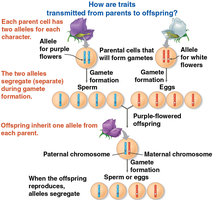
Mendel's Experimental Approach
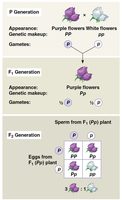
Mendel chose Pisum sativum (pea plants) for their ease of cultivation, short reproductive cycle, and clear, easily recognizable traits. He controlled matings and observed inheritance patterns across generations.
P generation: True-breeding parents (pure lines).
F1 generation: Offspring of hybridization; all showed dominant trait.
F2 generation: Resulted from self-pollination of F1; showed a 3:1 ratio of dominant to recessive traits.
Results of Mendel's Crosses
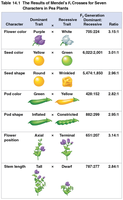
Mendel observed consistent ratios for seven characters in pea plants, demonstrating predictable inheritance patterns.
Character | Dominant Trait | Recessive Trait | F2 Generation Ratio |
|---|---|---|---|
Flower color | Purple | White | 3:1 |
Seed color | Yellow | Green | 3:1 |
Seed shape | Round | Wrinkled | 3:1 |
Pod color | Green | Yellow | 3:1 |
Pod shape | Inflated | Constricted | 3:1 |
Flower position | Axial | Terminal | 3:1 |
Stem length | Tall | Dwarf | 3:1 |
Genotype vs. Phenotype
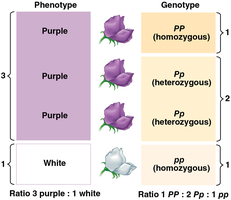
The genotype is the genetic makeup of an organism, while the phenotype is the observable physical trait. Mendel's crosses revealed a genotypic ratio of 1:2:1 and a phenotypic ratio of 3:1 in the F2 generation.
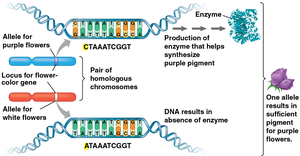
Genotype: PP, Pp, pp
Phenotype: Purple or white flowers
Mendel’s Model: Four Key Concepts
Mendel proposed four key concepts to explain inheritance:
Alleles: Different versions of a gene cause variation.
Inheritance: Each organism receives two alleles, one from each parent.
Dominance: One allele may mask the other (dominant vs. recessive).
Segregation: Allele pairs separate during gamete formation.
Punnett Squares: Predicting Offspring
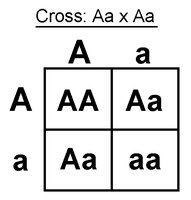
Punnett squares are tools used to predict the genotypic and phenotypic ratios of offspring from parental crosses.
List gametes along the top and side.
Combine alleles in each box to determine offspring genotypes.
Tally results for ratios.
Vocabulary in Mendelian Genetics
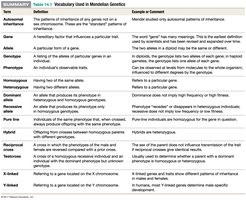
Understanding key terms is essential for mastering Mendelian genetics.
Term | Definition | Example or Comment |
|---|---|---|
Autosomal inheritance | Pattern of inheritance of any gene not on a sex chromosome | Mendel studied autosomal patterns |
Gene | A particular form of a gene | Gene has many meanings; Mendel's "heritable factor" |
Allele | A variant form of a gene | Alleles cause variation |
Genotype | An individual's observable traits | PP, Pp, pp |
Phenotype | Observable traits | Purple or white flowers |
Dominant | Allele that masks the other | Purple is dominant |
Recessive | Allele that is masked | White is recessive |
Hybrid | Offspring of two different parents | F1 generation |
Mendelian Probability and Dihybrid Crosses
Dihybrid Crosses and Independent Assortment
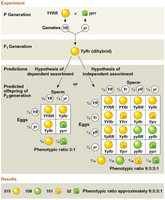
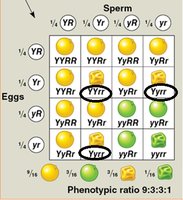
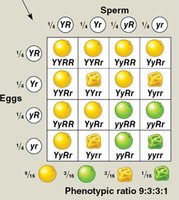
Mendel extended his studies to crosses involving two traits, revealing the principle of independent assortment. This principle states that alleles of different genes sort independently into gametes if the genes are on different chromosomes.
Dihybrid cross: RrYy × RrYy
Phenotypic ratio: 9:3:3:1
Probability Rules in Genetics
Probability is used to predict the likelihood of specific genotypes and phenotypes.
Addition Rule (OR): Probability of either of two mutually exclusive events is the sum of their probabilities.
Multiplication Rule (AND): Probability of two independent events occurring together is the product of their probabilities.
Example equations:
Addition Rule:
Multiplication Rule:
Trihybrid Crosses and Product Rule
The product rule can be extended to crosses involving three traits.
Example: FfBbTt × FfBbTt
Probability of FFBbtt:
Extensions of Mendelian Genetics
Beyond Simple Dominance
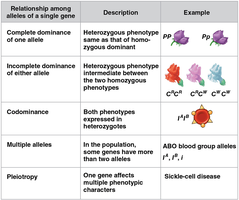
Not all traits follow strict dominant–recessive patterns. Extensions include incomplete dominance, codominance, epistasis, pleiotropy, and polygenic inheritance.
Relationship | Description | Example |
|---|---|---|
Complete dominance | Heterozygous phenotype same as homozygous dominant | PP, Pp |
Incomplete dominance | Heterozygous phenotype intermediate | CRCW (snapdragon color) |
Codominance | Both phenotypes expressed in heterozygotes | ABO blood group alleles |
Multiple alleles | More than two alleles in population | ABO blood group alleles |
Pleiotropy | One gene affects multiple characters | Sickle-cell disease |
Epistasis
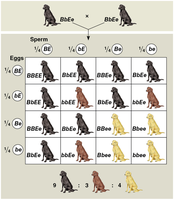
Epistasis occurs when the expression of one gene masks or modifies the expression of another gene at a different locus.
Example: Labrador Retriever coat color
One gene determines pigment color (B or b), another gene determines pigment deposition (E or e).
Dogs with ee are yellow regardless of B or b alleles.
Polygenic Inheritance and Environmental Effects
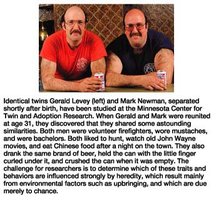
Polygenic inheritance involves multiple genes, each contributing a small additive effect, resulting in continuous variation. Environmental factors also influence phenotype, as seen in traits like skin color.
Polygenic traits: Show a continuous range of variation.
Environmental influence: Factors such as upbringing and environment can affect phenotype.
Summary Table: Mendelian Genetics Vocabulary
Term | Definition | Example or Comment |
|---|---|---|
Autosomal inheritance | Pattern of inheritance of any gene not on a sex chromosome | Mendel studied autosomal patterns |
Gene | A particular form of a gene | Gene has many meanings; Mendel's "heritable factor" |
Allele | A variant form of a gene | Alleles cause variation |
Genotype | An individual's observable traits | PP, Pp, pp |
Phenotype | Observable traits | Purple or white flowers |
Dominant | Allele that masks the other | Purple is dominant |
Recessive | Allele that is masked | White is recessive |
Hybrid | Offspring of two different parents | F1 generation |
Conclusion
Mendel's principles of inheritance—segregation and independent assortment—form the basis for understanding genetic variation. Extensions such as incomplete dominance, codominance, epistasis, pleiotropy, and polygenic inheritance further explain the complexity of genetic traits. Environmental factors also play a significant role in shaping phenotypes.
Additional info: This guide expands on the original notes by providing definitions, examples, and context for each concept, ensuring a comprehensive understanding suitable for exam preparation.
