 Back
Mendelian Genetics and Extensions: Study Guide for General Biology
Study Guide - Smart Notes
 Tailored notes based on your materials, expanded with key definitions, examples, and context.
Mendel and the Gene
Introduction to Mendel and the Gene
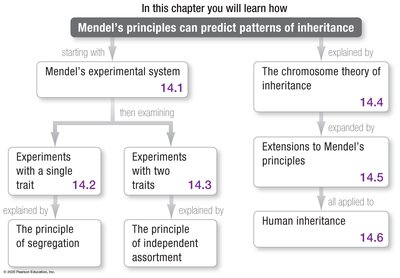
Gregor Mendel established the foundation of genetics through his experiments with garden peas. The chromosome theory of inheritance, proposed by Sutton and Boveri, linked genetic information transmission to meiosis and asserted that genes are located on chromosomes. Genetics is the branch of biology focused on inheritance.
Mendel’s Genetics
Heredity and Traits
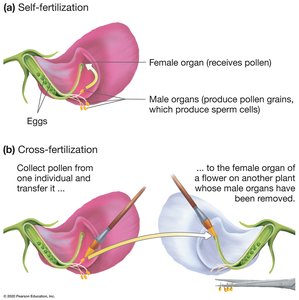
Heredity is the transmission of traits from parents to offspring. A trait is any characteristic of an individual. Mendel controlled matings in peas, which normally self-fertilize, by removing male organs to prevent self-pollination and using pollen from one flower to fertilize another, a process called cross-fertilization.
Traits Studied by Mendel
Mendel worked with pea varieties differing in seven easily recognizable traits: seed shape, seed color, pod shape, pod color, flower color, flower and pod position, and stem length. The observable features of an individual comprise its phenotype. Mendel used true-breeding lines, which produce offspring identical to themselves when self-fertilized, to create hybrids by mating two different pure lines.
Mendel’s Experiments with a Single Trait
Monohybrid Crosses and Dominance
Mendel’s first experiments involved crossing pure lines differing in one trait, such as round-seed and wrinkled-seed peas. The parental generation produced F1 offspring, all with round seeds, indicating dominance. Allowing F1 progeny to self-pollinate resulted in the reappearance of the wrinkled seed trait in the F2 generation, demonstrating recessiveness. The F2 generation showed a 3:1 ratio of dominant to recessive phenotypes.
Principle of Segregation
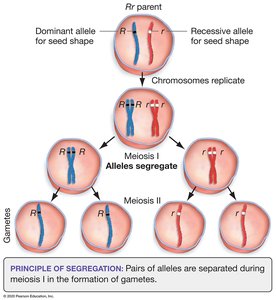
Mendel developed the principle of segregation to explain the 3:1 ratio in F2 individuals. Two members of each gene pair segregate into different gamete cells during egg and sperm formation. Homozygous individuals have two copies of the same allele, while heterozygous individuals have two different alleles. Mating between two heterozygous parents produces offspring in a 1:2:1 genotype ratio and a 3:1 phenotype ratio.
Summary of Mendel’s Model
Organisms have two copies of each gene and may have different alleles.
Genes are particles of inheritance that do not blend together.
Each gamete contains one copy of each gene due to segregation.
Males and females contribute equally to offspring genotype.
Some alleles are dominant to others.
Mendel’s Experiments with Two Traits
Dihybrid Crosses and Independent Assortment
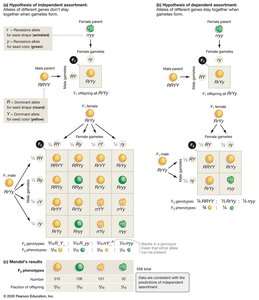
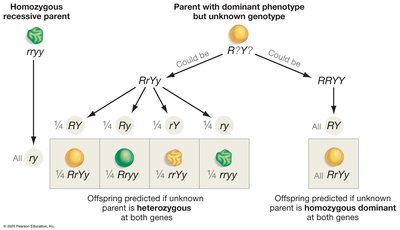
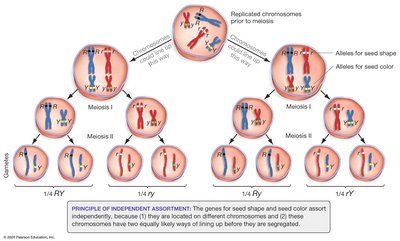
Mendel used dihybrid crosses to determine whether alleles of different genes segregate together or independently. The principle of independent assortment states that alleles of different genes are transmitted independently. A dihybrid cross produces four possible phenotypes in a 9:3:3:1 ratio, supporting independent assortment.
Testcrosses
A testcross involves crossing a parent with a dominant phenotype but unknown genotype with a parent contributing only recessive alleles. The offspring phenotypes reveal the unknown parental genotype. This method evaluates predictions made by the principle of independent assortment.
Chromosome Theory of Inheritance
Genes on Chromosomes and Meiosis
The chromosome theory of inheritance arose from observations of meiosis, showing that genes are located on chromosomes at specific loci. Physical separation of alleles during Meiosis I explains Mendel’s principle of segregation. Genes for different traits assort independently at Meiosis I if they are on different nonhomologous chromosomes.
Testing the Chromosome Theory
Sex Chromosomes and Linkage
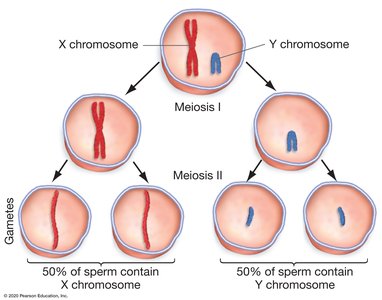
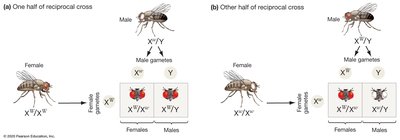
Model organisms like Drosophila melanogaster were used to test the chromosome theory. Sex chromosomes (X and Y) were discovered, with females having two X chromosomes and males having one X and one Y. Genes located on sex chromosomes exhibit sex linkage, affecting inheritance patterns.
Extending Mendel’s Rules
Linkage and Crossing Over
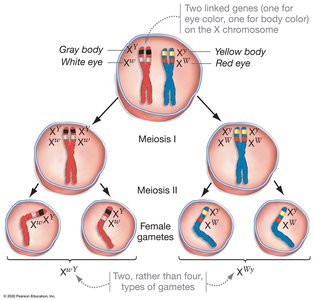
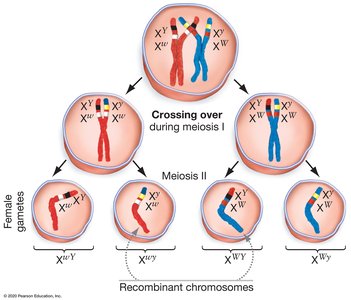
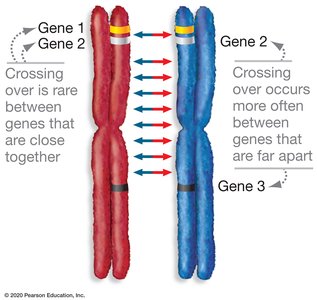
Linked genes are often inherited together, but crossing over during prophase of Meiosis I can generate recombinant genotypes. Genes farther apart on a chromosome are more likely to cross over, and the frequency of recombination can be used to estimate gene distance and create genetic maps.
Multiple Alleles and ABO Blood Types
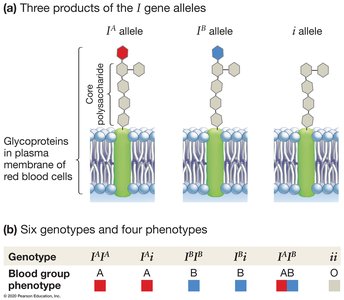
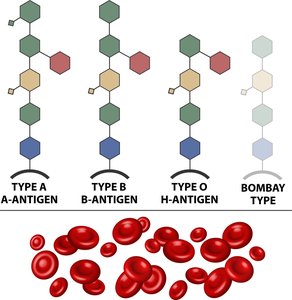
Some genes have more than two alleles in a population, a phenomenon called multiple allelism. For example, humans have three common alleles for the ABO blood types, each coding for a different enzyme that adds polysaccharides to red blood cell membranes.
Dominance Relationships
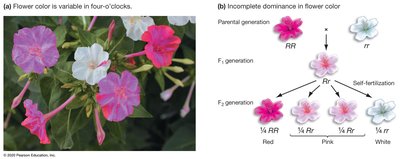
Dominant and recessive alleles describe which phenotype is observed. Complete dominance occurs when only the dominant phenotype appears in heterozygotes. Codominance is the simultaneous expression of both alleles in heterozygotes, as seen in the AB blood group. Incomplete dominance results in an intermediate phenotype in heterozygotes.
Pleiotropy and Gene Interaction
Pleiotropy occurs when a single gene affects multiple traits. Gene interaction involves two or more genes influencing a single trait, with epistasis being a form where the expression of one gene masks another.
Environmental Effects and Quantitative Traits
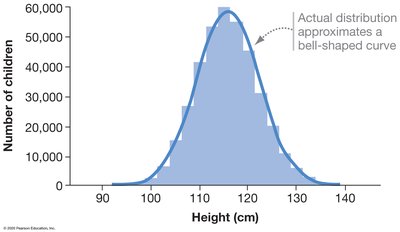
Phenotypes are influenced by both genes and environment. For example, the genetic disease phenylketonuria (PKU) can be managed by diet. Quantitative traits, such as height, vary continuously and often form a normal distribution, unlike discrete traits.
Applying Mendel’s Rules to Human Inheritance
Pedigrees and Modes of Transmission
Pedigrees are used to analyze inheritance patterns in humans, distinguishing between autosomal and sex-linked traits and types of dominance. Autosomal traits appear equally in males and females, while X-linked traits are more frequent in males. Pedigrees can differentiate autosomal recessive, autosomal dominant, X-linked recessive, and X-linked dominant traits.
Summary Tables
Key Terms in Mendelian Genetics
Term | Definition | Example or Comment |
|---|---|---|
Autosomal inheritance | Patterns of inheritance of genes not on a sex chromosome | Mendel studied autosomal patterns |
Gene | Hereditary factor influencing a trait | Region of DNA coding for protein or RNA |
Allele | Particular form of a gene | Diploid may have same or different alleles |
Genotype | Listing of alleles in an individual | Diploid: two alleles per gene; haploid: one allele |
Phenotype | Observable traits | Influenced by genotype |
Homozygous | Two of the same allele | Refers to a particular gene |
Heterozygous | Two different alleles | Refers to a particular gene |
Dominant allele | Produces phenotype in heterozygous and homozygous genotypes | Does not imply high frequency or fitness |
Recessive allele | Produces phenotype only in homozygous genotypes | Phenotype disappears in heterozygotes |
Pure line | Individuals always produce same phenotype when crossed | Homozygous for gene in question |
Hybrid | Offspring from crosses between homozygous parents with different genotypes | Heterozygous |
Reciprocal cross | Phenotypes of male and female reversed compared to prior cross | Tests if sex influences trait transmission |
Testcross | Cross of homozygous recessive and individual with dominant phenotype but unknown genotype | Determines if parent is homozygous or heterozygous |
X-linked | Gene located on X chromosome | Different inheritance in males and females |
Y-linked | Gene located on Y chromosome | Determines male-specific development |
Exceptions and Extensions to Mendel’s Rules
Type of Inheritance | Definition | Consequences or Comments |
|---|---|---|
Sex linkage | Gene located on sex chromosome | Inheritance patterns differ in males and females |
Linkage | Two or more genes on same chromosome | Linked genes do not assort independently |
Codominance | Heterozygotes have phenotypes of both alleles | More than two phenotypes seen |
Incomplete dominance | Heterozygotes have intermediate phenotype | Common, more than two phenotypes seen |
Multiple allelism | More than two common alleles for a locus | More than two phenotypes often seen |
Pleiotropy | Single gene affects many traits | Pleiotropy is common |
Polygenic (quantitative) trait | Trait influenced by many genes, continuous variation | Each gene adds small amount to phenotype |
Gene–gene interaction | Phenotype depends on alleles of another gene | One allele associated with different phenotypes |
Epistasis | Alleles of one gene mask expression of another | Leads to unexpected phenotypes |
Environmental effects | Phenotype influenced by environment | Same genotypes can lead to different phenotypes |
