 Back
Mendelian Genetics and Extensions: Study Notes for General Biology
Study Guide - Smart Notes
 Tailored notes based on your materials, expanded with key definitions, examples, and context.
Chapter 14: Mendel and the Gene Idea
Overview of Mendelian Genetics
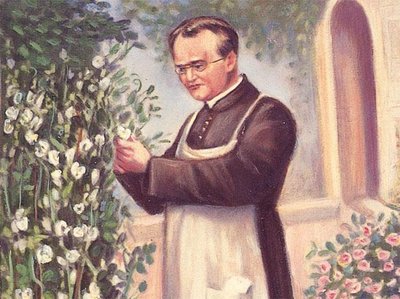
Mendelian genetics forms the foundation of classical genetics, explaining how traits are transmitted from parents to offspring. Gregor Mendel's experiments with garden peas led to the discovery of the particulate mechanism of inheritance, which replaced the earlier blending hypothesis.
Blending Hypothesis: Suggests offspring are a mix of parental traits; not supported by experimental evidence.
Particulate Hypothesis: Traits are inherited as discrete units called genes.
Gregor Mendel: Conducted controlled breeding experiments with pea plants, documenting inheritance patterns.
Character: A heritable feature (e.g., flower color).
Trait: A variant of a character (e.g., purple or white flowers).
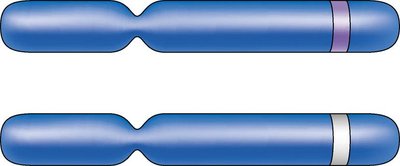
Alleles: Alternate versions of a gene.
Genetic Vocabulary
Understanding basic genetic terminology is essential for studying inheritance patterns.
Homozygous: An organism with two identical alleles for a gene (e.g., AA or aa); exhibits true-breeding.
Heterozygous: An organism with two different alleles for a gene (e.g., Aa).
Phenotype: Observable traits or physical appearance of an organism.
Genotype: The genetic makeup of an organism; all the genes an individual carries.
Molecular Mechanisms of Pigmentation
Melanin Types and Genetic Control
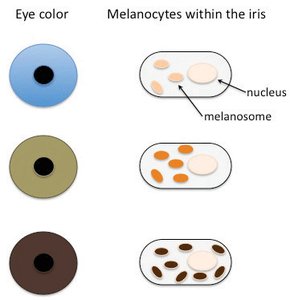
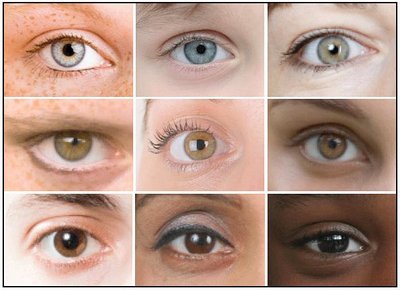
Human pigmentation is determined by the type and amount of melanin produced, which is controlled by genetic factors such as the MC1R receptor.
Eumelanin: Brown/black pigment.
Pheomelanin: Reddish-yellow pigment.
MC1R Receptor: Controls the switch between eumelanin and pheomelanin synthesis in melanocytes.
Dominant pigment: Fully active MC1R leads to brown/black hair; inactive/mutated MC1R leads to red hair and fair skin.
Mendel's Experiments and Laws
Hybridization and Generations
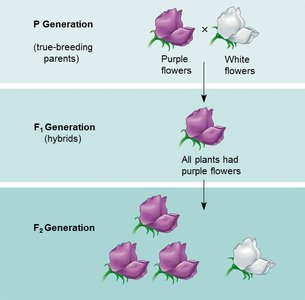
Mendel mated true-breeding varieties to study inheritance. The parental (P) generation produced hybrid (F1) offspring, which, when self-pollinated, produced the F2 generation.
P Generation: True-breeding parents.
F1 Generation: Hybrid offspring; all purple flowers in Mendel's experiment.
F2 Generation: Produced by self-pollination of F1; showed a 3:1 ratio of purple to white flowers.
Mendel's Model and Law of Segregation
Mendel developed a model to explain the 3:1 inheritance pattern observed in the F2 generation. Four key concepts underpin this model:
Alleles: Alternative versions of genes account for variations in inherited characters.
Two Alleles per Locus: Each organism inherits two alleles, one from each parent.
Dominance: If alleles differ, the dominant allele determines the phenotype; the recessive allele is masked.
Law of Segregation: The two alleles for a heritable character segregate during gamete formation and end up in different gametes.
Punnett Squares and Probability
Punnett squares are used to predict the outcome of genetic crosses, showing possible genotypes and phenotypes.
Monohybrid Cross: Cross between individuals heterozygous for one trait.
Testcross: Used to determine the genotype of an organism with a dominant phenotype by crossing it with a homozygous recessive individual.
Phenotypic Ratio: 3:1 in F2 generation for monohybrid crosses.
Genotypic Ratio: 1:2:1 in F2 generation for monohybrid crosses.
Law of Independent Assortment
Mendel's second law states that alleles for different traits segregate independently during gamete formation, leading to new combinations in offspring.
Dihybrid Cross: Cross between individuals heterozygous for two traits.
Phenotypic Ratio: 9:3:3:1 in F2 generation for dihybrid crosses.
Genotype | Phenotype |
|---|---|
YYRR | Yellow, Round |
YyRr | Yellow, Round |
yyrr | Green, Wrinkled |
Other combinations | Various phenotypes |
Additional info: Table summarizes dihybrid cross outcomes. |
Extensions of Mendelian Genetics
Complex Inheritance Patterns
Inheritance patterns can be more complex than simple Mendelian genetics, including variations such as incomplete dominance and codominance.
Complete Dominance: Heterozygote and dominant homozygote have identical phenotypes.
Codominance: Both alleles are expressed in the phenotype (e.g., human ABO blood types).
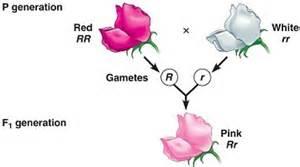
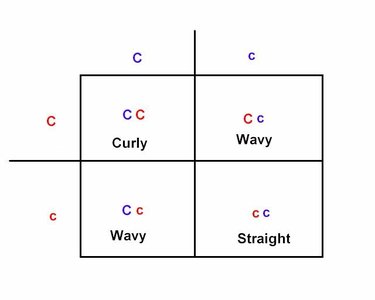
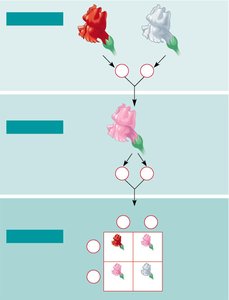
Incomplete Dominance: F1 hybrids have phenotypes intermediate between parental varieties.
ABO Blood Types
The ABO blood group system is an example of codominance and multiple alleles.
Genotype | Blood Type |
|---|---|
IAIA or IAi | A |
IBIB or IBi | B |
IAIB | AB |
ii | O |
Example: A woman with blood type AB marries a man with blood type O. Their children can have blood types A or B, but not AB or O.
Environmental Impact on Phenotype
The environment can influence the expression of genetic traits, leading to a range of phenotypes for a given genotype.
Norm of Reaction: The phenotypic range influenced by environmental factors.
Sex Determination and Sex Chromosomes
Chromosomal Basis of Sex Determination
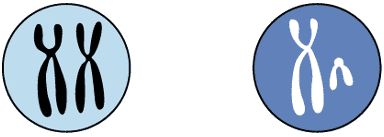
Sex is determined by the combination of sex chromosomes inherited from each parent. The X chromosome carries many genes, while the Y chromosome carries fewer, including the SRY gene for male determination.
XX: Female
XY: Male
X Chromosome: Contains over 2,300 genes, many unrelated to sex.
Y Chromosome: Contains the SRY gene, which triggers male development.
X-Linked Inheritance
Genes located on the X chromosome can cause X-linked diseases, such as hemophilia and colorblindness. These traits are inherited differently in males and females.
Example: Cross a male with normal vision (B) with a colorblind female (b).
Example: Cross a colorblind male with a female whose father had normal vision and mother was colorblind.
Chromosomal Disorders
Abnormalities in sex chromosome number can lead to syndromes such as Turner’s and Klinefelter’s.
Turner’s Syndrome (XO): Females with only one X chromosome; short stature, infertility, reduced secondary sexual traits.
Klinefelter’s Syndrome (XXY): Males with an extra X chromosome; tall, sterile, feminized traits.
Additional info: These notes expand on the original content with definitions, examples, and tables for clarity and completeness.
