 Back
Mendelian Genetics and Patterns of Inheritance
Study Guide - Smart Notes
 Tailored notes based on your materials, expanded with key definitions, examples, and context.
Mendel and the Gene Idea
Introduction to Mendelian Genetics
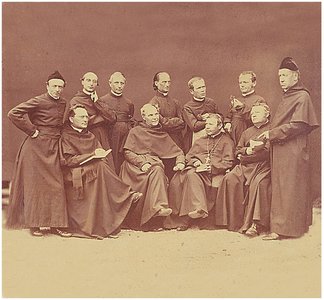
The study of heredity and the variation of inherited characteristics began with Gregor Mendel's experiments on pea plants. Mendel's work established the foundation for understanding how traits are passed from one generation to the next through predictable patterns.
Inheritance of traits often follows predictable rules, known as Mendelian inheritance.
Relationships between genes and phenotypes can be simple (Mendelian) or complex (polygenic, multifactorial).
Heritable phenotype variation is a key driver of evolution.
Mendel’s Experiments and Laws
Mendel’s Experimental Approach
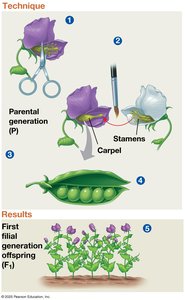
Mendel used hybridization experiments with pea plants, selecting varieties with distinct, heritable features (characters) and traits. He controlled mating to study inheritance patterns.
Used true-breeding plants (offspring identical to parents when self-pollinated).
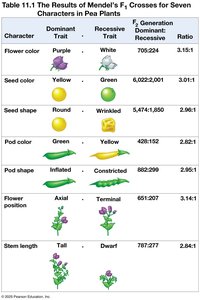
Studied characters with two alternative forms (e.g., purple vs. white flowers).
The Law of Segregation
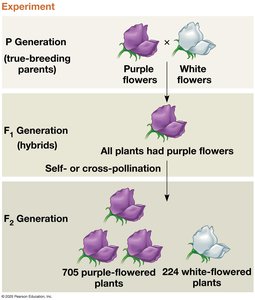
Mendel’s monohybrid crosses led to the discovery of the Law of Segregation:
Each individual has two alleles for each gene, which segregate during gamete formation.
Offspring inherit one allele from each parent.
Dominant alleles mask recessive alleles in heterozygotes.
Alleles, Genotypes, and Phenotypes
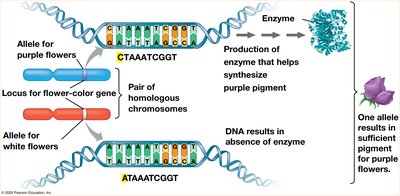
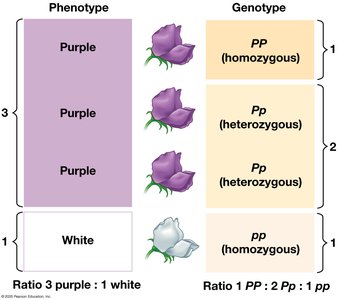
Alleles are alternative versions of a gene. The combination of alleles (genotype) determines the organism’s appearance (phenotype).
Homozygous: Two identical alleles (e.g., PP or pp).
Heterozygous: Two different alleles (e.g., Pp).
Dominant phenotype appears in both homozygous dominant and heterozygous individuals.
Punnett Squares and Testcrosses
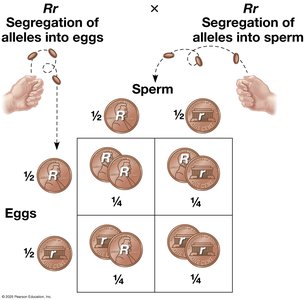
Punnett squares are used to predict the probability of offspring genotypes and phenotypes from parental crosses. A testcross can determine the genotype of an individual with a dominant phenotype by crossing it with a homozygous recessive individual.
The Law of Independent Assortment
Mendel’s dihybrid crosses led to the Law of Independent Assortment:
Alleles of different genes assort independently during gamete formation.
This law applies to genes on different chromosomes or those far apart on the same chromosome.
Probability and Genetic Crosses
Rules of Probability in Genetics
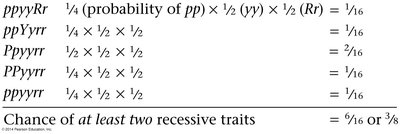
Mendelian inheritance follows the rules of probability. The probability of combined events is the product of their individual probabilities (the multiplication rule).
For example, the probability of an offspring being YyRR from a YyRr × YyRr cross is:

Complex Patterns of Inheritance
Degrees of Dominance
Complete dominance: Heterozygote and dominant homozygote are indistinguishable in phenotype.
Incomplete dominance: Heterozygote phenotype is intermediate between the two homozygotes (e.g., red × white flowers produce pink).
Codominance: Both alleles are fully expressed in heterozygotes (e.g., AB blood type).
Multiple Alleles
Many genes have more than two alleles in the population. The ABO blood group in humans is determined by three alleles: IA, IB, and i.
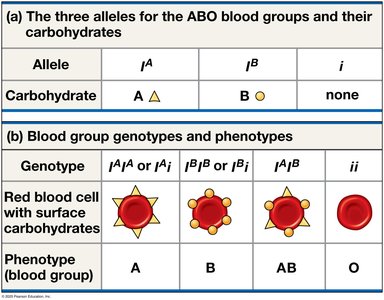
Blood Type | Genotype | U.S. Frequency |
|---|---|---|
O | ii | 46% |
A | IAIA, IAi | 40% |
B | IBIB, IBi | 10% |
AB | IAIB | 4% |
Multiple Alleles in Other Species
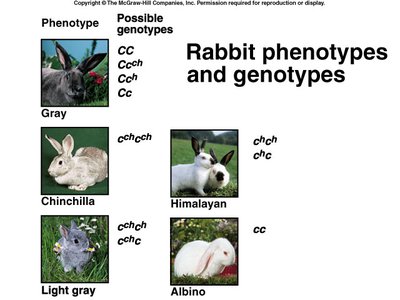
Some genes have even more alleles, such as the rabbit coat color gene, which has four alleles and produces five phenotypes.
Epistasis
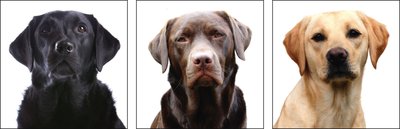
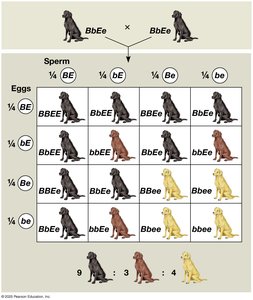
Epistasis occurs when one gene affects the expression of another gene. For example, in Labrador retrievers, one gene determines pigment color (B = black, b = brown), and another gene (E = color, e = no color) determines whether pigment is deposited in the hair.
Polygenic Inheritance
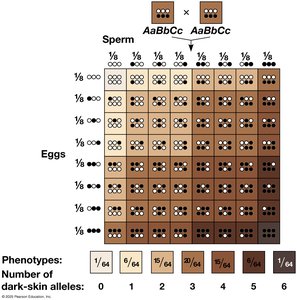
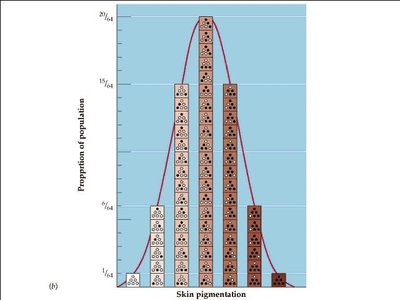
Polygenic inheritance occurs when multiple genes independently affect a single trait, resulting in continuous variation (e.g., human skin color).
Traits show a bell-shaped distribution in the population.
Pleiotropy
Pleiotropy occurs when one gene influences multiple phenotypic traits (e.g., sickle-cell disease affects multiple systems in the body).
Gene Interactions and Environmental Effects
Nature and Nurture: Multifactorial Traits
Some traits are influenced by both genetic and environmental factors. The norm of reaction describes the range of phenotypes produced by a genotype under different environmental conditions. Such traits are called multifactorial.
Genes set the limits of phenotypic expression; environment determines where within those limits the phenotype falls.
Summary Table: Patterns of Inheritance
Pattern | Description | Example |
|---|---|---|
Complete dominance | Heterozygote phenotype same as homozygous dominant | Purple flower color in peas |
Incomplete dominance | Heterozygote phenotype intermediate | Pink flowers from red × white |
Codominance | Both phenotypes expressed in heterozygotes | AB blood group |
Multiple alleles | More than two alleles for a gene | ABO blood group, rabbit coat color |
Epistasis | One gene affects expression of another | Labrador coat color |
Polygenic inheritance | Multiple genes affect one trait | Skin color in humans |
Pleiotropy | One gene affects multiple traits | Sickle-cell disease |
Multifactorial traits | Influenced by genes and environment | Height, skin color |
Key Takeaways
Mendel’s laws of segregation and independent assortment explain the basic patterns of inheritance.
Complex inheritance patterns include incomplete dominance, codominance, multiple alleles, epistasis, polygenic inheritance, pleiotropy, and multifactorial traits.
Genetic variation is essential for evolution and is influenced by both genetic and environmental factors.
