 Back
Mendelian Genetics and Patterns of Inheritance – Study Guide
Study Guide - Smart Notes
 Tailored notes based on your materials, expanded with key definitions, examples, and context.
Chapter 11: Mendelian Genetics and Patterns of Inheritance
Genetic Characters, Traits, Genes, and Alleles
Genetic inheritance is based on the transmission of heritable features, known as characters, which can exist in different forms called traits. The molecular basis for these differences lies in genes and their alternative versions, alleles.
Character: A heritable feature that varies among individuals (e.g., flower color).
Trait: Each variant for a character (e.g., purple or white flowers).
Gene: A DNA unit that influences a character (e.g., gene for flower color).
Allele: Alternative versions of a gene that produce different traits (e.g., allele for purple or white color).
Genotype: The allele combination an organism carries (e.g., PP, Pp, or pp).
Phenotype: The observable traits resulting from the genotype (e.g., purple flowers).
Example: In pea plants, the gene for flower color has two alleles: one for purple and one for white. The character is flower color, and the traits are purple or white.
Mendel’s Experiments and Laws of Inheritance
Gregor Mendel’s experiments with pea plants established the foundational principles of genetic inheritance, challenging the earlier idea of blending inheritance.
Law of Segregation: The two alleles for a heritable character segregate during gamete formation and end up in different gametes.
Law of Independent Assortment: Each pair of alleles segregates independently of other pairs during gamete formation (applies to genes on different chromosomes).
Key Insight: Traits can disappear in one generation and reappear in the next, indicating that hereditary information is carried in discrete units (genes).
Example: In a monohybrid cross, crossing true-breeding purple (PP) and white (pp) flowers produces all purple F1 offspring (Pp), but the white trait reappears in the F2 generation.
Genetic Crosses and Terminology
Understanding genetic crosses requires familiarity with specific terms and their application to Mendel’s experiments.
True-breeding: Organisms that produce offspring of the same variety over many generations of self-pollination.
Hybridization: Mating/crossing of two true-breeding varieties.
P Generation: Parental generation (true-breeding parents).
F1 Generation: First filial generation (hybrid offspring).
F2 Generation: Second filial generation (offspring of F1 hybrids).
Homozygous: Organism with two identical alleles for a gene.
Heterozygous: Organism with two different alleles for a gene.
Dominant allele: Expresses its trait in the presence of another allele.
Recessive allele: Masked by the dominant allele unless paired with an identical allele.
From Genotype to Phenotype
The genotype determines the phenotype through gene expression, where DNA is transcribed to RNA and translated into proteins that manifest as observable traits.
Gene (DNA sequence) → mRNA → Protein → Cell function/structure → Trait
Mendel’s Model of Genetic Inheritance
Mendel’s model consists of four main points:
Alternative versions of genes (alleles) account for variations in inherited characters.
Each organism inherits two alleles for each gene, one from each parent.
If the alleles differ, the dominant allele determines the phenotype.
The two alleles segregate during gamete formation (Law of Segregation).
Punnett Squares and Testcrosses
Punnett squares are used to predict the genotype and phenotype ratios of offspring from genetic crosses. A testcross involves breeding an organism with a dominant phenotype (but unknown genotype) with a homozygous recessive individual to determine the unknown genotype.
Dihybrid Crosses and Independent Assortment
A dihybrid cross examines the inheritance of two characters simultaneously. If the genes are on different chromosomes, they assort independently, producing recombinant phenotypes in the F2 generation. If on the same chromosome, recombination during meiosis can still produce new allele combinations.
Probability in Genetics: Multiplication and Addition Rules
Multiplication Rule: Probability of two independent events occurring together is the product of their individual probabilities.
Addition Rule: Probability that any one of two or more mutually exclusive events will occur is the sum of their individual probabilities.
Complex Patterns of Inheritance
Complete Dominance: Heterozygote and dominant homozygote are indistinguishable in phenotype.
Incomplete Dominance: Heterozygote phenotype is intermediate between the two homozygotes (e.g., red × white flowers → pink).
Codominance: Both alleles are fully expressed in the heterozygote (e.g., AB blood type).
Multiple Alleles: More than two alleles exist in the population for a gene (e.g., ABO blood types).
Pleiotropy: One gene affects multiple traits (e.g., Marfan syndrome).
Epistasis: One gene alters the phenotypic expression of another gene (e.g., Labrador coat color).
Polygenic Inheritance: Multiple genes contribute additively to a single trait (e.g., human skin color).
Quantitative Characters: Traits that vary continuously over a range (e.g., height).
Phenotypic Plasticity: The ability of a genotype to produce different phenotypes under different environmental conditions.
Multifactorial Traits: Influenced by multiple genes and environmental factors.
Pedigrees and Human Genetic Disorders
A pedigree is a diagram showing the inheritance of a trait across generations. It helps infer inheritance patterns (dominant, recessive, X-linked, etc.).
Carrier: Heterozygous individual for a recessive disorder; does not show symptoms but can pass the allele to offspring.
Cystic Fibrosis: Recessive disorder affecting chloride channels, common in people of European descent.
Tay-Sachs Disease: Recessive disorder due to a dysfunctional enzyme.
Huntington’s Disease: Dominant disorder with late-onset nervous system deterioration.
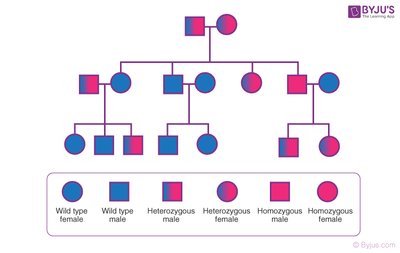
Application: Interpreting Pedigrees
Pedigrees use standardized symbols to represent individuals and their genotypes/phenotypes. Circles represent females, squares represent males, and shading or patterns indicate genotype (wild type, heterozygous, homozygous).
By analyzing the pattern of affected and unaffected individuals, one can infer the mode of inheritance (dominant, recessive, X-linked, etc.).
Carriers (heterozygotes) can be identified in recessive inheritance patterns.
