 Back
Mendelian Genetics and Patterns of Inheritance
Study Guide - Smart Notes
 Tailored notes based on your materials, expanded with key definitions, examples, and context.
Genetic Characters, Traits, Genes, and Alleles
Definitions and Relationships
In genetics, it is important to distinguish between the terms character, trait, gene, and allele. These concepts form the foundation for understanding inheritance patterns.
Character: A heritable feature that varies among individuals (e.g., flower color).
Trait: Each variant for a character (e.g., purple or white flowers).
Gene: The DNA unit that influences a character (e.g., gene for flower color).
Allele: Alternative versions of a gene that may produce distinguishable phenotypic effects (e.g., allele for purple or white color).
Genotype: The allele combination an organism possesses (e.g., PP, Pp, or pp).
Phenotype: The observable traits of an organism (e.g., purple flowers).
Example: In pea plants, the character is flower color, the traits are purple and white, the gene is the flower color gene, and the alleles are the versions for purple or white.
Mendel’s Experiments and Laws of Inheritance
Contributions and Historical Context
Gregor Mendel’s experiments with pea plants established the basic principles of genetic inheritance, challenging the earlier idea of blending inheritance.
Law of Segregation: The two alleles for a heritable character segregate during gamete formation and end up in different gametes.
Law of Independent Assortment: Genes for different characters assort independently during gamete formation, provided they are on different chromosomes.
Discrete Inheritance: Traits are inherited as discrete units (genes), not blended.
Example: When Mendel crossed true-breeding purple and white flowered plants, the F1 generation was all purple, but the white trait reappeared in the F2 generation, supporting the idea of discrete inheritance.
Genetic Crosses and Terminology
Key Terms and Applications
True-breeding: Organisms that produce offspring of the same variety over many generations of self-pollination.
Hybridization: Mating/crossing of two true-breeding varieties.
P Generation: Parental generation (true-breeding parents).
F1 Generation: First filial generation (hybrid offspring).
F2 Generation: Second filial generation (offspring of F1 generation).
Homozygous: Having two identical alleles for a gene.
Heterozygous: Having two different alleles for a gene.
Dominant: Allele that determines the phenotype in a heterozygote.
Recessive: Allele that is masked in the presence of a dominant allele.
From Genotype to Phenotype
Gene Expression and Trait Manifestation
An organism’s genotype leads to its phenotype through gene expression. DNA is transcribed into mRNA, which is translated into proteins. These proteins determine cell structure and function, resulting in observable traits.
Gene (DNA sequence) → mRNA → Protein → Cell function/structure → Trait
Mendel’s Model of Genetic Inheritance
Four Key Components
Alternative versions of genes (alleles) account for variations in inherited characters.
Each organism inherits two alleles for each gene, one from each parent.
If the two alleles differ, the dominant allele determines the phenotype; the recessive allele has no noticeable effect.
The two alleles segregate during gamete formation (law of segregation).
Punnett Squares and Testcrosses
Predicting Offspring Genotypes and Phenotypes
Punnett Square: A diagram used to predict the genotype and phenotype ratios of offspring from a genetic cross.
Testcross: Breeding an organism of unknown genotype with a recessive homozygote to determine the unknown genotype.
Dihybrid Crosses and Independent Assortment
Genotype of Gametes and Offspring Ratios
Dihybrid Cross: A cross between individuals heterozygous for two characters (e.g., AaBb × AaBb).
Independent Assortment: Genes on different chromosomes assort independently, leading to new combinations (recombinant phenotypes) in the F2 generation.
Linked Genes: Genes located on the same chromosome may not assort independently.
Complex Patterns of Inheritance
Beyond Simple Dominance
Complete Dominance: Heterozygote and dominant homozygote are phenotypically indistinguishable.
Incomplete Dominance: Heterozygote phenotype is intermediate between the two homozygotes (e.g., red × white flowers produce pink).
Codominance: Both alleles are fully expressed in the heterozygote (e.g., AB blood type).
Multiple Alleles: More than two alleles exist in the population for a gene (e.g., ABO blood types).
Pleiotropy: One gene affects multiple traits (e.g., Marfan syndrome).
Epistasis: One gene affects the expression of another gene (e.g., Labrador coat color).
Polygenic Inheritance: Multiple genes contribute additively to a single trait (e.g., skin color).
Phenotypic Plasticity: The ability of a genotype to produce different phenotypes in different environments.
Multifactorial Traits: Influenced by multiple genes and environmental factors.
Pedigrees and Inheritance Patterns
Interpreting Family Trees
A pedigree is a diagram that shows the occurrence of heritable characters in parents and offspring across generations. Pedigrees are used to infer inheritance patterns of traits and diseases.
Carrier: An individual heterozygous for a recessive disorder; does not show symptoms but can pass the allele to offspring.
Autosomal Recessive Disorders: Cystic fibrosis, Tay-Sachs disease.
Autosomal Dominant Disorders: Huntington’s disease.
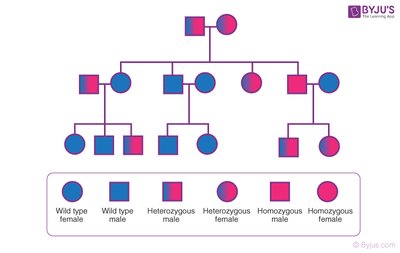
Example: The pedigree above shows inheritance patterns for a genetic trait, distinguishing wild type, heterozygous, and homozygous individuals by color and shape. Squares represent males, circles represent females, and the color coding indicates genotype.
Probability in Genetics
Rules for Predicting Outcomes
Multiplication Rule: The probability of two independent events occurring together is the product of their individual probabilities.
Addition Rule: The probability of any one of two or more mutually exclusive events occurring is the sum of their individual probabilities.
Example: To calculate the probability of getting a specific genotype in a cross, multiply the probabilities for each allele combination.
Summary Table: Types of Genetic Inheritance
Pattern | Description | Example |
|---|---|---|
Complete Dominance | Dominant allele masks recessive | Purple vs. white flowers |
Incomplete Dominance | Heterozygote is intermediate | Pink snapdragons |
Codominance | Both alleles expressed | AB blood type |
Multiple Alleles | More than two alleles in population | ABO blood types |
Pleiotropy | One gene, multiple effects | Marfan syndrome |
Epistasis | One gene affects another | Labrador coat color |
Polygenic Inheritance | Multiple genes, one trait | Skin color |
