 Back
Mendelian Genetics and Patterns of Inheritance – Study Guide Walkthrough
Study Guide - Smart Notes
 Tailored notes based on your materials, expanded with key definitions, examples, and context.
Q1. Is the phenotype observed in the F1 generation dominant or recessive?
Background
Topic: Mendelian Genetics – Dominance and Recessiveness
This question tests your understanding of how dominant and recessive traits are expressed in offspring, specifically in the F1 generation of a monohybrid cross.
Key Terms:
Dominant trait: The trait that is expressed when at least one dominant allele is present.
Recessive trait: The trait that is only expressed when both alleles are recessive.
F1 generation: The first filial generation, offspring of the parental (P) generation.
Step-by-Step Guidance
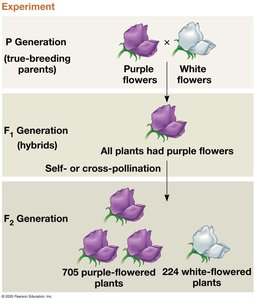
Recall that Mendel crossed true-breeding purple (PP) and white (pp) pea plants.
All F1 offspring inherited one allele from each parent, resulting in the genotype Pp.
Consider which trait is expressed in the F1 generation and why, based on the genotype.
Try solving on your own before revealing the answer!
Final Answer: Dominant
The phenotype observed in the F1 generation is dominant (purple flowers), because the presence of one dominant allele (P) masks the effect of the recessive allele (p).
Q2. What is the approximate ratio of dominant to recessive phenotypes in the F2 generation?
Background
Topic: Mendelian Genetics – Phenotypic Ratios
This question tests your ability to interpret the results of a monohybrid cross and calculate the ratio of dominant to recessive phenotypes in the F2 generation.
Key Terms:
Phenotype: Observable trait (e.g., flower color).
F2 generation: Second filial generation, offspring of the F1 generation.
Punnett square: Diagram used to predict genotypes and phenotypes.
Step-by-Step Guidance
Recall that F1 plants are heterozygous (Pp).
Set up a Punnett square for a cross between two Pp plants.
Identify the possible genotypes and their frequencies in the F2 generation.
Determine which genotypes correspond to dominant and recessive phenotypes.
Try solving on your own before revealing the answer!
Final Answer: Approximately 3:1
The ratio of dominant (purple) to recessive (white) phenotypes in the F2 generation is about 3:1, as shown by the numbers in the experiment (705 purple-flowered to 224 white-flowered plants).
Q3. If the genotype of the P generation plants are PP and pp, what genotypes appear in the F1 generation?
Background
Topic: Mendelian Genetics – Genotype Prediction
This question tests your understanding of how alleles are inherited from true-breeding parents and what genotypes result in the F1 generation.
Key Terms:
Genotype: The genetic makeup of an organism (e.g., PP, pp, Pp).
True breeding: Organisms that always pass down certain traits.
Allele: Alternative form of a gene.
Step-by-Step Guidance
Identify the alleles contributed by each parent: PP (purple) and pp (white).
Each F1 offspring receives one allele from each parent.
Combine the alleles to determine the genotype of the F1 generation.
Try solving on your own before revealing the answer!
Final Answer: All F1 plants are Pp
Each F1 plant inherits a P allele from the purple parent and a p allele from the white parent, resulting in the genotype Pp for all F1 offspring.
Q4. What genotypes appear in the F2 generation?
Background
Topic: Mendelian Genetics – Genotype Ratios
This question tests your ability to predict the genotypes of offspring in the F2 generation after crossing two F1 heterozygotes.
Key Terms:
Genotype: The combination of alleles (PP, Pp, pp).
Punnett square: Tool for predicting genetic outcomes.
Step-by-Step Guidance
Recall that F1 plants are Pp.
Set up a Punnett square for Pp x Pp.
List all possible genotype combinations from the cross.
Try solving on your own before revealing the answer!
Final Answer: PP, Pp, and pp
The F2 generation includes three genotypes: PP, Pp, and pp, with frequencies of 1:2:1 respectively.
Q5. Why did Mendel need to breed multiple generations through self-pollination to get true breeding purple plants (PP) for his experiment?
Background
Topic: Mendelian Genetics – True Breeding
This question tests your understanding of how true breeding lines are established and why repeated self-pollination is necessary for certain traits.
Key Terms:
True breeding: Producing offspring with the same phenotype over many generations.
Self-pollination: Fertilization of a plant by its own pollen.
Homozygous: Having two identical alleles for a gene.
Step-by-Step Guidance
Consider the possibility of hidden recessive alleles in purple-flowered plants.
Understand that repeated self-pollination helps eliminate heterozygotes (Pp) and ensures only homozygous (PP) plants remain.
Think about why this process is necessary for dominant traits but not for recessive traits.
Try solving on your own before revealing the answer!
Final Answer: To ensure all plants were homozygous (PP)
Mendel needed to breed multiple generations to eliminate any plants carrying the recessive allele (p), ensuring only PP plants remained for a true breeding line.
Q6. Why did Mendel not need to breed multiple generations through self-pollination to get true breeding white plants?
Background
Topic: Mendelian Genetics – True Breeding for Recessive Traits
This question tests your understanding of why establishing a true breeding line for a recessive trait is simpler than for a dominant trait.
Key Terms:
Recessive trait: Only expressed when both alleles are recessive.
Homozygous recessive: Both alleles are the same and recessive (pp).
Step-by-Step Guidance
Recall that white-flowered plants must have the genotype pp.
Understand that the recessive phenotype only appears when both alleles are recessive.
Consider why self-pollination is not needed to eliminate hidden alleles.
Try solving on your own before revealing the answer!
Final Answer: All white plants are already homozygous (pp)
Because the recessive phenotype only appears in homozygous recessive plants, Mendel did not need to breed multiple generations to ensure true breeding for white flowers.
