 Back
BackMendelian Genetics and Phenotypic Ratios: Step-by-Step Guidance
Study Guide - Smart Notes
 Tailored notes based on your materials, expanded with key definitions, examples, and context.
Q5. In the garden pea, Mendel found that yellow seed colour (Y) was dominant to green (y) and round seed shape (S) was dominant to shrunken (s).
Background
Topic: Mendelian Genetics, Dihybrid Crosses
This question tests your understanding of Mendel's laws of inheritance, specifically how dominant and recessive alleles interact in a dihybrid cross and how to predict phenotypic ratios in the F2 generation.
Key Terms and Formulas
Dihybrid cross: A cross between two individuals that are both heterozygous for two traits.
Phenotype: Observable traits (e.g., yellow/green, round/shrunken).
Genotype: Genetic makeup (e.g., YY, Yy, yy).
Law of Independent Assortment: Alleles for different traits segregate independently during gamete formation.
Step-by-Step Guidance
Identify the genotypes of the parents: Pure yellow, round (YYSS) crossed with green, shrunken (yyss).
Determine the genotype of the F1 generation: All offspring will be heterozygous (YySs).
Set up the F1 cross: YySs × YySs.
Apply the law of independent assortment to predict the gametes produced by each F1 parent.
Use a Punnett square to organize the possible combinations and count the phenotypes (yellow/green, round/shrunken).
Try solving on your own before revealing the answer!
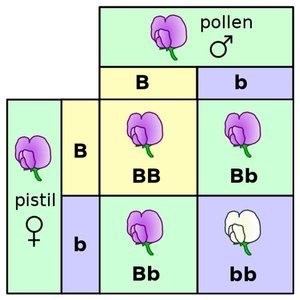
Q6. A pair of alleles governs coat colour in guinea pigs; a dominant allele B produces black colour and its recessive allele b produces white, another locus on a different chromosome is known to govern length of hair. L produces short hair and l produces long hair. Do a test cross on a black short-haired female (BbLl) and show the genotypic and phenotypic ratios that result among the progeny.
Background
Topic: Test Cross, Dihybrid Crosses
This question is about performing a test cross to determine the genotypic and phenotypic ratios for two independently assorting traits: coat colour and hair length.
Key Terms and Formulas
Test cross: Crossing an individual with a dominant phenotype (but unknown genotype) with a homozygous recessive individual.
Dihybrid cross: Cross involving two traits.
Phenotypic ratio: The ratio of observable traits in the offspring.
Step-by-Step Guidance
Identify the genotype of the black short-haired female: BbLl.
Identify the genotype of the test cross partner: bbll (white, long-haired).
Determine the possible gametes produced by BbLl: BL, Bl, bL, bl.
Set up a Punnett square to show all possible combinations of gametes and resulting genotypes.
Count the genotypic and phenotypic ratios among the progeny based on the combinations.
Try solving on your own before revealing the answer!
Q7. In mice, black coat colour (B) is dominant to white (b). At a different locus, a dominant allele (A) produces a band of yellow just below the tip of each hair in mice with black fur. This gives a frosted appearance known as agouti. There is no band in mice with white fur and they appear solid white. Expression of the recessive allele (a) results in a solid coat colour. If mice that are heterozygous at both loci are crossed, what are the expected genotypic and phenotypic ratios of their offspring?
Background
Topic: Dihybrid Crosses, Epistasis
This question tests your ability to predict genotypic and phenotypic ratios in a cross involving two loci, one of which modifies the expression of the other (epistasis).
Key Terms and Formulas
Epistasis: Interaction between genes where one gene modifies the expression of another.
Dihybrid cross: Cross between individuals heterozygous for two traits.
Step-by-Step Guidance
Identify the genotypes of the parents: Both are BbAa.
Determine the possible gametes produced by each parent: BA, Ba, bA, ba.
Set up a Punnett square to show all possible combinations of gametes.
Determine the genotypes and phenotypes based on the interaction between the two loci.
Count the expected genotypic and phenotypic ratios among the offspring.
Try solving on your own before revealing the answer!
Q8. A true breeding radish with long red roots was crossed to a true breeding radish with round white roots. The F1 radishes were all oval and purple. Assuming that two independently assorting loci are involved, what would be the ratio of all the possible phenotypes among the F2 produced by crossing two of the F1 radishes?
Background
Topic: Dihybrid Crosses, Incomplete Dominance
This question tests your understanding of dihybrid crosses and incomplete dominance, where the F1 phenotype is intermediate between the two parental phenotypes.
Key Terms and Formulas
Incomplete dominance: Neither allele is completely dominant, resulting in an intermediate phenotype.
Dihybrid cross: Cross involving two traits.
Step-by-Step Guidance
Identify the genotypes of the parents: Long red (RRLL) × round white (rrll).
Determine the genotype of the F1 generation: All RrLl (oval, purple).
Set up the F1 cross: RrLl × RrLl.
Apply the law of independent assortment to predict the gametes produced by each F1 parent.
Use a Punnett square to organize the possible combinations and count the phenotypes among the F2.
Try solving on your own before revealing the answer!
