 Back
BackMendelian Genetics and Sexual Life Cycles: Study Guide
Study Guide - Smart Notes
 Tailored notes based on your materials, expanded with key definitions, examples, and context.
Mendelian Genetics
Introduction to Mendelian Genetics
Mendelian genetics is the foundation of classical genetics, describing how traits are inherited from one generation to the next through discrete units called genes. Gregor Mendel's experiments with pea plants established the basic principles of inheritance, including the concepts of dominant and recessive alleles.
Gene: A segment of DNA containing instructions for a specific protein.
Allele: A version or particular copy of a gene.
Genotype: The list of alleles present at the gene copies on homologous chromosomes.
Phenotype: The physical appearance of a certain trait.
Heterozygous: Having different alleles at the gene copies on homologous chromosomes.
Homozygous: Having the same alleles at the gene copies on homologous chromosomes.
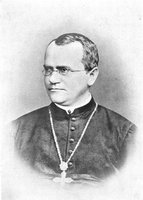
Mendel’s Model of Inheritance
Mendel proposed that individuals possess two genetic factors (alleles) for each trait, one inherited from each parent. These factors may be dominant or recessive, and their combination determines the phenotype. Mendel’s experiments predicted a 3:1 ratio of dominant to recessive traits in the offspring of hybrids.
Dominant allele: The allele that is observable in a heterozygote.
Recessive allele: The allele that is masked in a heterozygote.
3:1 ratio: Typical ratio of dominant to recessive phenotypes in the F2 generation of a monohybrid cross.
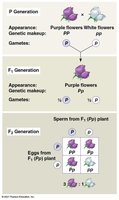
Experimental Evidence: Mendel’s Crosses
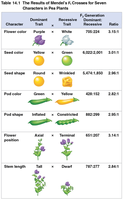
Mendel performed crosses with pea plants, tracking seven distinct traits. His results consistently supported his model of inheritance, with predictable ratios of dominant and recessive traits in the offspring.
Character | Dominant Trait | Recessive Trait | F2 Generation Ratio |
|---|---|---|---|
Flower color | Purple | White | 3.15:1 |
Seed color | Yellow | Green | 3.01:1 |
Seed shape | Round | Wrinkled | 2.96:1 |
Pod color | Green | Yellow | 2.82:1 |
Pod shape | Inflated | Constricted | 2.96:1 |
Flower position | Axial | Terminal | 3.14:1 |
Stem length | Tall | Dwarf | 2.84:1 |
Punnett Squares
Punnett squares are a visual tool used to predict the genotypes and phenotypes of offspring from a genetic cross. They help organize possible gametes and their combinations.
Procedure:
Identify the genotypes of the parents.
Identify the possible gametes each parent can produce.
Write the possible gametes from each parent along the side and top of the Punnett square.
Fill in each box, creating possible offspring genotypes by combining gametes from the row and column headings.
Identify the phenotype of each offspring based on the genotype.
Example: Two heterozygous short-haired cats (Hh) mate. The probability that a kitten will have long hair (hh) is 25%.
Punnett Square Pitfalls
Common mistakes when using Punnett squares include writing genotypes instead of gametes, incorrectly linking genotype to phenotype, bookkeeping errors, and confusion between capital and lowercase letters.
Always use print upper-case and script lower-case letters for clarity.
Carefully count genotypes and phenotypes that meet question requirements.
Sexual Life Cycles and Meiosis
Meiosis and Genetic Variation
Meiosis is a specialized cell division process that reduces the chromosome number by half, creating haploid gametes. It introduces genetic variation through independent assortment and crossing over, setting the stage for sexual reproduction.
Independent Assortment: Chromosomes may be a mixture of maternal and paternal DNA.
Crossing Over: Results in recombination of genetic material.
Genetic Variation: Essential for adaptation and evolution.
Life Cycles: Diploid and Haploid Phases
All life cycles with sexual reproduction must have both diploid and haploid phases. The relative duration of these phases varies across different types of organisms.
Diploid (2n): Two sets of chromosomes.
Haploid (n): One set of chromosomes.
Fertilization: Fusion of gametes restores diploid state.
Meiosis: Reduces diploid to haploid, producing gametes or spores.
Types of Sexual Life Cycles
There are three main types of sexual life cycles, each with distinct patterns of meiosis and fertilization:
Gametic Meiosis: Found in animals; diploid phase dominant; meiosis produces gametes.
Sporic Meiosis: Found in plants and some algae; both phases multicellular; meiosis produces spores, mitosis produces gametes.
Zygotic Meiosis: Found in most fungi and some protists; haploid phase dominant; gametes produced by mitosis.
Mitosis vs. Meiosis
Mitosis and meiosis are two distinct types of cell division with different outcomes and purposes.
Mitosis:
Results in two cells
Cells are diploid
Cells genetically identical
Used for growth and tissue replacement
Meiosis:
Results in four cells
Cells are haploid
Cells genetically distinct
Used to create gametes for sexual reproduction
Legacy of Mendel
Impact on Genetics and Evolution
Mendel’s work established the baseline for studying inheritance patterns, including sex-linked traits, gene linkage, and gene interactions. His findings contributed to the modern synthesis of evolutionary biology, enhancing our understanding of genetic variation and evolutionary processes.
Sex-linked inheritance: Traits associated with sex chromosomes.
Linkage: Genes located close together on the same chromosome tend to be inherited together.
Modern Synthesis: Integration of Mendelian genetics with Darwinian evolution.
