 Back
Mendelian Genetics and the Gene Idea: Study Notes
Study Guide - Smart Notes
 Tailored notes based on your materials, expanded with key definitions, examples, and context.
Mendelian Genetics and the Gene Idea
Introduction to Mendelian Genetics
Mendelian genetics forms the foundation of classical genetics, describing how traits are inherited from one generation to the next through discrete units called genes. Gregor Mendel's experiments with pea plants established the basic principles of heredity, including the concepts of dominant and recessive alleles, and the laws of segregation and independent assortment.
Key Terminology
Definitions and Concepts
Understanding genetics requires familiarity with several key terms:
Allele: A variant form of a gene at a specific locus on a chromosome.
Dominant allele: An allele that masks the expression of a recessive allele in a heterozygous individual.
Recessive allele: An allele whose expression is masked by a dominant allele.
Phenotype: The observable physical or physiological traits of an organism, determined by its genotype.
Genotype: The genetic makeup of an organism; the combination of alleles present at a locus.
Homozygous: Having two identical alleles for a particular gene.
Heterozygous: Having two different alleles for a particular gene.
Parental generation (P): The original true-breeding parents in a genetic cross.
F1 generation: The first filial generation, offspring of the parental generation.
F2 generation: The second filial generation, offspring of the F1 generation.
Hybrid: Offspring resulting from the cross of two different true-breeding strains.
Monohybrid: A cross involving one trait.
Dihybrid: A cross involving two traits.
Testcross: A cross used to determine the genotype of an individual with a dominant phenotype.
Pedigree: A diagram that traces the inheritance of traits through generations.
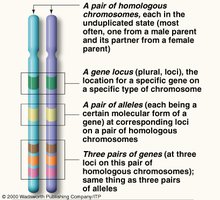
Gregor Mendel: The Father of Genetics
Historical Context and Experiments
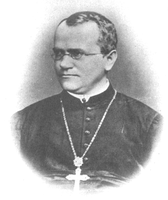
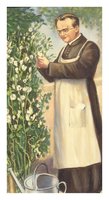
Gregor Mendel was a 19th-century monk who conducted pioneering experiments on pea plants (Pisum sativum) to study inheritance. His quantitative approach and use of controlled breeding led to the discovery of fundamental genetic laws.
Quantitative experiments: Mendel blended mathematics and biology to analyze inheritance patterns.
Blending vs. particulate hypothesis: Mendel tested whether traits blended or were inherited as discrete units.
Outcomes: Mendel documented a particulate mechanism and developed two laws of inheritance.
Model Genetic Organisms
Characteristics and Examples
Model genetic organisms are species used in genetic research due to their suitability for controlled experiments.
Distinct heritable traits: Easily observable characteristics (e.g., flower color, seed shape).
Short generation time: Rapid reproduction allows for multiple generations in a short period.
Controlled breeding: Ability to self-pollinate or cross-pollinate enables precise genetic studies.
Examples: Pea plants (Pisum sativum), fruit flies (Drosophila melanogaster), mice, yeast, and zebrafish.
Plant Reproduction and Mendel's Experimental Design
Sexual and Asexual Reproduction in Angiosperms
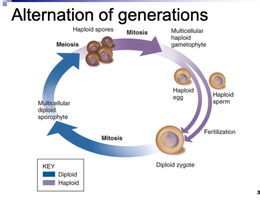
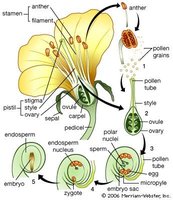
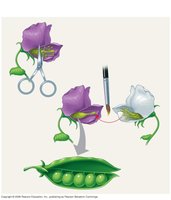
Flowering plants reproduce sexually via gametes produced in the stamen (male) and carpel (female). Mendel controlled breeding by removing stamens to prevent self-fertilization and manually transferring pollen.
Self-fertilization: Fertilization occurs within the same plant.
Cross-fertilization: Fertilization occurs between different plants.

Mendel's Experimental Results
Tracing Traits Across Generations
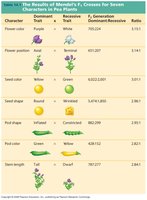
Mendel traced seven distinct characteristics in pea plants, observing their inheritance across generations.
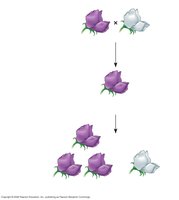
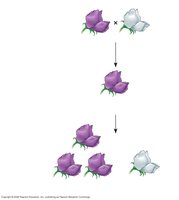
P generation: True-breeding parents.
F1 generation: All hybrids showed the dominant trait.
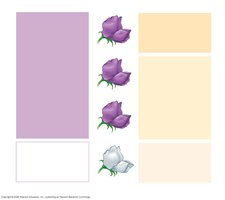
F2 generation: Offspring showed a 3:1 ratio of dominant to recessive phenotypes.
Summary Table of Mendel's Results
Mendel observed consistent ratios for several traits:
Character | Dominant Trait | Recessive Trait | F2 Generation Dominant:Recessive | Ratio |
|---|---|---|---|---|
Flower color | Purple | White | 705:224 | 3.15:1 |
Flower position | Axial | Terminal | 651:207 | 3.15:1 |
Seed color | Yellow | Green | 602:134 | 4.5:1 |
Seed shape | Round | Wrinkled | 547:98 | 5.6:1 |
Pod color | Green | Yellow | 428:152 | 2.8:1 |
Pod shape | Inflated | Constricted | 882:299 | 2.95:1 |
Stem length | Tall | Dwarf | 787:277 | 2.84:1 |
Mendel's Laws of Inheritance
Law of Segregation
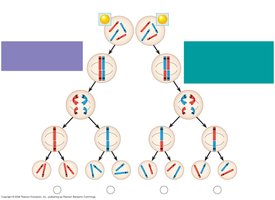
The law of segregation states that two alleles for each heritable characteristic separate during gamete formation, so each gamete receives only one allele.
Each organism inherits two alleles, one from each parent.
Alleles separate during gamete formation.
Monohybrid crosses demonstrate this law.
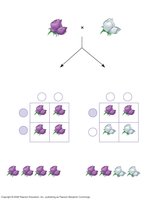
Punnett Square
A Punnett square is a diagram used to predict the outcome of genetic crosses.
Capital letter: Dominant allele (e.g., A)
Lowercase letter: Recessive allele (e.g., a)
Homozygous: AA or aa
Heterozygous: Aa
Testcross
A testcross is used to determine whether an individual with a dominant phenotype is homozygous or heterozygous.
Cross the individual with a homozygous recessive (pp).
If all offspring show the dominant phenotype, the individual is homozygous dominant.
If offspring show a 1:1 ratio, the individual is heterozygous.
Law of Independent Assortment
Inheritance of Multiple Traits
The law of independent assortment states that alleles of different genes assort independently during gamete formation.
Inheritance of one trait does not affect inheritance of another.
Dihybrid crosses demonstrate this law.
Phenotypic ratio for dihybrid cross: 9:3:3:1
Summary of Mendelian Ratios
Monohybrid and Dihybrid Crosses
Monohybrid cross: F2 generation shows a 3:1 phenotypic ratio and a 1:2:1 genotypic ratio.
Dihybrid cross: F2 generation shows a 9:3:3:1 phenotypic ratio.
Conclusion
Significance of Mendelian Genetics
Mendel's principles form the basis for understanding inheritance patterns, genetic variation, and the prediction of offspring traits. These concepts are fundamental to modern genetics and biology. Additional info: Mendel's work was not recognized until decades after his experiments, but it now underpins all classical and molecular genetics.
